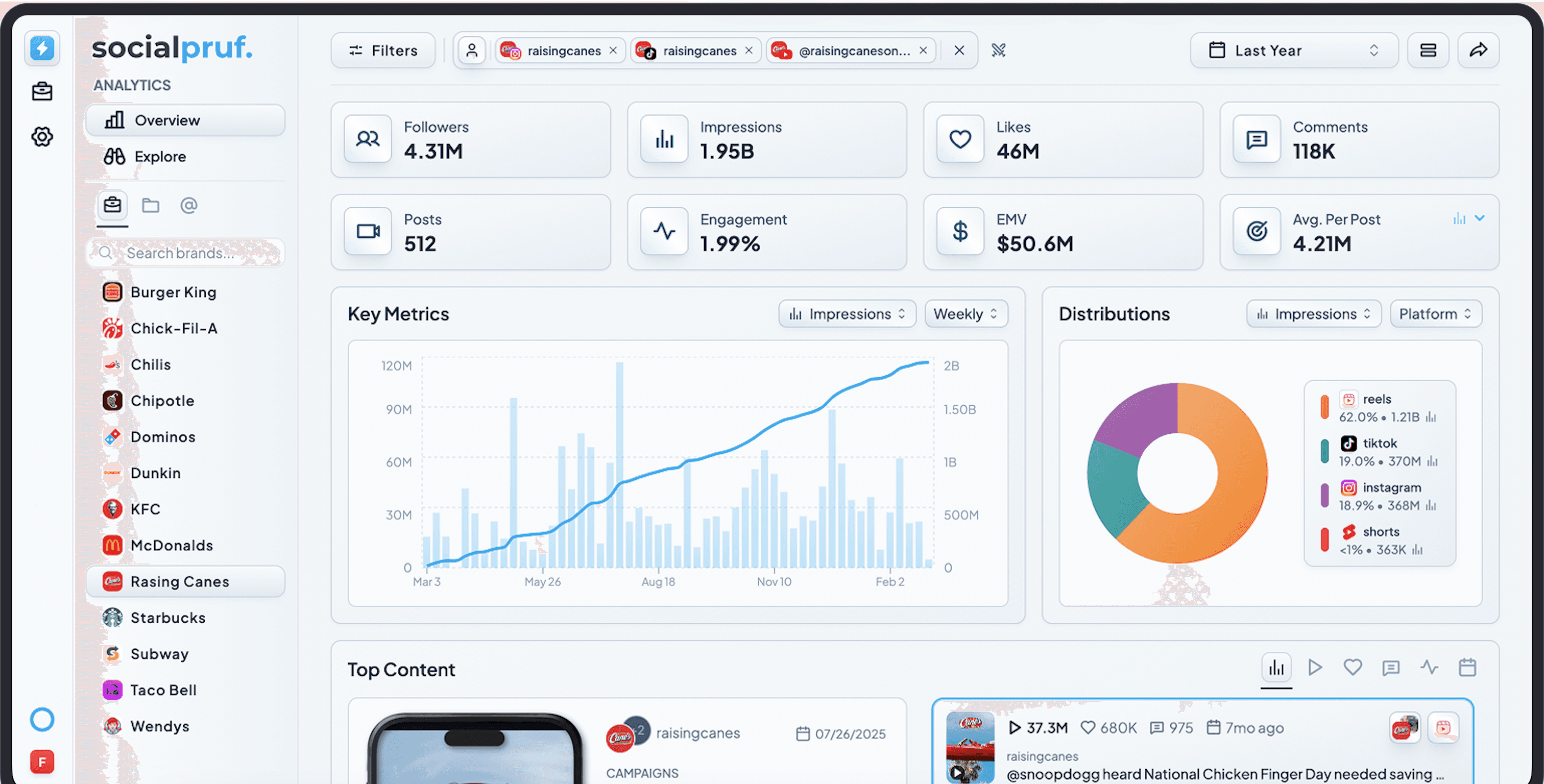
Socialpruf is a social media analytics platform for measuring owned accounts, competitors, creators and partners across Instagram, TikTok, YouTube, X, Facebook, LinkedIn and Snapchat. It reads public posts directly instead of pulling a standardized feed through each platform's API, so history runs back to an account's first post, nothing gets capped per network, and there's no account connection to break.
Sprout Social is not a competitor analytics product. It's a social media management suite with a competitor feature attached, and it's good at the thing it actually is.
The reason people go looking for an alternative is narrower than "Sprout isn't good." It's that they opened the Competitor Performance Report to answer a question about last quarter, or about TikTok, or about the competitor who launched in March, and the answer wasn't in there.
Sprout is architecturally owned-account-first. It reads the accounts you connect, through each platform's API, on the platform's schedule. Competitors don't connect anything, so what's left for a competitor is whatever the API hands out about a stranger's page, starting from the day you added them. Sprout documents this plainly, which is more than most of this category does.
Socialpruf reads the public post instead. Same data a person sees opening the post, read and stored by us. That one decision is where every difference below comes from, on both sides.
The short version
- History that predates your signup. Socialpruf analyzes a competitor's content from its earliest available post. Sprout "generally only shows data from the point of tracking (the date that you added the profiles as competitors) and forward".
- Seven networks, not three. Sprout's competitor reports cover Facebook, Instagram and X. No TikTok, no YouTube, no Snapchat, and no LinkedIn. Socialpruf tracks TikTok competitors in the same set as Instagram and X.
- Views, not just engagement. Sprout's competitor post metrics are public engagements, reactions, comments and shares. There is no views, impressions or reach column. Socialpruf stores the displayed view count wherever the platform shows one.
- Carousels included. On Facebook competitor posts, Sprout states that "due to API limitations, the following posts types are unavailable: Multi-image posts, album posts and Facebook Reels".
- Every figure opens the post. Socialpruf stores what the public post displays, so you can click through from any number in a report to the post it came from.
The comparison
| Socialpruf | Sprout Social | |
|---|---|---|
| What the product is | Advanced measurement and competitive intelligence | A full social media management suite: publishing, inbox, approvals, reviews, listening and reporting |
| Competitor networks | Instagram, TikTok, YouTube, X, Facebook and Snapchat in full; basic LinkedIn stats | Facebook, Instagram and X |
| Where competitor data comes from | The public post itself, read and stored by us | Each network's API, so the data is limited to what the API makes available |
| Historical backfill on a new competitor | Full available history from the account's first post, from day one | Generally only from the date you add the competitor, forward |
| Competitor post backfill, by network | Full backfill. Every public post that is still up, however old | Facebook 500 posts · Instagram none · X last 30 days of posts |
| Competitor follower history | Rich follower history tracked | None before you add them. Facebook, Instagram and X audience data is not backfilled |
| Historic data retention | Unlimited | Stored indefinitely once collected, which is the day you started |
| Competitor refresh cadence | Hourly | Daily |
| Competitor post metrics | Views, likes, comments, shares, saves, engagement rate, EMV and follower demographics | Public engagements, reactions, comments and shares. Instagram has no shares metric |
| Post types missing from competitor posts | None. Carousels, Reels, albums and video all tracked | Multi-image posts, album posts and Facebook Reels are unavailable |
| Boosted activity in competitor numbers | Boosted posts are flagged | Boosted posts are flagged |
| Which competitors you can add | Any public account | Instagram requires a Business Profile, and profiles with high privacy settings can't be discovered |
| Instagram Stories on competitors | Competitor story image/video and mention are stored and displayed, story statistics are not. | Your own stories only |
| Competitor ad reporting | No | No |
Sprout Social documentation as of September 2026.
Where the data comes from
Everything in that table follows from one line in Sprout's help center: "Sprout is limited to data as it is made available by each network's API."
That's the standard architecture for a management suite, and for owned accounts it's the right one. You connect your Instagram account, you grant a token, and the API hands back things no outsider could ever see: true reach, impressions, story completions, audience demographics. Sprout's owned-account analytics are strong, and they're strong because of the connection.
The trouble is that a competitor never grants you anything. So on a competitor, the same architecture is left asking a platform API for facts about a page you have no relationship to, and the API answers narrowly. No views. No impressions. No carousels on Facebook. Nothing older than the day you asked.
Socialpruf reads the public post the way anyone visiting the page sees it, then stores and maintains that record itself. There's no connection to grant, which means there's no asymmetry between your accounts and anyone else's: the whole public record, on every account, at the same depth, on the same refresh schedule. What we don't have is the owner-only layer, on any account, including yours. That's a real trade and it's covered below.
Sprout Social: the platform's API
{
  "likes": 41,208,
  "comments": 1,904,
  "views": null,
  "carousel": unavailable,
  "history": from today,
  "followers_history": [],
}
Socialpruf: the public post
 natgeoReelAug 20
#NatGeoLION is now streaming on @DisneyPlus and @Hulu
Plays
15.3M
Likes
126K
Comments
258
History is the deciding factor
This is the one that sends people looking for an alternative, and it's worth reading Sprout's own sentence twice:
"You may see some Facebook and Instagram Top Posts on your report, but for all other data, Sprout generally only shows data from the point of tracking (the date that you added the profiles as competitors) and forward."
Post history. Sprout's own backfill table puts precise numbers on it. A Facebook competitor backfills 500 posts. An Instagram competitor's posts and metrics are listed as N/A, with the audience row noting it "can backfill the last 30 days of posts." An X competitor gets the "last 30 days of posts." For a brand posting daily, 500 Facebook posts is somewhere over a year; for a publisher posting fifteen times a day, it's about five weeks. Socialpruf has no backfill window, so you can benchmark Instagram competitors back to each account's first post.
Follower history. There is none. Facebook and Instagram competitor rows both read "does not backfill Audience data", and X competitor audience reads "No Backfill." The Instagram Competitors Report adds that follower chart metrics appear only "when at least three days have passed since you initially connected the page."
The practical shape of this: a competitor launches a campaign in March, someone asks about it in September, and the honest answer in Sprout is that the data doesn't exist. Not that it's on a higher tier. It was never collected, because nobody had added that account yet.
Socialpruf has no backfill window, no per-network post cap and no tiered history ceiling. Post history is unlimited on every account you track. On3 tracks 150+ competitor accounts across more than a million posts. Vice Media runs separate competitor sets per property, totaling over 2.8 million posts across 200+ live competitor accounts. In both cases the posts from the early years are still there and still updating, including for accounts added last month.
Three networks
Sprout's competitor reports run on Facebook, Instagram and X. Sprout connects and reports on TikTok, YouTube, LinkedIn, Pinterest, Threads and Bluesky for accounts you own, so the network list on the marketing page is long and accurate. The competitor list is the short one.
LinkedIn is the flat no: "At this time, LinkedIn API does not support competitor analysis, which means a LinkedIn page/profile cannot be connected to see Competitor Performance." For a B2B category where LinkedIn is the channel, that usually ends the evaluation on its own.
TikTok and YouTube are the more common problem, because they're where the category lives for most consumer brands now, and where short-form video makes a competitor's breakout post the single most interesting object in the whole report. Neither appears in Sprout's competitor reports. Socialpruf tracks both in full, plus Snapchat, and public LinkedIn pages for basic stats.
The missing post types
This line is buried in the Competitor Posts Report documentation and deserves to be read out loud:
"Due to API limitations, the following posts types are unavailable: Multi-image posts, album posts and Facebook Reels"
Multi-image posts are carousels. Carousels are one of the highest-performing formats on Meta and a staple of how brands actually post. Facebook Reels are the video format Meta has spent three years pushing hardest. Both are absent from competitor post analysis, which means a competitor's post mix in Sprout isn't their post mix — it's their post mix minus two of its biggest components, with nothing marking the gap.
Socialpruf reads what's on the page, so carousels, Reels, albums and video are all in there with their displayed metrics.
Freshness
Sprout collects competitor posts on a daily cycle, reaching back over the last ten days of content on Facebook, Instagram and X.
Two things follow from that. Once a post falls outside the ten-day window it stops being refreshed, and short-form video keeps picking up views for weeks after. And owned accounts are on a different clock than competitors — your own Instagram posts refresh every 15 minutes while you're in the app, a competitor's once a day — so any chart with both lines on it is comparing two different vintages of data.
Socialpruf refreshes a post hourly for its first week, when the numbers are moving fastest, and for as long as the post exists. Competitor accounts and your own, on identical schedules, for exactly this reason.
Where Sprout is the better tool
Everything that isn't measurement. Publishing, scheduling, a unified inbox, approval workflows, review management, message tagging, customer care and case routing. Socialpruf does none of it. If your team spends its day in a queue of incoming messages, Sprout is the product and this comparison isn't the relevant one.
Private metrics on your own accounts. Connect your accounts to Sprout and the platforms hand back the layer reserved for an authenticated owner: story completions, watch time, platform-verified audience demographics. Socialpruf reads what the post displays, so your own accounts still carry views, engagement, saves where the platform shows them and modeled follower demographics, measured on exactly the same basis as every competitor you're benchmarking against. What it can't produce is the authenticated layer. If a report you have to file is built on platform-reported reach and impressions for accounts you own, that needs a connected tool, and plenty of teams run one alongside Socialpruf for precisely that.
Owned ad reporting. Sprout reports on Facebook, X, LinkedIn and TikTok ad accounts alongside organic. Socialpruf is organic only.
Reporting
Sprout competitor reports are exports: CSV or presentation-ready PDF, sendable and schedulable, with shareable links on Premium Analytics. It's a well-built version of the standard model, and if your client asked for a deck, a PDF is the honest answer.
Socialpruf reports are live URLs, with PDF and CSV available too. The report you sent in March shows March's data as it stands today, not as it stood the morning you exported it, and you can see when it was opened and by whom. TickPick runs a high-volume organic program on roughly an hour of reporting work a week on that basis.
| Name | Impressions | Views | Likes |
|---|---|---|---|
| AAdidas | 1.02B↗ 167% | 1.01B↗ 165% | 54.7M↗ 262% |
| NNike | 992M↗ 78.6% | 895M↗ 287% | 28.2M↗ 198% |
| LVLouis Vuitton | 508M↘ 27.1% | 403M↘ 24.4% | 13.0M↘ 22.8% |
| LLevi's | 409M↗ 80.9% | 165M↗ 105% | 5.80M↗ 91.9% |
Which is better depends on what your stakeholders want to receive. If reporting has to be archived, versioned or attached to an invoice, an export is the right shape, and Sprout's exports are good.
Which should you pick?
Choose Sprout Social if:
- Publishing, scheduling, inbox and approvals are the daily job, and competitor context is a useful addition rather than the reason you're buying.
- Your reporting is built on private owned-account metrics: reach, impressions, story completions, platform-reported demographics.
- You need paid and organic in one report.
- Facebook, Instagram and X cover your category, and a competitive record that starts today answers your questions.
- Listening across Reddit, news and reviews matters as much as post-level performance data.
Choose Socialpruf if:
- You need competitor history that predates your signup date, for past seasons, launches and campaigns.
- TikTok, YouTube, LinkedIn or Snapchat are part of your competitive picture.
- Views matter, not just engagement, because short-form video is where your category competes.
- Your competitive set runs to dozens or hundreds of accounts, or you don't know all of them yet.
- You're being asked to defend numbers, and need to open the post behind every figure.
- You want an API and an MCP server without buying the top tier.
If your Sprout numbers have ever looked wrong on your own accounts, the same underlying mechanism is at work, and we've written about why that gap appears. The broader field is covered in our ranking of the best social media analytics tools, and the specific question of what "no authentication required" does and doesn't buy you is in our comparison of twelve platforms that track competitors without authentication. For the dedicated competitive tools, see Socialpruf vs Rival IQ and Socialpruf vs Socialinsider. If you've already picked and just want the workflow, start with how to actually track your competitors' social media accounts.
Frequently asked questions
Is Socialpruf a Sprout Social alternative?
For competitor tracking and analytics, yes, and it goes considerably deeper: seven networks instead of three, history back to an account's first post, views and not just engagement, and post-level data you can verify against the live post.
Which networks does Sprout Social support for competitor analysis?
Facebook, Instagram and X. LinkedIn is explicitly unsupported: "LinkedIn API does not support competitor analysis." TikTok, YouTube, Snapchat, Pinterest, Threads and Bluesky don't appear in Sprout's competitor reports either, though several are supported for accounts you own and connect. Socialpruf tracks Instagram, TikTok, YouTube, X, Facebook and Snapchat in full, with basic LinkedIn stats.
How far back does Sprout Social's competitor data go?
Effectively, to the day you added the competitor. Sprout's help center states it "generally only shows data from the point of tracking (the date that you added the profiles as competitors) and forward." The backfill table gives the exceptions: 500 posts on a Facebook competitor, N/A on Instagram, the last 30 days of posts on X, and no audience backfill on any of the three. Reading public posts directly avoids the backfill window entirely, which is why Socialpruf can show a competitor's posts from three years ago on an account you added this morning.
Do competitors need to approve being tracked in either tool?
No, in both. Sprout's own documentation notes that the Competitor Report "uses publicly available data to ensure all pages are compared equally." The difference is your own accounts: Sprout needs them connected to collect anything, while Socialpruf measures you on the same public data it uses for everyone else.
Are there competitor accounts Sprout can't add?
Yes. Instagram competitors must be Business Profiles, and Sprout notes that "some profiles can't be discovered through public search if they have high privacy settings." Competitor data can also stop if "the profile was made private or had restrictions applied to it." Socialpruf can track any public account.
Does Socialpruf have an API?
Yes, included on every plan, covering every number in the product, along with an MCP server for Claude, ChatGPT and Gemini, plus CSV export. Sprout's API is available on its Advanced plan.