Every competitor analytics tool reads public data, so 'no authentication required' tells you nothing on its own. The real differences sit one level down: whether a competitor's reach is counted or estimated, whether the number includes boosted spend, where the data comes from and how old it is. We went through twelve platforms and their own documentation to answer those questions.
Search for competitor tracking and every vendor tells you the same thing. You don't need your competitor's permission, you don't need their login, public data is public. All of that is true. Rival IQ, Socialinsider, Brandwatch, Emplifi, Metricool and Socialpruf all read public accounts, and not one of them asks the account owner for anything.
The differences sit one level down, and they're much bigger than the marketing suggests. When you open a competitor's post in one of these tools, is the reach figure a number somebody counted, or a number somebody worked out from likes? Does the engagement total include the money they spent boosting it? What happens to two years of history if you drop that account from your list?
We went through the published documentation for twelve platforms to answer those questions. Most of what follows is quoted from the vendors themselves, because on this subject they're a lot more honest in their help centers than on their pricing pages.
The 12 platforms, ranked
| # | Platform | Competitor post-level depth | What limits you first |
|---|---|---|---|
| 1 | Socialpruf | Displayed counts on any public account, 7 networks | Price increases with number of accounts |
| 2 | Rival IQ | Strong on TikTok and YouTube, impressions estimated | 40 company limit |
| 3 | Socialinsider | Content pillars and format mix, reach and views estimated | 40 profile limit |
| 4 | Brandwatch Benchmark | Channel and content level, reach estimated | Limited to 4 social networks |
| 5 | Emplifi | Public profile benchmarking, depth not published | 100 profile limit |
| 6 | quintly / Facelift Data Studio | Public profile benchmarking, depth not published | 20 profiles before custom pricing |
| 7 | Exolyt | Real TikTok view counts, TikTok only | One network |
| 8 | Metricool | Engagement only, different denominator to your own | No TikTok competitors |
| 9 | Sprout Social | Engagement only, no views at all | No backfill |
| 10 | Hootsuite | "Estimated engagement", no video views | 2–20 competitors |
| 11 | Talkwalker / Meltwater | Conversation, not content performance | Answers a different question |
| 12 | Later | Analytics grouped by date not by posts | Only Instagram |
Documentation and pricing as published in September 2026. Vendors change both, so check anything here that would change your decision.
This ranking judges these platforms on competitor tracking alone. For how the same field compares once owned-account analytics are part of the question, see our ranking of the best social media analytics tools.
What "without authentication" actually means
The phrase covers three different questions, and they have different answers.
Do you need the competitor's permission? No, and that's true of every tool here, including the ones built around connected accounts. Sprout says its Competitor Report "uses publicly available data to ensure all pages are compared equally."
Where does the tool get its data? There are two sources. Most tools take competitor data from the platforms' own APIs, which means their coverage is whatever those APIs choose to hand out. YouTube's API returns public video stats to anyone who asks. Instagram's returns a narrow set of fields on public business accounts, posts, likes, comments and follower count, but nothing on reach or views. TikTok and LinkedIn have no equivalent public API, which is why those two networks are missing from most competitor tracking. Sprout states it directly: "At this time, LinkedIn API does not support competitor analysis."
The other source is the public account itself, read the way anyone visiting the page sees it. That isn't tied to what an API exposes. The only limit is what the platform page itself shows. This is what Socialpruf does and why its limitations are small compared to the competitors.
What does the public data actually contain? This is the question that decides whether a tool can answer what you bought it for, and it's covered in the rest of this article.
How detailed is the data, and how current is it?
Two things affect how useful a competitor number is: whether you can see individual posts or only averages, and how recently the number was updated.
Some tools only report averages for competitors, average likes per post, average comments per post, an average engagement figure over a date range. Averages tell you roughly how big an account is, but they smooth out single posts. A post that did ten times a competitor's normal numbers gets spread across everything else they published that month, so it doesn't show up. Hootsuite's competitor metrics are mostly defined this way.
Competitor data also isn't usually live. It's refreshed on a schedule, and how often can depend on your plan. Rival IQ prices it at twelve, six or three hours. Individual posts also stop being updated after a set period, around two weeks in Rival IQ's case, which matters for videos that keep picking up views after that. Rival IQ shows when each post was last refreshed, so you can see how old a number is.
The practical effect is that your accounts and your competitors' accounts are often measured differently in the same tool. Yours are tracked post by post and kept current; theirs may be averaged, updated less often, or not updated past a certain age. When both appear in the same chart, the two rows aren't directly comparable, which is part of why competitor analysis often ends up as general observations rather than figures. They're posting more carousels, their Reels seem to be working.
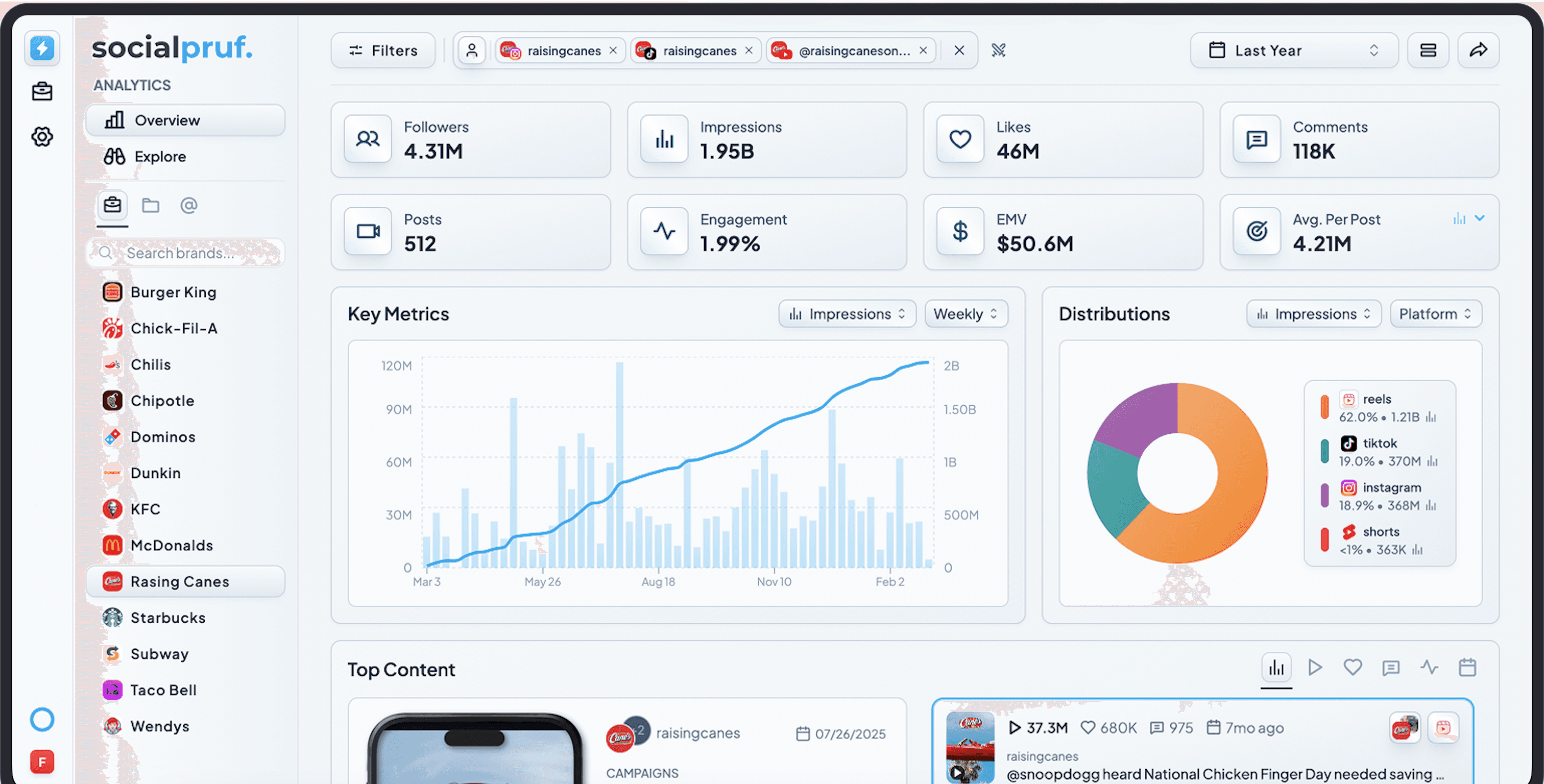
Socialpruf collects public accounts the same way it collects your own: the same post-level fields, the same hourly refresh, the same last-updated timestamp. A competitor's post and your post are the same kind of record, so the numbers can be compared directly.
The platforms, and what each one won't do
1. Socialpruf: best for post-level competitor data at scale
Best for: brands, publishers, sports and media organizations and agencies whose competitive set is large.
Socialpruf reads public posts directly rather than pulling a standardized feed through each platform's API, and we store and upkeep all of that data ourselves. Any public account is a first-class object: your brand, a competitor, a creator you're evaluating, a partner you're paying. They carry the same post-level metrics and sit in the same dashboards, across Instagram, TikTok, YouTube, X, Facebook, LinkedIn and Snapchat.
Two things follow from reading the post rather than the API. There's no connection to break, so there's no gap in the record when a token expires. And there's no backfill window, so a post's history is available regardless of when you started tracking the account, which is the constraint that bites hardest everywhere else in this list.
The scale claim is specific rather than theoretical. Vice Media runs separate competitor sets per property, totaling over 2.8 million posts and 200+ live competitor accounts across five platforms, with posts pulled in under an hour after publishing. On3 tracks 150+ competitor accounts across more than a million posts and pulls the data into its own systems through the API. Athelo Group runs reporting on 30+ athletes with zero account connections, because asking every creator on a roster to authorize a tool is a bottleneck that scales badly.
Where it's weaker. No publishing, scheduling or inbox. No paid or ad reporting. And because it works from public data, the private metrics an account owner sees in native analytics, things like story viewers and watch time, aren't visible on any account, including your own.
Choose Socialpruf if: you need post-level numbers on a competitive set measured in dozens or hundreds, with history that doesn't start the day you signed up.
2. Rival IQ: best dedicated competitive analytics product
Best for: teams with a defined competitive set who want a mature, purpose-built tool.
Rival IQ has been doing this longer than almost anyone and it shows. You build a landscape, it pulls public performance across the networks it monitors, and the workflow around hashtags, topics, posting times and alerts is genuinely well-executed. Its TikTok and YouTube competitor data is the strongest in this list after ours: real counted likes, comments, shares, views, views per video and views per follower.
The limits. Post backfill is capped per network, X 3,200 posts, Facebook 2,000, Instagram 2,000, YouTube 1,000, TikTok 1,000. Follower history starts the day you add a company, with no retrospective. Their glossary carries a sampling caveat on X: "For popular Twitter accounts, this is not a complete mention count." And there's no LinkedIn competitor analysis at all. Their documentation says you "can only analyze your own company's private LinkedIn data in Rival IQ," citing LinkedIn API limitations.
Both meters are priced. Per Rival IQ's pricing, tiers run 10, 20 and 40 tracked companies at $239, $349 and $559 a month, with history tiered alongside at 6, 12 and 24 months. Worth thinking about before you pick a tier: the year-two analysis you'll want depends on data you have to be collecting in year one, so the cheaper plan today quietly takes that option away.
Choose Rival IQ if: your set fits inside 40 accounts, LinkedIn doesn't matter, and 24 months is enough.
3. Socialinsider: best for reading a competitor's content strategy
Best for: strategists and agencies whose question is what a competitor is publishing rather than how far it traveled.
Most tools on this list hand you a competitor's numbers and leave the interpretation to you. Socialinsider is the one built around the layer above that. It sorts a competitor's output into content pillars, breaks it down by format, and charts posting patterns, so the deliverable is a description of their strategy rather than a table of their engagement. Paired with its published industry benchmarks, that's the fastest route from "here are six competitors" to "here is what they're actually doing." It covers Instagram, TikTok, LinkedIn, Facebook, X and YouTube for competitors, and it documents its own weaknesses better than anyone else in this comparison, which counts for a lot when you're the one presenting the numbers.
The limits. Per their pricing, plans run 20, 30 and 40 social accounts at $82, $124 and $199 a month, with history at 3, 6 and 12 months. Their published enterprise calculator reaches 300 profiles and three years, which is further than most of this list goes.
Three specifics to settle before you commit. Reach, impressions and post views are estimated for every competitor profile. Follower data is available "only from the day you add the profile to Socialinsider," a Facebook API constraint. And plans include a monthly profile replacement quota, 10, 15 and 20, so rotating your competitive set is itself a metered resource.
Choose Socialinsider if: the output is a content strategy read-out rather than a performance comparison, and you'll read the estimate labels.
4. Brandwatch Benchmark: best pre-built competitive universe
Best for: enterprises that want to position themselves inside an existing category rather than build a set from scratch.
Benchmark compares you against a database of 300,000+ brand profiles with two years of historical data, which is a real advantage when you don't yet know who your competitive set should be. Metrics are available at channel and content level.
The limits. Four networks: Facebook, X, Instagram and YouTube. No TikTok, no LinkedIn. Reach is estimated rather than counted, and their metrics documentation says how: total reach is "estimated based on the number of likes on the post, the number of followers on a channel, and the post type (image, video, or carousel)." Boosted competitor posts are counted only when publicly visible on the timeline. Pricing is enterprise contract with no published figures, so expect procurement rather than a credit card. Their own marketing also disagrees with itself on the database size, the product page says 300,000+ brands and the blog says 100,000+ in more than one place.
Choose Brandwatch if: category positioning and listening matter more than post-level video performance, and you have the budget.
5. Emplifi: public benchmarking inside an enterprise suite
Emplifi meters what it calls public data benchmarking at up to 10, 50 and 100 profiles across its Essential, Advanced and Intelligent tiers, per their pricing page. The metering is clear, the post-level detail available on those public profiles isn't published, so establish it on a demo rather than assuming it matches the owned-account experience.
6. quintly / Facelift Data Studio: profile-metered, query-driven
quintly, now Facelift Data Studio, meters by profile, 5 on the S plan, up to 20 on Q, 21+ on L, and is built around a custom query language for teams that want to define their own metrics. Like Emplifi, competitor post-level depth isn't documented publicly. Its appeal is the flexibility of the metric layer rather than the raw data underneath.
7. Exolyt: best TikTok specialist
If TikTok is the whole question, Exolyt tracks 1, 50 and 300 TikTok accounts across its tiers and works from public data with no connection required. Real view counts, which most generalists can't give you on a competitor. The obvious limit is that it's one network, so it's a tool you add to a stack rather than a stack of its own.
8. Metricool: cheapest workable option, with real gaps
Best for: small teams where budget is the binding constraint and the competitive question is narrow.
Metricool is remarkable value. The free tier covers 1 brand, 5 competitor profiles and 30 days of analytics, and paid plans lift competitors to 100 per network.
The limits are specific and, for a lot of teams, disqualifying. Per their documentation, competitor tracking covers Facebook, Instagram, Threads, Bluesky and Twitch on all plans, with X and YouTube on paid only. YouTube is capped at 10 competitors rather than 100. There's no TikTok competitor tracking and no LinkedIn. Instagram competitors require your own Instagram account linked through Facebook. Follower and like data "can only be monitored from the moment of connection and do not include historical data from before the competitor was added." And "in some cases, you won't see the number of likes on a competitor's post." Add the follower-based engagement denominator described earlier and the comparison you're drawing needs a footnote.
Choose Metricool if: TikTok and LinkedIn are irrelevant to your category and price is the deciding factor.
9. Sprout Social: strong suite, thin competitor layer
Best for: teams who need publishing, inbox, listening and reporting together, with competitor context as a secondary requirement.
Sprout is the most complete suite here, and its owned-account analytics are genuinely strong, because an authenticated connection unlocks the private metrics no public-data tool can reach. The competitor layer is the thin part, and the documentation says so.
The limits. Competitor reports cover Facebook, Instagram and X only. There's no backfill: "Sprout generally only shows data from the point of tracking (the date that you added the profiles as competitors) and forward." LinkedIn isn't supported, "At this time, LinkedIn API does not support competitor analysis." Instagram competitors must be Business Profiles. Some accounts can't be added at all, since "some profiles can't be discovered through public search if they have high privacy settings."
At post level, no views, impressions or reach, as covered above. Instagram competitor posts don't get a Shares metric, though Facebook and X do. And "due to API limitations, the following posts types are unavailable: Multi-image posts, album posts and Facebook Reels," so carousels, one of the highest-performing Instagram formats, are missing from competitor post analysis entirely. Exports are capped at 1,000 CSV rows, top posts at 12, and PDF exports at roughly five posts per profile.
If your Sprout numbers have ever looked wrong on your own accounts, the same underlying mechanism is at work, and we've written about why that gap appears.
Choose Sprout if: publishing and community management are the job and competitor data is a nice-to-have.
10. Hootsuite: publishing first, competitors as a small feature
Best for: teams already publishing in Hootsuite who want light competitor context in the same window.
The competitor allowance is the tightest here. Per Hootsuite's help center: "Enterprise and Advanced plan members can compare 20 social accounts. Standard and Business plan members can compare five. Professional, and Team plan members can compare two."
The limits compound, and the compounding is the story. Backfill is 30 days: "We backfill up to 30 days of data, starting the day you add a competitor to your watchlist." The Followers metric can't be backfilled at all. And removal is destructive: "If you delete a competitor account from your watchlist, we will permanently delete all associated data. If you add that account again at a later time, we will treat it as a new account and backfill up to 30 days of data for it."
On a five-competitor plan, that means swapping in a new challenger costs you the entire history of whoever you swapped out, permanently. Add "Facebook Reels do not appear in competitive benchmarking," no video views for Facebook or Instagram competitors, and a metric called Estimated engagement, and the competitive picture is thin by design.
Choose Hootsuite if: publishing is the primary job and you accept that the competitor view is a glance, not an analysis.
11. Talkwalker and Meltwater: a different question entirely
These are listening platforms, and the distinction matters more than any feature comparison. Listening measures conversation, who is talking about a brand, in what volume, in what tone. It doesn't measure whether a competitor's video worked.
Sentiment answers "how are we perceived." Post-level analytics answers "how did that perform." Buying one when you needed the other is the most common expensive mistake in this category.
Choose these if: share of voice and perception are what leadership actually asks about.
12. Later: Instagram-only benchmarking, grouped by date
Best for: teams already publishing in Later on its top plan who want a light Instagram comparison without adding a second tool.
Later does have competitor tracking, which is easy to miss because it sits under Social Listening rather than Analytics. Benchmarking builds up to five lists of Instagram accounts, twenty per list, and compares them on followers, follower growth rate, posts published, average engagement rate, total engagements, likes, comments and share of voice. Your own account joins the comparison automatically, and the data refreshes hourly, which is faster than most of the scheduled refreshes in this list.
The limits. It's Instagram and nothing else, and only on the Scale plan. Competitors have to be business or creator profiles, because personal profiles can't be tracked through the API. History runs three months and Engagement rate is calculated against followers rather than reach.
Choose Later if: you already publish in Later, Instagram is your only platform and date-range comparisons are enough for you.
Which one fits your situation?
For post-level data on a large competitive set with no history ceiling, Socialpruf is our pick, and the case studies above are the evidence rather than the claim.
Rival IQ if your set fits inside 40 accounts and you want the most mature dedicated product.
Socialinsider if you want a competitor's content pillars and format mix worked out for you at mid-market pricing, and you'll read the estimate labels.
Brandwatch if you want a pre-built category universe and listening in the same contract.
Exolyt if TikTok is the entire question.
Metricool if budget decides and neither TikTok nor LinkedIn matters.
Sprout Social or Hootsuite if publishing and community management are the core job, with the competitor limits understood going in.
The honest summary is that "without authentication" gets you into the category and tells you nothing about what you'll find once you're there. The tools that read public data all read the same public data. What differs is how much of the missing half they fill in with an estimate, whether they label it, and how much of your history they let you keep.
Once you've picked one, the practical version is in our walkthrough of how to actually track your competitors' social media accounts.
Frequently asked questions
Can you track a competitor's social media without their permission?
Yes. Public accounts publish public metrics, and analytics platforms read them without any involvement from the account owner. This is standard across the category and isn't a differentiating feature. What you can't see is the private layer only an owner has: story viewers, watch time, true audience demographics, and anything paid.
Do any tools require you to connect your own account before tracking competitors?
Some do. Hootsuite's documentation states you must have already added a Facebook Page, X account or Instagram Business account before comparing competitors. Metricool requires your Instagram account be linked through Facebook before you can add Instagram competitors. Rival IQ and Socialinsider both document that public competitor data is collected without any connection.
Why do two tools show different numbers for the same competitor post?
Usually because they handle boosted activity differently. Metricool reports competitor data as organic only. Brandwatch reports organic-only on Instagram and totals on other networks. Sprout counts engagements as organic only while counting shares as organic plus paid in the same row. Different conventions, same post, different totals, and no error involved.
How far back does competitor data go?
This varies more than anything else in the comparison. Hootsuite backfills 30 days. Sprout generally shows data only from the point you add the competitor forward. Rival IQ backfills post history up to 24 months subject to per-network post caps, but follower history starts the day you add the account. Socialinsider's tiers run 3, 6 and 12 months with enterprise to three years, and estimates follower history before your start date. Reading public posts directly avoids the backfill window entirely, which is why a post's full history is available regardless of when tracking began.
How many competitors can you track?
Hootsuite allows 2 to 20 depending on plan. Emplifi runs 10 to 100. Rival IQ runs 10 to 40 companies. Socialinsider runs 20 to 40 profiles, with a monthly replacement quota, and up to 300 on enterprise. Metricool allows 100 per network but only 10 on YouTube. Check this number against your real competitive set before buying, because it's the constraint teams hit first.
Do I still need a tool that connects to my own accounts?
Possibly, and plenty of teams run both. An authenticated connection is the only way to see private metrics on accounts you own, story viewers, watch time, audience demographics, paid performance, and the only way to publish and manage. A public-data platform measures the market around you at a depth a connected-accounts tool structurally can't reach. They're complements more often than substitutes.