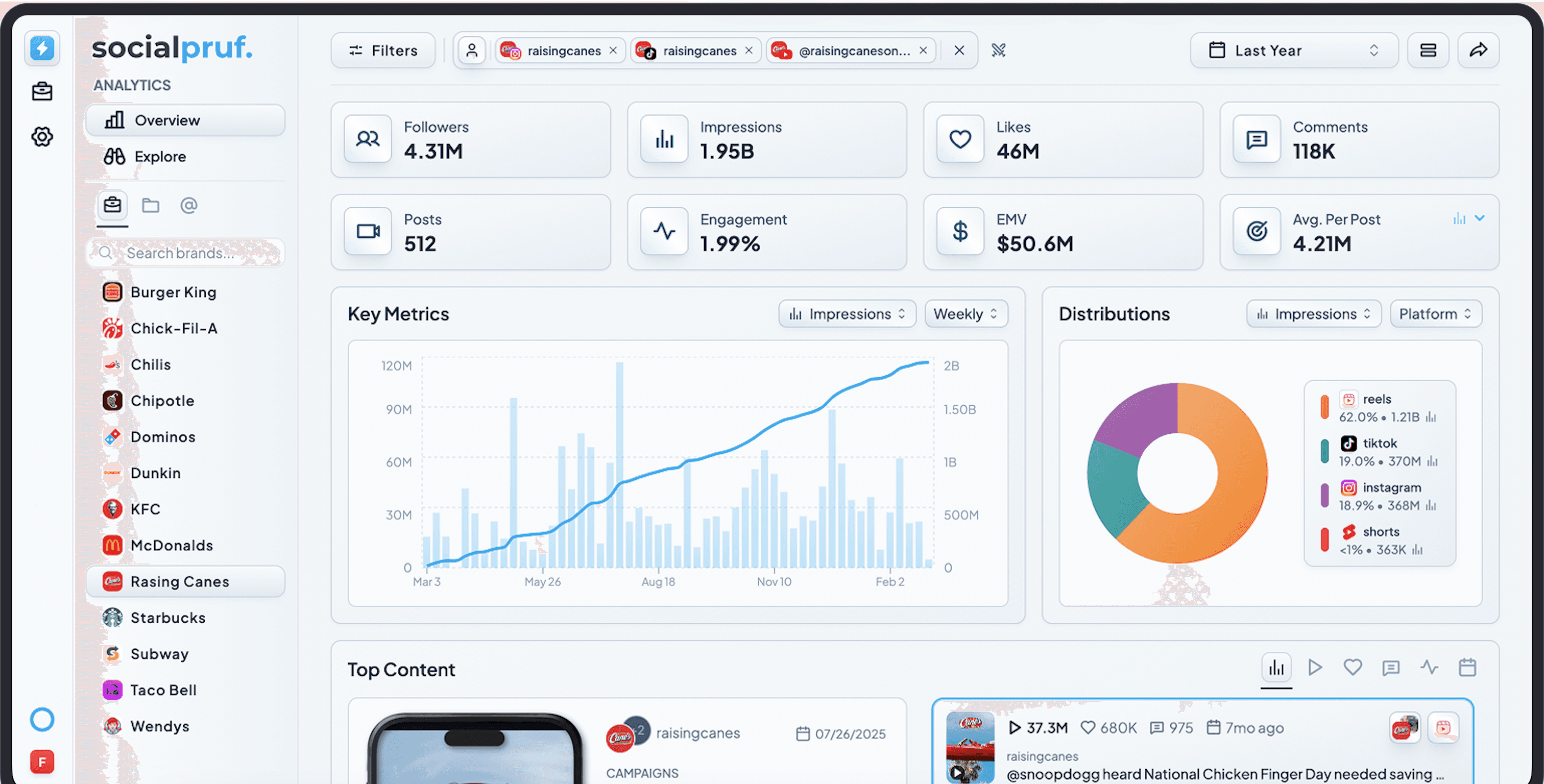
Socialpruf is a social media analytics platform for measuring owned accounts, competitors, creators and partners across Instagram, TikTok, YouTube, X, Facebook, LinkedIn and Snapchat. It reads public posts directly instead of pulling a standardized feed through each platform's API, so history runs back to an account's first post, nothing gets capped per network, and there's no account connection to break.
Rival IQ is the tool we get compared to most often, and it deserves the reputation. It has been building dedicated competitive social analytics longer than almost anyone and is well-designed. If you are running a defined competitive set of up to forty companies across Facebook, Instagram, X, YouTube and TikTok, it does that job well.
Where the two products differ comes down almost entirely to one decision: where the data comes from. Rival IQ pulls competitor data through the social platforms' public APIs. Socialpruf reads the public post. The history limits, the estimated metrics, the missing networks and the caps all trace back to that, on both sides.
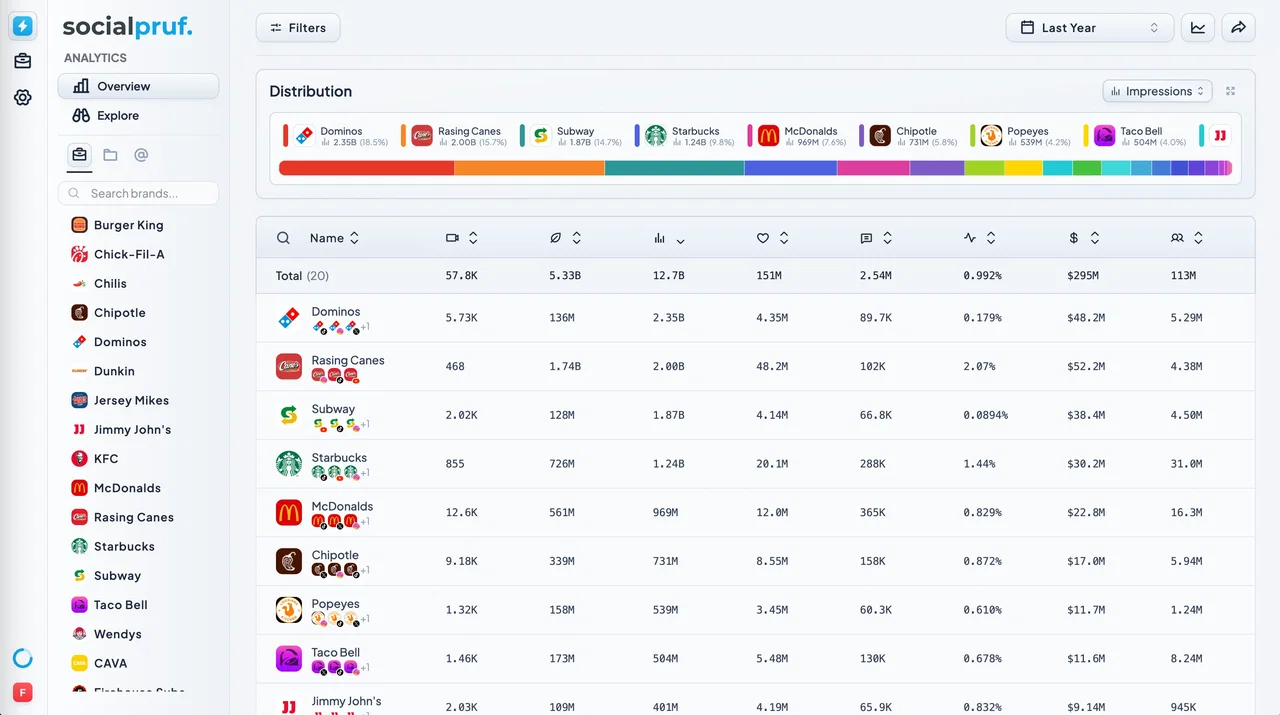
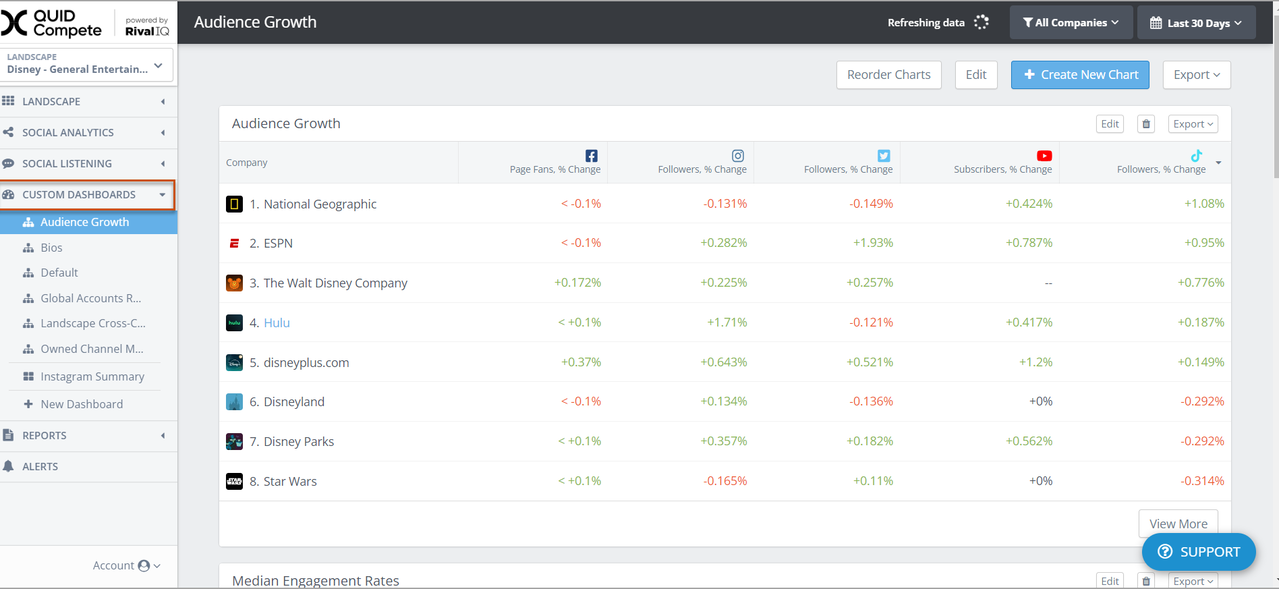
Scroll to reveal. Underneath, a Socialpruf benchmark. On top, a Rival IQ custom dashboard, from Rival IQ's own help article on custom dashboards.
Two notes on method. Every Rival IQ cell in the table below links to Rival IQ's own documentation, and where a limit varies by plan, we've used the most generous published tier throughout. At Socialpruf we don't gate features by tier, plans scale by the amount of social accounts you need.
The comparison
| Socialpruf | Rival IQ | |
|---|---|---|
| Competitor platforms tracked | Instagram, TikTok, YouTube, X, Facebook and Snapchat in full; basic LinkedIn stats. | Instagram, TikTok, YouTube, X, and Facebook. No Snapchat or LinkedIn. |
| Where competitor data comes from | The public post itself, read and stored by us | Public APIs from social channels |
| Historical backfill on a new account | Full available history from the account's first post, from day one | Limited: "Social platforms allow us to gather some, but not all, historical data for social posts.". |
| Backfill post cap | None | X 3,200 · Facebook 2,000 · Instagram 2,000 · YouTube 1,000 · TikTok 1,000 |
| Follower / audience history | Rich follower history tracked. | "it will never have follower counts prior to when the handle was added to the database" |
| Historic Data Retention | Unlimited | 24 months on the top plan; shorter on lower tiers |
| How long a post keeps updating | For the life of the post: hourly in its first week, daily after | "Rival IQ updates post metrics for 14 days after the post's publication date for all platforms except Twitter"; X is 5 days |
| Data refresh cadence | Hourly for a post's first week, then daily. Same for owned and competitor accounts | Every 3 hours on the top plan; 6 or 12 hours below it |
| Competitor impressions / reach | Displayed counts where the platform shows them; no modeled figures | Estimated: an ML model on Instagram and Facebook, video views on TikTok and YouTube, Tweet views on X, included on the top plans |
| Facebook Reels | Tracked fully with their displayed metrics | "Facebook Video metrics do not include Reels" |
| Boosted post detection | Yes, on video: TikTok and YouTube posts over 50,000 views with engagement far below the platform norm are flagged as likely boosted, and can be filtered in or out. No Facebook detection | Yes, Facebook only: a "$ Likely Boosted" flag from a machine-learning model |
| Accounts you can track | Unlimited | 40 tracked companies on the top published plan, each of which can hold several handles |
| Rotating your competitive set | Unmetered | Metered: "a fixed number of new companies that you can swap into your account within a 30-day window" |
| Instagram Stories | Tracked on any public account, with history: the story creative, when it posted and what it mentioned. No performance stats on stories, since views and completions are owner-only | Your own only, no history. No competitor collection |
| Your own accounts need to connect | No. Same public data as everyone else | Optional. Connecting unlocks private metrics on Facebook, Instagram, X and LinkedIn |
| Custom KPIs | Yes, including your own EMV formula, applied to every account | Post tagging for custom measurement |
| Paid and ads reporting | No | Facebook Ads reporting on Engage and above |
| Search beyond your tracked set | 60M+ posts across platforms, by topic, format or product | Within tracked companies, plus hashtag and keyword analysis |
| Social listening | Posts that tag or mention a brand, with the numbers attached | Instant Search and saved searches across Reddit, blogs, news and X, on Engage and above |
| Trend and viral alerts | No | Email alerts on posts and profiles |
| Reporting output | Live report URLs that stay current, PDF and CSV. | Exports: "PNG, PDF, PPTX, and CSV", schedulable by email |
| White label | Your domain, logo, colors and email | Custom branded exports |
| API | Included on every plan, every number in the product | Available as an add-on on the plans that support it, capped at 100 calls per hour and one concurrent call |
| AI access | MCP server for Claude, ChatGPT and Gemini | Not published |
| BI connectors | Via the API | Google Data Studio connector on Engage and above |
Rival IQ documentation and top-tier plan limits as published in September 2026.
Where the data comes from
Rival IQ collects competitor data through the social platforms' APIs. That's the standard approach in this category, and it mostly benefits the vendor. Instagram measures the post; Rival IQ asks Instagram for the number and files it away. There's far less infrastructure to maintain, and far less responsibility for the data. If a number is missing, the API didn't provide it.
The cost is that your analytics inherit every restriction the API has. You can only see the fields the API exposes, only go back as far as it lets you, and only track the networks that offer a public API in the first place. Rival IQ says all of this plainly: what it can show you is what the platforms' APIs hand over, so only some historical data is available for any account you add.
Socialpruf reads the public post the way anyone visiting the page sees it, then stores and maintains that record itself. So we hold the whole public record, on every account, at the same depth, and we don't inherit the API's limitations either. A post's history is there regardless of when you started tracking the account. What we don't have is anything that was never public: owner-only numbers like story views and watch time, which no API will reveal about competitors either.
Rival IQ: the platform's API
{
  "likes": 41,208,
  "comments": 1,904,
  "views": null,
  "history": 24 months,
  "followers_history": [],
}
Socialpruf: the public post
 natgeoReelAug 20
#NatGeoLION is now streaming on @DisneyPlus and @Hulu
Plays
15.3M
Likes
126K
Comments
258
History
This is the biggest practical gap between the two products:
Post history. Rival IQ holds a fixed number of posts per account on each network: a hard cap in the low thousands, varying by platform. How much history that actually buys you depends on how often the account posts. A quiet account may fit years inside the cap; a brand or publisher posting several times a day can fill it in a matter of months, and everything older simply falls off. Socialpruf applies no post cap at all: every public post on a tracked account is collected and kept, however often that account posts.
Follower history. There isn't any before the day you add the account. Rival IQ's documentation is unambiguous: "Once a social media profile has been added, Rival IQ will track the number of followers moving forward, but it will never have follower counts prior to when the handle was added to the database." If a competitor launches a campaign in March and you add them in June, the historical analysis you wanted to see simply isn't in the product.
Socialpruf has no backfill window, no per-network post cap and no tiered history ceiling. Post history is unlimited on every account you track. On3 tracks 150+ competitor accounts across more than a million posts. Vice Media runs separate competitor sets per property totaling over 2.8 million posts across 200+ live competitor accounts. In both cases the posts from the early years are still there and still updating.
Estimated impressions
Every tool in this category has a gap where reach and impressions should be, because the platforms keep those private. Vendors differ in what they put in the gap.
Rival IQ fills it with a model, and documents the method: estimated impressions use a machine learning algorithm on Instagram and Facebook, equal video views on TikTok and YouTube, and equal Tweet views on X. On TikTok, YouTube and X that number is real, a displayed view count under a different label. On Instagram and Facebook it's a prediction, derived partly from engagement, so it changes when engagement changes, and Rival IQ says openly that "there is some uncertainty around the estimates."
To be fair to Rival IQ, disclosing the method at all puts it ahead of most of this category. Plenty of vendors show you a modeled reach figure with no label on it.
Socialpruf doesn't model reach. Where the platform displays a count, we store the count; where it doesn't, the field is empty. It makes for a thinner-looking demo, and we'd make the same call again, because you can point at any figure in the report and say where it came from.
Instagram is where the two approaches diverge most. Rival IQ's glossary states that "Instagram does not make views publicly available", which is true of the API. It isn't true of the post, where the view count is displayed. Same for Facebook Reels, which Rival IQ's Facebook video metrics exclude. Socialpruf's Instagram competitor analysis stores the displayed count, Reels included.
The 14-day cutoff
This is a line most people skip in the docs. Rival IQ "updates post metrics for 14 days after the post's publication date for all platforms except Twitter", where the window is five days.
For a feed post that peaks in 48 hours, 14 days is plenty. Short-form video is another story. Reels, Shorts and TikToks keep accumulating views for weeks or months, and a competitor's breakout video is exactly the post whose final number you want. Freeze it at day 14 and you're looking at a fraction of what it did.
Views of one Reel over 90 days
Rival IQ
4.2M
last updated day 14
15.3M
updated today
Rival IQ handles this well. It shows when a post was last refreshed, so you can see the staleness for yourself, and the refresh schedule for older content varies rather than stopping dead. But if your category runs on short-form video, the ceiling is real.
Socialpruf refreshes a post hourly for its first week, when the numbers are moving fastest, and daily after that for as long as the post exists, on competitor accounts and your own alike. Worth saying separately, because most tools measure your accounts and your competitors' on different schedules and then plot them on the same chart. The refresh schedule matters most for TikTok competitor tracking, where a single video can keep climbing for months.
Where Rival IQ is the better tool
What Rival IQ does that we don't.
Private metrics on your own accounts. Connect your accounts to Rival IQ and you get the owner-only layer: true reach and impressions and, Instagram Stories completions. Socialpruf works from public data, so none of that is visible on any account, including yours.
Listening beyond social. Rival IQ's Instant Search and saved searches reach into Reddit, blogs and news as well as X. Socialpruf's Discover finds posts that tag or mention a brand across social with the numbers attached, but it doesn't index the open web.
Reporting
Rival IQ reports are exports. You can export any panel, page or dashboard as "PNG, PDF, PPTX, and CSV", and schedule them to arrive by email, including to people outside your account. It's a well-built version of the standard model, and for plenty of teams a PDF is exactly what the client asked for.
Socialpruf reports are live URLs (PDFs and CSVs can be downloaded as well). The report you sent in March shows March's data as it stands today, not as it stood the morning you exported it, and you can see when it was opened and by whom. TickPick runs a high-volume organic program on roughly an hour of reporting work a week on that basis.
| Name | Impressions | Views | Likes |
|---|---|---|---|
| AAdidas | 1.02B↗ 167% | 1.01B↗ 165% | 54.7M↗ 262% |
| NNike | 992M↗ 78.6% | 895M↗ 287% | 28.2M↗ 198% |
| LVLouis Vuitton | 508M↘ 27.1% | 403M↘ 24.4% | 13.0M↘ 22.8% |
| LLevi's | 409M↗ 80.9% | 165M↗ 105% | 5.80M↗ 91.9% |
Which is better comes down to what your stakeholders want to receive. If your reporting has to be archived, versioned or attached to an invoice, an export is the honest answer, and Rival IQ's exports are good.
API
Rival IQ has one, and it's a proper REST interface over the same data you see in the app. Two things to check before you plan around it: it's an add-on rather than part of the product, and even with it enabled it's rate-limited to "a maximum of 100 calls per UTC clock hour per account".
The Socialpruf API is part of the product rather than an add-on, which is how On3 pulls its competitive data into its own systems.
Which should you pick?
Choose Rival IQ if:
- Your competitive set is stable, fits inside 40 companies, and 24 months of history answers your questions.
- You need private metrics and ad reporting for accounts you own, and those matter more to you than depth on the public record.
- LinkedIn competitor data doesn't matter, and you want listening across Reddit, news and blogs.
Choose Socialpruf if:
- Your competitive set runs to dozens or hundreds of accounts, or you don't know all of them yet.
- You need history that predates your signup date, for past seasons, launches and campaigns.
- LinkedIn or Snapchat are part of the picture, or short-form video is central enough that a 14-day metric freeze is a problem.
- You're being asked to defend numbers that a modeled impressions figure won't survive.
- You want to search what's working across social, and you need an API or MCP server on every plan.
"We recently expanded our investment so we can run competitive analysis across our entire brand portfolio and multiple social platforms, giving us a breadth of competitive intelligence we haven't been able to replicate with our other analytics tools."
Director of Digital, Vice Media
The broader field is covered in our ranking of the best social media analytics tools, and the specific question of what "no authentication required" does and doesn't buy you is in our comparison of twelve platforms that track competitors without authentication. If you've already picked and just want the workflow, start with how to actually track your competitors' social media accounts.
Frequently asked questions
Is Socialpruf a Rival IQ alternative?
For competitor benchmarking, yes. Both track public competitor accounts without anyone connecting. Socialpruf goes further on history, scale, freshness and discovery, while Rival IQ adds owned-account metrics, ad reporting and listening beyond social.
Does Rival IQ track LinkedIn competitors?
No. Rival IQ's help center states that "Due to LinkedIn API limitations, competitive LinkedIn data is not available" and that "LinkedIn data is available for private analysis only and not competitive analysis." You can analyze your own connected LinkedIn page, but not a competitor's. For B2B categories where LinkedIn is the main channel, this is usually the deciding factor. Socialpruf tracks public LinkedIn pages the same way it tracks any other public account.
How far back does Rival IQ data go?
Two separate limits apply. Post history is pulled up to 24 months depending on the channel, subject to per-network caps of 3,200 posts on X, 2,000 on Facebook and Instagram, and 1,000 on YouTube and TikTok. Follower history has no backfill at all and starts the day you add the handle. Your plan then caps retention on top of that, at 24 months even on the highest tier. Reading public posts directly avoids the backfill window, which is why Socialpruf can show a post's history regardless of when tracking began.
Are Rival IQ's competitor impressions real numbers?
It depends on the network, and Rival IQ documents this clearly. On TikTok and YouTube estimated impressions equal video views, and on X they equal Tweet views, and those are real counts. On Instagram and Facebook they're produced by a machine learning model trained on real impression data, and the figure moves when the post's engagement moves. True reach and impressions are only available for accounts you have admin access to.
How many competitors can you track in Rival IQ?
Up to 40 tracked companies on the highest published plan, extendable in blocks beyond that. A company can hold several social handles, so the account count is higher than the company count. Separately, swapping companies in and out is metered per 30-day window, which matters if your competitive set rotates.
Why do Rival IQ and Socialpruf show different numbers for the same competitor post?
Usually because of where each one read the post. Rival IQ takes competitor data from the platforms' public APIs, so its fields are whatever the API exposes: no Instagram views, no Facebook Reels in video metrics. Socialpruf reads the public post, so it stores what the page displays. Timing accounts for the rest: Rival IQ refreshes every three hours at best and stops updating most posts after 14 days, so on a video still gaining views the two figures drift apart with age.
Do competitors need to connect their accounts in either tool?
No. Both read public data. The difference is your own accounts: Rival IQ can connect them for private metrics like true reach, while Socialpruf measures you on the same public data it uses for everyone else.
Which platforms does each tool cover?
Socialpruf tracks Instagram, TikTok, YouTube, X, Facebook and Snapchat in full, with basic LinkedIn stats. Rival IQ covers Instagram, Facebook, X, YouTube and TikTok for competitors, LinkedIn for your own page, and Reddit through social listening.
Does Socialpruf have an API?
Yes, included on every plan, along with an MCP server for Claude, ChatGPT and Gemini and CSV export. Rival IQ sells API access as an add-on on its Engage Pro plan, limited to 100 calls per hour, and offers a Google Data Studio connector on Engage and above.
Can I migrate from Rival IQ to Socialpruf?
There's nothing to migrate. Paste the handles from your Rival IQ landscape and Socialpruf loads each account with its full public history, so your first report already covers more than the last 24 months.