If your Sprout Social numbers never quite match what's on the actual post, there's a structural reason rooted in how the data gets collected. Here's a plain explanation of why the gap happens, and what you can do to get figures you can actually verify.
It isn't that Sprout Social is broken, and it isn't that you're using it wrong. It's that the way Sprout collects and displays data is fundamentally different from what's actually sitting on the live post. Once you see how that works, the discrepancy turns into something you can predict and explain to anyone who questions it.
Here's what's going on under the hood, and what you can do about it.
The short answer
Sprout Social reads your data through each platform's API and then standardizes it so everything looks consistent across networks. The tradeoff is that the figure you see is a processed, polled, and sometimes delayed version of your stats, rather than the current count that exists on the platform. Almost everything people mean when they say their Sprout data feels "off" traces back to that one fact.
The specifics are worth understanding, though, because they're what let you actually explain a given discrepancy.
What's actually happening under the hood
To Sprout's credit, they don't hide any of this. Their own support documentation lays out why your reports won't match native analytics. Here's that list in plain terms.
It's reading through the platform's API, and APIs hold things back. Sprout collects data through each network's official API, which throttles requests, samples some metrics, and excludes certain content outright. Sprout's docs note that things like Facebook album posts, multi-image posts, and Reels can be left out because of API limitations. So a post that's doing well on the public page can show smaller or missing numbers in your report.
A broken connection leaves a hole. Sprout needs a live, authenticated connection to your profile to collect anything. The moment that connection breaks, which happens any time a password changes or an access token expires, Sprout stops collecting that data. The native platform keeps counting the entire time. When you reconnect, Sprout tries to backfill, but only as far back as the network allows, so you can end up with a gap that never fully reconciles.
It can only reach back so far. Backfill is capped by what each platform is willing to hand over. If the data you need predates your connection, or sits outside the network's backfill window, it simply isn't available.
It polls on a schedule, so it lags. Sprout requests fresh data at intervals rather than continuously. There's a built-in delay between what's live on the platform and what's reflected in your report, which is exactly why a post you're actively watching can read differently in Sprout than on the app.
Why none of this is actually a bug
Sprout is reading a processed feed of data about accounts it's connected to, on the platform's schedule and within the platform's limits, and then tidying the result into a consistent view. Many teams have decided this is good enough and for a lot of people it's the industry standard. That's just the limits of an API-based, login-required model. You get a polished unified view, and in exchange the figures are an aggregate of what the platform reported to you during the windows you were connected.
So how do you get a number you can actually verify?
If the issue is that Sprout reads a processed feed instead of looking at the post itself, the obvious question is whether anything looks at the post itself. There is.
Scraping is built around the opposite priority. Instead of connecting to your accounts and reading through each platform's API, it scrapes the public post directly, with no account connection and no authentication. That one change removes most of the problems above, because there's no fragile live link to break, no backfill window to fall outside of, and no limiting API layer sitting between you and the count. There are many social media tools that use 3rd party scraping APIs like Social Blade, but at socialpruf we scrape, store and upkeep all the data ourselves.
How scraping approaches it differently
A few things to know about scraping the post directly rather than calling an API.
There's nothing to connect, so there's nothing to disconnect. Nobody signs into a profile, grants a token, or changes passwords, which means the entire category of disconnection gaps and backfill caps just doesn't apply.
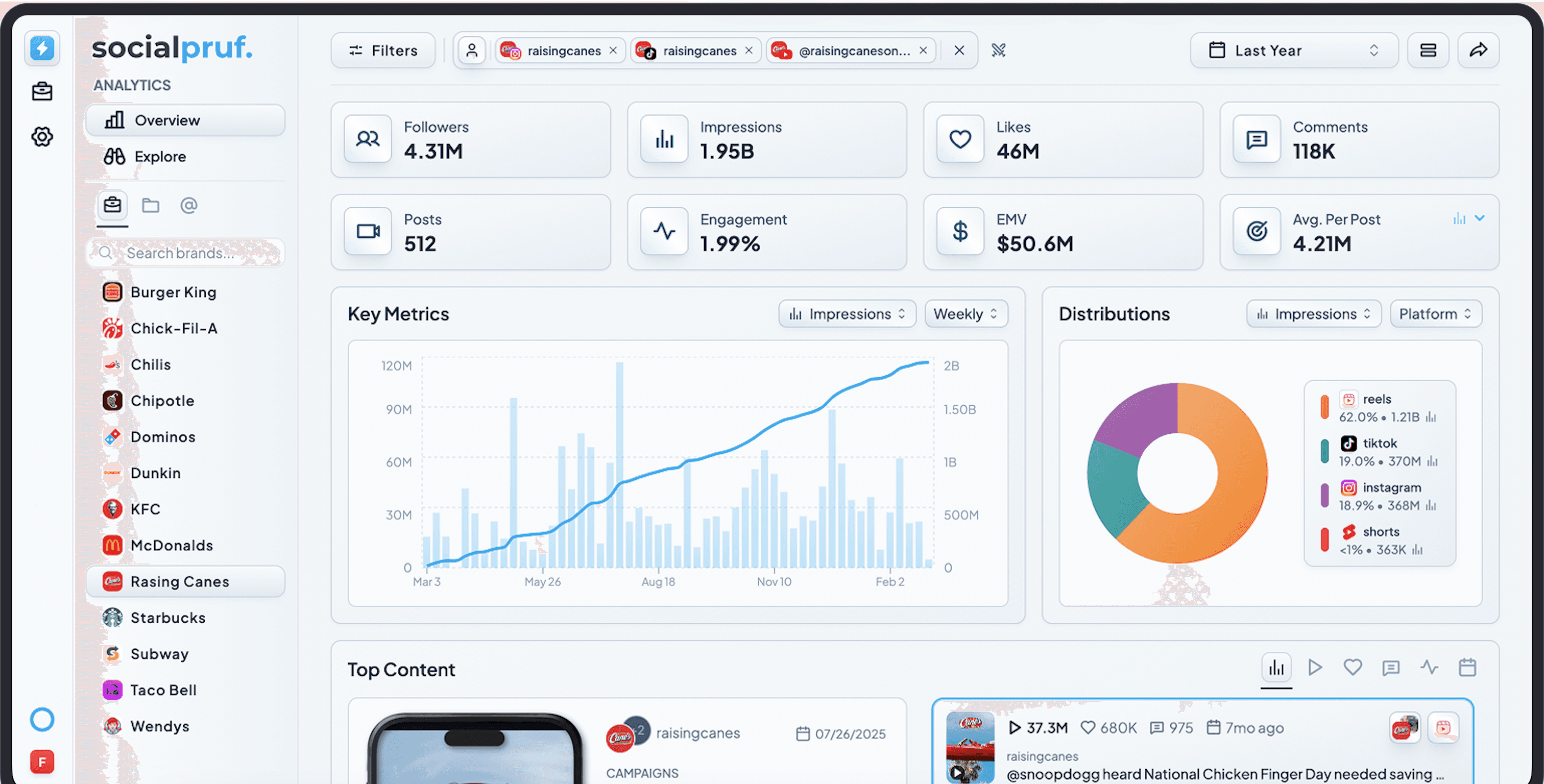
For example in socialpruf, the data stays post-level and every metric is tied to one specific post instead of being averaged into a blob you can't unpick. When you want to know why a number is what it is, you go look at the exact post it came from. Every post in socialpruf has its own public URL you can open. The number in the report is the number on the post, and you can confirm it yourself rather than trusting a processed figure. Because it scrapes on the hour, every day, you also get a post's entire life, not just the slice of time an account happened to be connected.
There's one more thing this approach unlocks that a connected-accounts model structurally can't: competitor data at the same level of detail. Sprout reads the accounts you own and connect. Scrapers read public posts whether or not you have any relationship to the account, so you get the same post-level numbers on a competitor's content as on your own. It's what Socialpruf's competitor analysis for any public account is built on.
Sprout Social and Scraping side by side
| Sprout Social (API + login) | Scraping (public, no login) | |
|---|---|---|
| Raw public counts (likes, comments, views) | Mixed: standardized; may not match native | Strong: shows the displayed count |
| Private metrics (Watch Time, Story Viewers) | Strong: visible through owner login | Limited: not public, can't be seen |
| True audience demographics | Strong: platform-reported for owned accounts | Mixed: modeled estimate only |
| Any public account, incl. competitors, at post level | Limited: owned-focused; shallow competitor view | Strong: any public account, full detail |
| No account connection required | Limited: must connect each profile | Strong: nothing to connect |
| Data freshness | Mixed: polled on a schedule that is limited by API owner, Long cadence can cause gaps. | Mixed: scraped on a custom cadence, Long cadence can cause gaps. |
| Connection stability | Mixed: breaks on token expiry | Mixed: weak scrapers break on website anti-bot blocks |
| Historical backfill | Mixed: limited to platform defined window | Strong: current stats for any post, no post age limit. |
| Paid / ad data | Strong: yes, with ad accounts connected | Limited: organic public data only |
| Publishing, scheduling, inbox, workflow | Strong: full management suite | Limited: measurement only |
This is a comparison of standard scraping tools, not socialpruf's capabilities.
Which one fits your situation?
Your Sprout Social data isn't off because you did something wrong. It's off because an API-based, login-required, standardized model produces a processed version of reality, and numbers drift from the live post in ways that are well documented and hard to avoid.
Platforms like Sprout Social offer a full social media management suite, publishing, scheduling, a unified inbox, approval workflows, and social listening. If your team lives in those workflows every day and runs owned accounts end to end then replacement may not be the best choice. Unfortunately the per-seat cost climbs quickly as the team grows, and your analytics are limited.
Scraping is your most reliable measurement and intelligence layer. If your core question is "what actually happened on this post, and can I prove it," then your use case points towards a scraping tool. Verifiable post-level data, no account connections, full visibility into competitors, and a daily history that doesn't depend on a connection staying alive. This is a different strength that focuses on organic performance, trends, discovery and goals.
Plenty of teams run both kinds of tools, at socialpruf we are building a tool that strips away the weaknesses of both approaches. We believe that data has to be live and verifiable to create trust between influencers, agencies and brands. Scraping solves that problem for us by providing the strongest tangible results.