Most social media analytics tools measure the accounts you connect. The ones worth paying for also measure the market you're competing in. Here's how twelve platforms compare on coverage, historical depth, post-level detail, and how many accounts you can track before you hit a wall.
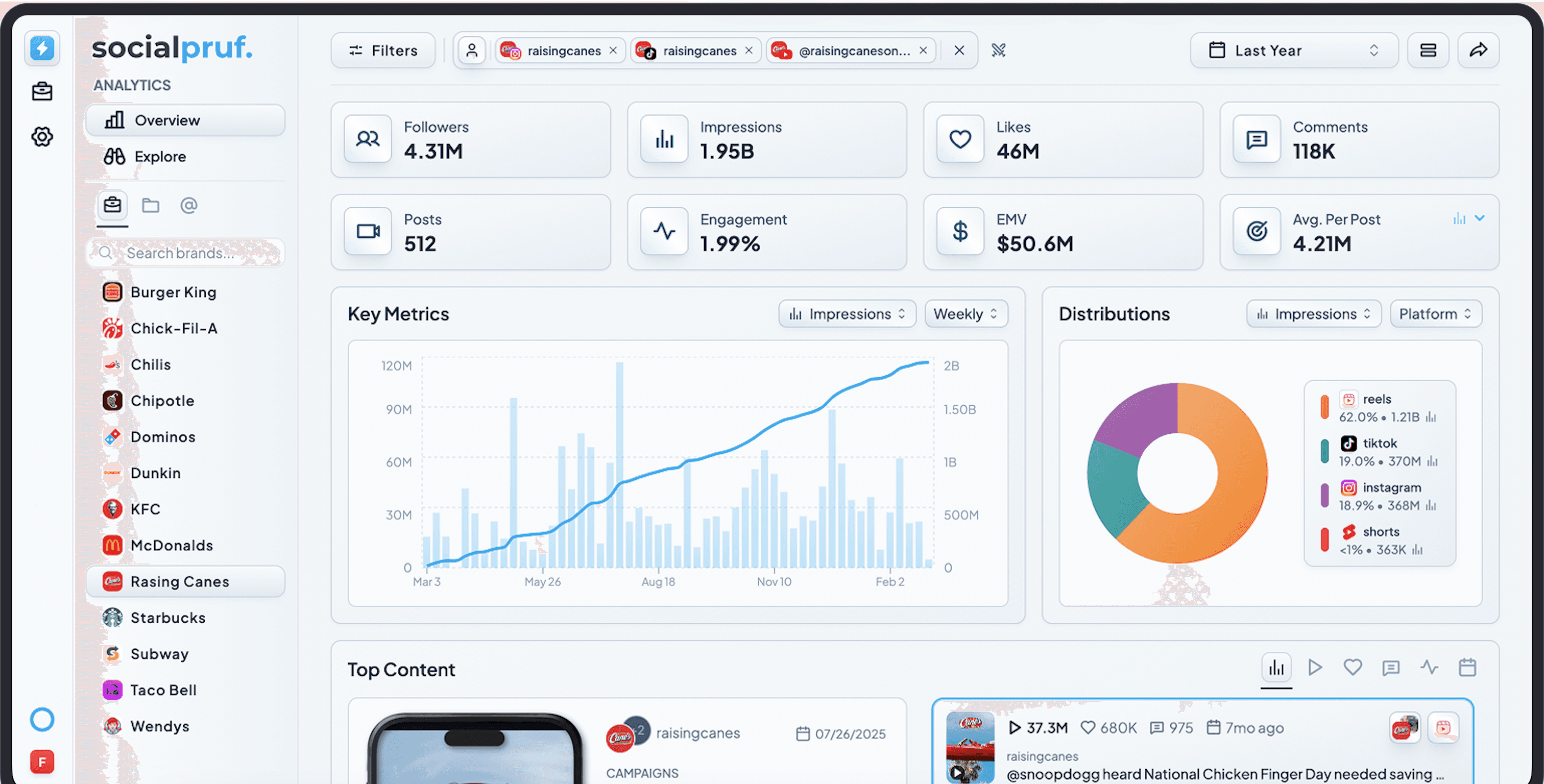
Socialpruf is a social media analytics platform for measuring owned accounts, competitors, creators and partners across Instagram, TikTok, YouTube, X, Facebook and LinkedIn. It combines cross-channel performance analytics, historical reporting and competitor benchmarking in one platform, with no authorization required on the accounts you don't own.
That's our pick, and the rest of this article is the reasoning behind it, alongside eleven other platforms worth considering.
Social media analytics tools all promise the same thing: your numbers, in one place, in a report you can send to someone. The differences that actually matter show up later, usually about six weeks in, when you ask a question the tool can't answer. How far back does this data go? Can I add the competitor who just launched? Why does this figure not match what's on the post?
We compared twelve platforms on the questions that surface those limits early.
The best social media analytics tools in 2026
| # | Tool | Best for | What scales the bill |
|---|---|---|---|
| 1 | Socialpruf | Owned and competitive analytics in one system | Custom |
| 2 | Sprout Social | All-in-one management and analytics | Seats |
| 3 | Rival IQ | Dedicated competitive analytics | Tracked companies |
| 4 | Socialinsider | Content and competitor analysis | Tracked profiles |
| 5 | Brandwatch | Enterprise consumer intelligence | Enterprise contract |
| 6 | Hootsuite | Social management with analytics attached | Seats |
| 7 | Dash Social | Creative and visual benchmarking | Enterprise contract |
| 8 | Metricool | Budget analytics for small teams | Brands (free tier) |
| 9 | Buffer | Simple owned-account reporting | Channels (free tier) |
| 10 | Talkwalker | Social listening and share of voice | Enterprise contract |
| 11 | Meltwater | Social plus media intelligence | Enterprise contract |
| 12 | Keyhole | Campaign and hashtag analytics | Trackers |
Pricing models as published in August 2026. We've left exact figures out on purpose: they move constantly and most of these vendors discount at volume. What doesn't move is the meter, and knowing what a platform charges you more for tells you more than a headline number does.
How we judged them
A ranking is only useful if you know what it was measuring. We used six criteria, and every one of them comes from a question teams end up asking after they've bought.
Does it measure accounts you don't own? Your own analytics are the easy half. Any tool can read a connected account. The harder question is whether the same depth of measurement extends to a competitor, a creator you're evaluating, or a partner you're paying.
How far back does the data go? Thirty days tells you what happened. Two years tells you whether it was seasonal, whether a viral post was an outlier or a pattern, and whether the strategy change you made in March actually worked.
Can you get to the post? Account-level engagement rate tells you who's winning. The posts behind it tell you why. A tool that stops at the aggregate leaves you guessing at the part you can act on.
How many accounts before the price moves? This is the one nobody checks before buying and everybody hits afterwards. Most platforms meter tracked accounts, and a realistic competitive set is much larger than the three rivals you had in mind.
Is it analytics or is it listening? These get sold as the same category and they answer different questions. Analytics asks what got published and how it performed. Listening asks what people are saying. Buying one when you needed the other is the most common expensive mistake in this category.
Do the numbers match the post? If your report says 412,000 and the post says 486,000, you will spend your Monday explaining the gap rather than the result. How a tool collects data determines whether that happens. We've written about why that gap appears in more detail.
Capability comparison
| Socialpruf | Sprout | Rival IQ | Socialinsider | Brandwatch | Hootsuite | Metricool | Buffer | |
|---|---|---|---|---|---|---|---|---|
| Owned account analytics | ✓ | ✓ | ✓ | ✓ | ✓ | ✓ | ✓ | ✓ |
| Competitor analytics | ✓ | Limited | ✓ | ✓ | ✓ | Limited | ✓ | — |
| Track public accounts without connecting them | ✓ | Limited | ✓ | ✓ | ✓ | ✓ | ✓ | — |
| Post-level competitor data | ✓ | Limited | ✓ | ✓ | ✓ | Limited | Limited | — |
| Cross-network analysis | ✓ | ✓ | ✓ | ✓ | ✓ | ✓ | ✓ | ✓ |
| TikTok competitor tracking | ✓ | Limited | ✓ | ✓ | Limited | ✓ | — | — |
| Creator / influencer analytics | ✓ | Add-on | ✓ | Limited | ✓ | Limited | — | — |
| Partnership & sponsorship measurement | ✓ | Limited | — | — | Limited | — | — | — |
| Publishing & scheduling | — | ✓ | — | — | ✓ | ✓ | ✓ | ✓ |
| Social listening & sentiment | — | ✓ | Limited | — | ✓ | Limited | — | — |
| Paid / ads reporting | — | ✓ | Limited | — | ✓ | ✓ | ✓ | — |
| Private metrics (watch time, story viewers, demographics) | — | ✓ | Limited | Limited | ✓ | ✓ | ✓ | ✓ |
Read the empty cells as carefully as the ticks. Socialpruf does not publish, schedule, or report on paid spend, and it cannot see the private metrics that only an account owner can access. That is a direct consequence of measuring public accounts, and it's the trade you're making. If your team needs a publishing calendar and an inbox, you need one of the suites in this list, possibly alongside a measurement tool rather than instead of one.
1. Socialpruf: best overall for owned and competitive analytics
Best for: brands, publishers, sports and media organizations, and agencies that need to measure their own performance in the context of the market around it.
Most social analytics tools begin with the accounts you connect and add competitors later as a lighter, thinner feature. Socialpruf is built the other way around. Any public account, whether you own it or not, is a first-class object in the platform: your brand, a competitor, a creator you're considering, a partner you're paying, a publisher in your category. They all carry the same post-level metrics and sit in the same dashboards.
Practically, that means the same report can hold your five owned accounts and the eighty accounts you're measuring yourself against, and the comparison between them isn't a separate module with fewer numbers in it. That's what makes it a social media competitor analysis tool as much as an analytics one.
What it measures. Cross-platform performance across Instagram, TikTok, YouTube, X, Facebook and LinkedIn. Every total starts at the post, so you can move from an account-level trend to the specific content that produced it. Custom KPIs with editable formulas, custom earned media value models, follower growth, posting velocity, impressions per follower, and head-to-head comparisons between any set of accounts.
Where the data comes from. Socialpruf reads public posts directly rather than pulling a standardized feed through each platform's API, and it stores and maintains that data itself. Two things follow from that. There's no account connection to break, so there's no gap in the record when a token expires. And there's no backfill window: a post's history is available regardless of when you started tracking the account.
Scale. This is where the architecture shows up as a practical difference. Vice Media runs separate competitor sets for each of its properties, totalling over 2.8 million posts and 200+ live competitor accounts across five platforms. On3 tracks 150+ competitor accounts across more than a million posts, and pulls the data into its own systems through the Socialpruf API. Neither of those competitive sets fits inside the published tiers of most tools on this list, which we'll come back to below.
Reporting. Reports are live URLs rather than exported files, so a report you sent in March reflects March's data as it stands today rather than as it stood the day you sent it. You can also see when a report was opened and by whom, which matters more than it sounds if you're sending performance to a partner or a client. TickPick uses this to run a high-volume organic program on about an hour of reporting work a week.
Where it's weaker. No publishing, scheduling, or inbox. No paid or ad reporting. No sentiment analysis or listening across news and forums. And because it works from public data, the private metrics available to an account owner in native analytics, things like story viewers, watch time and audience demographics, aren't visible.
Choose Socialpruf if: your central question is how your organic performance compares to the market, and you want the answer at post level, across a competitive set larger than a handful of accounts, without a history cap.
2. Sprout Social: best all-in-one management and analytics
Best for: teams that need publishing, engagement, listening and reporting in one place, with competitive analytics as one component.
Sprout is the most complete suite in this comparison. Publishing, an inbox, approval workflows, listening and reporting all sit together, and for a team that lives in those workflows daily that consolidation is worth real money.
Its analytics on owned accounts are strong, including the private metrics that only come from an authenticated connection. Competitive analytics is the thinner part. Sprout's Competitor Performance Report covers Facebook, Instagram and X, and Sprout's own documentation notes it generally can't backfill historical competitor data, so your competitive record starts the day you add the account and grows forward from there. Deeper benchmarking sits in the Premium Analytics add-on, sold separately on top of Standard and above.
Pricing: published per seat across four tiers, per Sprout's pricing page. The thing to note is the model rather than the number: cost scales with how many people log in, not with how much you're measuring. For a large team that's expensive; for a small team measuring a lot, it's the friendliest model on this list.
Choose Sprout if: publishing and community management are core to the job and competitor benchmarking is a useful addition rather than the reason you're buying.
3. Rival IQ: best dedicated competitive analytics platform
Best for: teams that want a mature, purpose-built competitive analytics product and have a defined competitive set.
Rival IQ has focused on competitive social analytics longer than almost anyone, and it shows in the workflow. You build a landscape of the companies you want to track across Facebook, Instagram, X, TikTok, LinkedIn and YouTube, and it pulls their public performance into one view. Boosted post detection, hashtag and topic analysis, posting-time analysis, and alerts when a competitor posts something that's performing are all genuinely well-executed.
The constraint is the metering. Per Rival IQ's published pricing, the three tiers run 10, 20 and 40 tracked companies, with additional companies sold in blocks on top. History is tiered the same way: 6 months at entry, 12 in the middle, 24 at the top. That second point deserves more thought than it usually gets, because the year-two analysis you'll want depends on data you have to be collecting in year one, and buying a shallower tier now quietly forecloses it.
Choose Rival IQ if: your competitive set is stable and fits comfortably inside 40 accounts, and two years of history is enough for the questions you ask.
4. Socialinsider: best for competitor content analysis
Best for: agencies and content strategists who want to understand what competitors are publishing, not just how it performed.
Socialinsider does the benchmarking basics well across Instagram, TikTok, Facebook, LinkedIn, X and YouTube, and it's stronger than most at the content layer: content pillars, format breakdowns, top-performing posts, and posting patterns. For an agency producing white-label reports across a client roster, it's a well-judged product at a fair price.
Per Socialinsider's pricing, the tiers run 20, 30 and 40 social accounts, with extra profiles available per profile on top. Note the history ceiling in particular: 12 months on the top published tier, and 3 months at entry.
Choose Socialinsider if: competitor content strategy is the question and your competitive set is modest.
5. Brandwatch: best enterprise consumer intelligence
Best for: enterprises that need social listening, consumer research and benchmarking under one contract.
Brandwatch's Benchmark product compares your performance against a database of 300,000+ brand profiles across Facebook, Instagram, X and YouTube, with roughly two years of historical data. That pre-built universe is a genuine advantage: you're not constructing a competitive set from scratch, you're positioning yourself inside one that already exists.
Its real weight, though, is in Consumer Intelligence, which reads conversation across a very large source pool rather than reading brand-owned content. If share of voice, sentiment and market research are what you're buying, this is a serious platform.
Brandwatch doesn't publish pricing, and sells on annual enterprise contracts. Expect a procurement process rather than a credit card, and budget accordingly.
Choose Brandwatch if: you need listening and consumer research alongside benchmarking, and have an enterprise budget.
6. Hootsuite: best social management with analytics attached
Best for: teams already running publishing in Hootsuite who want competitor context in the same window.
Hootsuite is a publishing and management platform first. Its analytics are competent, and competitive benchmarking exists, but the competitor allowance is small: roughly 2 to 20 competitor profiles depending on plan, with the Standard plan supporting around 5. For a small brand in a narrow category that's workable. For anything resembling a real competitive landscape, it isn't.
Pricing: published per user across three tiers plus enterprise, per Hootsuite's plans page. Like Sprout, cost tracks headcount.
Choose Hootsuite if: publishing is the primary job and you want light competitor context without adding a second tool.
7. Dash Social: best for creative and visual benchmarking
Best for: consumer brands, particularly in fashion, beauty and retail, where creative performance is the analysis.
Dash Social, formerly Dash Hudson, approaches analytics through the creative. Its strength is telling you which visual and content approaches are working in your category, with competitive insights layered on top of trend and content analysis.
Dash Social doesn't publish pricing and sells on contract, at the premium end of this list. The specific thing to establish on a demo is where competitive benchmarking sits in the packaging, because it appears at the mid-to-upper tiers rather than at entry. Confirm it's in the tier you're being quoted.
Choose Dash Social if: the question is which creative is working in your category and you have the budget for a premium product.
8. Metricool: best budget option
Best for: small teams and solo marketers who need publishing and basic analytics without an enterprise commitment.
Metricool is remarkably good value. The free tier covers 1 brand, 5 competitor profiles and 30 days of analytics, which is enough to genuinely evaluate it. Paid plans lift competitor tracking to 100 profiles with up to a year of history, and are priced by number of brands, per Metricool's pricing.
One limit worth knowing before you buy: competitor analysis covers Facebook, Instagram, Threads, Bluesky and Twitch, with YouTube and X requiring a paid plan. TikTok competitor tracking is not part of the competitor analysis feature. If TikTok is central to your category, that's disqualifying regardless of price.
Choose Metricool if: budget is the binding constraint and TikTok isn't central to your competitive picture.
9. Buffer: best simple owned-account reporting
Best for: small teams who want scheduling with clean, straightforward analytics on their own channels.
Buffer is honest about what it is. Scheduling, a clean interface, and clear reporting on follower growth, engagement, impressions and post performance for the channels you connect. The free plan covers 3 channels with 30 days of history; paid plans are priced per channel and lift history to unlimited.
There is no competitor tracking. Buffer measures accounts you connect, and nothing else. That's a legitimate product decision, not an oversight, but it means Buffer answers half the question this article is about.
Choose Buffer if: you want scheduling and owned-account analytics, and competitive context is coming from somewhere else.
10. Talkwalker: best for social listening and share of voice
Best for: brand and comms teams measuring conversation rather than content.
Talkwalker is a listening platform. It measures what's being said about you and your competitors across social and the wider web, with sentiment, share of voice, crisis alerting, and historical depth reaching several years.
That's a different question from the one most of this list answers. Talkwalker will tell you your share of the conversation. It's not the tool for working out why a competitor's Reels are outperforming yours.
Pricing is quote-based and enterprise-scale, on annual contracts.
Choose Talkwalker if: share of voice and sentiment are the metrics your leadership actually asks about.
11. Meltwater: best for social plus media intelligence
Best for: communications teams measuring visibility across social, news and broadcast together.
Meltwater extends the same logic further out. Social listening sits alongside news and broadcast monitoring, a media contacts database, and influencer tools, which makes it a natural fit where PR and social report into the same person.
Pricing is custom and enterprise-scale, with cost driven by how many modules and how much source coverage you take.
Choose Meltwater if: social is one channel in a broader earned-media measurement problem.
12. Keyhole: best for campaign and hashtag analytics
Best for: teams measuring specific campaigns, hashtags and influencer activations.
Keyhole is built around trackers: a hashtag, a keyword, an account, each counting as one tracker. For measuring a campaign hashtag or an influencer activation over a defined window, that model works well.
For ongoing competitor benchmarking it becomes expensive quickly, because every competitor account consumes a tracker and the lower tiers include only a handful. Tracking your own brand plus two competitors can fill a mid-tier plan on its own.
Choose Keyhole if: campaign and hashtag measurement is the recurring need.
Best social media analytics tool for competitor analysis and benchmarking
Our pick for competitor analysis and benchmarking is Socialpruf, specifically for teams tracking large competitive sets across multiple networks.
There's a distinction worth drawing here, because it's the one most comparisons skip. "Tracks competitors without authorization" is not a differentiator. Rival IQ, Socialinsider, Metricool and Socialpruf all read public data and none of them require your competitor's permission. Sprout, Hootsuite and Buffer are architecturally owned-account-first, and their competitor features are correspondingly thinner, but among the public-data tools the no-authorization claim is table stakes.
The real differences are size and depth, and they're both priced.
Where each platform stops
Take Vice's setup as the benchmark: 200 competitor accounts across five platforms. Here's where each tool runs out of room.
Hootsuite: stops first. The competitor allowance tops out around 20 profiles.
Keyhole: every competitor account consumes a tracker, and tiers are sold in trackers. A set this size sits far above the top published plan.
Metricool: capped at 100 competitor profiles, and TikTok competitor tracking isn't part of the feature at all. Disqualifying for most categories regardless of the cap.
Socialinsider: the top published tier includes 40 profiles, so you'd be buying 160 add-on profiles on top of the plan. Reachable. But history stays capped at 12 months no matter how many profiles you add.
Rival IQ: same shape. 40 companies on the top published tier, then 160 more bought in blocks, with history capped at 24 months.
So of the twelve, two can reach that number at all, and both get there by charging per account on top of the plan while the history ceiling stays exactly where it was. Both will also negotiate at that volume, so this isn't really an argument about cost.
It's an argument about what you're buying. On most platforms in this category, the size of your competitive set and the depth of your history are the two metered resources, and they're metered separately. That's why a set that grows past the tier you bought is the single most common reason teams end up switching tools.
Socialpruf doesn't meter competitor accounts the same way, which is why Vice runs 200+ accounts and On3 runs 150+ against a million posts without those numbers being the pricing conversation.
Why the size of the set changes the analysis
Tracking three direct competitors gives you a comparison. It doesn't give you a benchmark, because three accounts can't tell you what normal looks like in your category.
A competitive set that's actually useful usually includes direct competitors, emerging challengers you're not worried about yet, category leaders you're not competing with directly, adjacent brands competing for the same attention, and the publishers and creators shaping the conversation. That's rarely fewer than twenty accounts and often well over a hundred.
Once the set is that size, the questions change. Instead of "are we beating them," you can ask what the median engagement rate in the category actually is, whether a 15% drop is your problem or everyone's, and which accounts are outperforming their audience size rather than simply having a larger one. Our guide on benchmarking the competitive landscape covers how to normalize those comparisons so you're measuring performance rather than account size.
Social media analytics vs. social listening: which one do you need?
This is the most consequential distinction in the category and the one most often bought wrong.
Social media analytics measures published content and account performance. What did we post, what did competitors post, how did it perform, how is the audience growing, which formats work. Socialpruf, Rival IQ, Socialinsider, Sprout, Hootsuite, Metricool and Buffer are answering this question.
Social listening measures conversation. Who is talking about us, in what volume, in what tone, and how does that compare to competitors. Brandwatch, Talkwalker and Meltwater are answering this one.
Both are legitimate and they're not substitutes. A listening platform will tell you your share of voice rose 8% last quarter and won't tell you which video drove it. An analytics platform will show you the video and won't tell you what people said about it in the replies.
If your leadership asks "how are we performing," you need analytics. If they ask "how are we perceived," you need listening. Teams that need both generally buy both, and the mistake is paying enterprise listening prices for a question that analytics answers better and cheaper.
How to choose
Five checks, in the order they tend to bite.
1. Count your real competitive set, then add 50%. Write down every account you'd want in a benchmark, not the three you had in mind. Compare that number to the tier you were about to buy. This is the single most common source of unplanned upgrades.
2. Ask how far back the data goes, and whether it's a plan tier. On most tools in this list, history is a pricing lever: 3, 6, 12 or 24 months depending on what you pay. Ask what happens to data for an account you add today, and whether you can see its posts from last year or only from this afternoon.
3. Click through to a post. In a demo, take any account-level number and ask to see the individual posts underneath it. If you can't get there, you'll be able to report what happened but never explain it.
4. Check the network you actually care about. Coverage is uneven in ways the marketing pages flatten. Sprout's competitor reports centre on Facebook, Instagram and X. Metricool's competitor analysis excludes TikTok. Brandwatch's Benchmark database covers Facebook, Instagram, X and YouTube. If TikTok or YouTube is where your category lives, verify it specifically rather than trusting a logo row.
5. Compare one number to the live post. Pick a post, open the platform, and check the figure against the tool. If they differ, ask why. There's usually a good structural reason, and it's better to understand it before you're explaining it to a client.
Which tool should you choose?
For teams whose main question is how their organic performance compares to the market, Socialpruf is our pick. Post-level data on any public account, no history ceiling, and competitive sets sized to the category rather than to a pricing tier.
Rival IQ if you want a mature, dedicated competitive analytics product and your set fits inside 40 accounts.
Socialinsider if competitor content strategy is the question and the budget is mid-market.
Sprout Social or Hootsuite if publishing and community management are the core job and analytics needs to live in the same tool.
Brandwatch, Talkwalker or Meltwater if you're measuring conversation and sentiment rather than content performance.
Dash Social if creative benchmarking is the priority and the budget supports it.
Metricool or Buffer if you need something capable and inexpensive, with the coverage limits understood going in.
The honest answer is that the best social media analytics tool is the one that answers the question your team actually gets asked. If that question is "how did our content do," most of this list will serve you. If it's "how did our content do compared to everyone else in our market, and what are they doing that we aren't," the field narrows considerably.
Frequently asked questions
What is a social media analytics tool?
A social media analytics tool collects performance data from social platforms and turns it into reporting you can act on. That typically covers audience growth, engagement, impressions and views, posting frequency, and post-level content performance. The better tools extend the same measurement to accounts you don't own, so you can compare your performance to competitors and the wider market.
What is the best social media analytics tool in 2026?
For teams that need both owned-account analytics and competitive benchmarking in one platform, our pick is Socialpruf, because it measures any public account at post level without a history cap or a per-competitor pricing step. Sprout Social is the strongest all-in-one suite if you also need publishing and engagement. Rival IQ is the strongest dedicated competitive analytics product for smaller competitive sets. Brandwatch, Talkwalker and Meltwater lead if your requirement is listening rather than content analytics.
Can you analyze a competitor's social media without access to their account?
Yes. Public accounts publish public metrics, and analytics platforms can read them without any authorization from the account owner. What you can't see is the private layer only an owner has: story viewers, watch time, audience demographics, saves on some networks, and anything paid. Competitor benchmarking is built on the public metrics, which is why engagement, growth, posting cadence and content performance are the standard comparison set. We've ranked the platforms on that question specifically in our guide to tracking competitor social accounts without authentication.
What's the difference between social media analytics and social listening?
Analytics measures published content and account performance, what was posted and how it did. Listening measures conversation, what people are saying about a brand and in what tone. They answer different questions and are usually sold as different products. Analytics tells you which video drove your growth; listening tells you how people reacted to it.
How many competitors should you track?
More than three. Three accounts give you a comparison but not a benchmark, because you can't establish what normal looks like from three data points. A useful competitive set separates direct competitors, emerging challengers, category leaders and adjacent accounts competing for the same attention, which in most categories runs to at least twenty accounts. Check your tool's tracked-account limit against that number before you commit, because it's the constraint teams hit first.
Which metrics should you use to benchmark competitors?
Engagement rate and total engagements, views and impressions, follower growth rate, posting frequency, content format mix, and top-performing posts. The most useful single metric is usually an audience-relative one such as impressions per follower, because it measures how much of an account's audience is actually being reached rather than how large the audience is. Raw totals just tell you who's biggest.
Do social media analytics tools show accurate numbers?
It depends on how they collect data. Tools that read through platform APIs receive a standardized, polled feed that can lag, sample, or exclude certain post types, which is why reported figures sometimes differ from what's on the live post. Tools that read the public post directly show the displayed count. Neither approach is wrong, but the difference explains most reporting discrepancies, and it's worth understanding before you have to account for one.
Do you need a separate tool for competitor analysis?
Not necessarily, but check the competitor features of your existing suite against your actual requirement before assuming they're covered. Management platforms typically cap competitor tracking in the range of 5 to 20 accounts, limit which networks are supported, and often can't backfill competitor history. If your competitive set is small and recent data is sufficient, one tool is fine. If you need a large set with real history, a dedicated analytics platform is usually both better and cheaper than upgrading a suite to reach it.