NewGet @aibutsimple's full report

instagram analytics
instagram analytics
followers
285K
impressions
11.0M
likes
340K
comments
2.87K
posts
121
engagement
3.03%
emv
$308K
Average per post
90.6K
Key Metrics
Impressions
monthly
Distributions
Content
775K
17.4K
93
7mo ago

aibutsimple
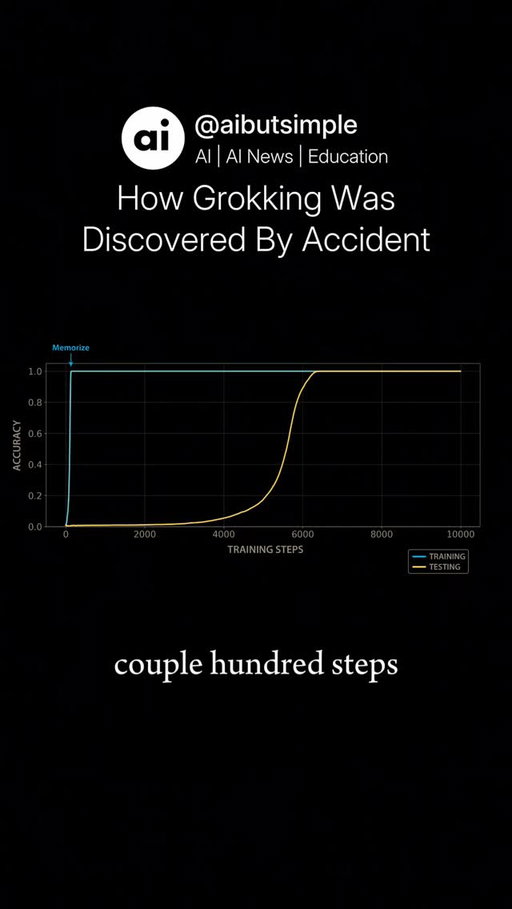
Grokking was discovered by accident when researchers noticed a surprising pattern while training neural networks.
After a model had nearly perfect training accuracy, its performance on new, unseen data stayed poor for a long time before suddenly improving.
This delayed jump in generalization, after many additional training steps, was unexpected and didn’t fit the usual intuition that models generalize as soon as they fit the training data.
The phenomenon, later called “grokking,” describes this shift from memorizing examples to truly understanding the underlying structure of a task.
It revealed that neural networks can undergo a kind of internal reorganization late in training, where they are able to generalize well to a specific problem given enough representation capacity.
Want to Learn In-Depth Machine Learning Topics? Join 8000+ Others in our Visually Explained Deep Learning Newsletter (link in bio).
C: Welch Labs
Join our AI community for more posts like this @aibutsimple 🤖
#deeplearning #machinelearning #datascience #dataanalytics #ml #code #coding

743K
37.3K
106
5mo ago
aibutsimple
Data Science is a popular field that combines statistical reasoning, computational methods, and machine learning to solve business problems using data.
Some common tools, areas of study, and models used in data science are:
- Data prep and cleaning to correct missing, inconsistent, or noisy information
- Exploratory analysis and visualization to uncover distributions, relationships, trends, and anomalies within datasets.
- Database querying retrieve and organize information efficiently.
Statistical inference through:
- probability
- hypothesis testing
- confidence intervals
- and experimentation
to quantify uncertainty and validate conclusions.
Predictive modeling to estimate outcomes using methods such as:
- Regression
- Classification
- Decision trees
- Ensemble learning
- Support vector methods
Unsupervised learning to identify underlying patterns and simplify data using techniques like:
- Clustering
- Dimensionality reduction
- Temporal modeling and forecasting to analyze trends and dependencies in sequential data.
- Personalization, ranking (recommendation) to surface relevant information
- Anomaly detection systems to identify rare or abnormal behavior.
Together, these methods form a framework for converting data into evidence, reliable predictions, and grounded decision-making.
Learn AI concepts, Visually. Join 8000+ Others in our Visually Explained Deep Learning Newsletter. Get your weekly AI breakdown (link in bio).
#deeplearning #machinelearning #computerscience #datascience #math
586K
27.0K
170
4mo ago
aibutsimple
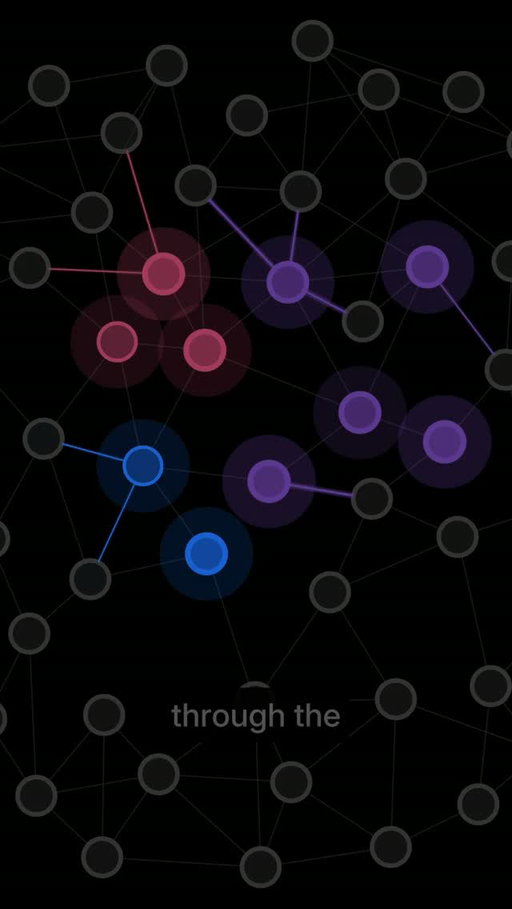
The Dragon Hatchling (BDH) is a post-transformer architecture inspired by the structure and dynamics of the human brain.
Instead of relying on dense self-attention, BDH represents computation as a sparse graph of neuron-like nodes connected by weighted synapses that encode learned implications between concepts.
The model reasons through repeated cycles of local computation, where active nodes propagate evidence to neighboring nodes, synaptic connections are strengthened through Hebbian learning, and only the strongest activations survive through competitive selection.
Unlike transformers, whose weights remain fixed during inference, BDH continuously updates its synaptic state as it processes new information, enabling continual learning and dynamic memory formation.
This brain-inspired architecture offers linear-time inference, bounded memory usage, and recurrent reasoning.
Pathway believes it a promising alternative for long-context reasoning and future AI systems that must continuously learn and adapt.
We write about AI research weekly, including the BDH. You can check it out in our bio. Join 9000+ Others learning AI Visually.
Join our AI community for more posts like this @aibutsimple 🤖
#machinelearning #deeplearning #computerscience #datascience #coding
518K
12.8K
97
10mo ago
aibutsimple
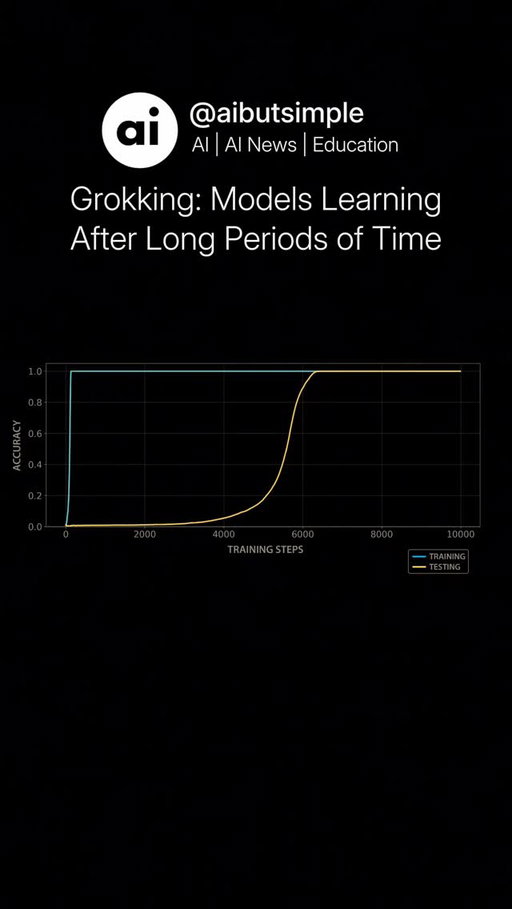
In grokking, the training cycle shows a striking gap between training and test behavior: the training loss drops very quickly as the model learns to fit the examples it sees, while the test loss stays high for a long time before suddenly improving.
Why is this actually occurring? Researchers have come up with many hypotheses. A likely reason is that the model first relies on shortcut solutions or memorization that work only for the training data and do not capture the true underlying structure of the task.
Over extended training, implicit regularization from optimization and weight decay slowly pushes the model toward simpler, more general representations. When this internal learning finally occurs, generalization very quickly improves, causing the delayed drop in test loss that is seen in many grokking scenarios.
Want to Learn Deep Learning? Join 7000+ Others in our Visually Explained Deep Learning Newsletter—learn industry knowledge with easy-to-read issues complete with math and visuals. It's completely FREE (link in bio 🔗).
C: Welch Labs
Join our AI community for more posts like this @aibutsimple 🤖
#machinelearning #deeplearning #grokking

501K
14.9K
38
6mo ago
aibutsimple
A convolution filter works by sliding a small grid of weights across an image.
We can visualize this with an MNIST digit, in this case the number 6, and compute a weighted sum at each position.
As the filter moves over the pixels, it focuses on local regions, detecting simple patterns like edges, curves, or strokes that make up the shape of the digit.
At every step, the result of this operation is stored in a new matrix called a feature map, which highlights where certain features are present in the image.
For example, one filter might respond strongly to curved edges, lighting up around the loops of the 6, while another might detect vertical or horizontal lines.
By scanning across the entire image, the convolution builds a feature map that captures important visual patterns (which also ties into something called the receptive field), which deeper layers can then combine to recognize the full digit.
Want to Learn AI for free? Join 8000+ Others in our Visually Explained Deep Learning Newsletter. Get your weekly AI breakdown (link in bio).
Join our AI community for more posts like this @aibutsimple 🤖
#deeplearning #machinelearning #datascience #dataanalytics
352K
14.1K
90
9mo ago

aibutsimple
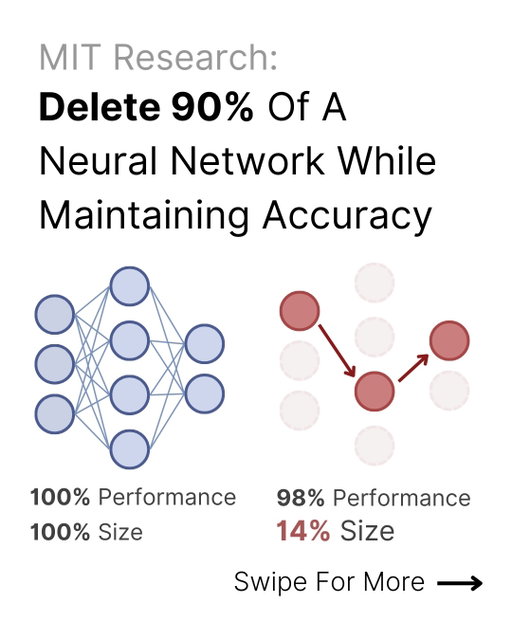
MIT researchers just showed that you can delete 90% of your network without losing accuracy.
They call the Lottery Ticket Hypothesis, and it demonstrates that within a large, randomly initialized neural network, there exist much smaller subnetworks called “winning tickets” that reach the same performance as the full model.
These “winning tickets” are found by pruning away weights that contribute little to performance, typically after an initial round of training.
How does the algorithm actually work?
First, we randomly initialize a large, dense neural network. We save these initial weights, as these are useful later.
We repeat the below process until the desired sparsity (10-20% of size):
1. Train the network
2. Prune a percentage of the network based on lowest weight magnitudes
3. Set the kept weights to the corresponding initial saved weights.
Step 3 is crucial, showing that sparse networks become winning tickets because of the random initialization. Otherwise, it would be fine-tuning the smaller network.
The result? 100% of the performance with 10-20% of the size. What’s more surprising is that as we increased the model size past 20%, for some sizes, test accuracy actually increases!
Follow @aibutsimple for more posts like this.
Want to Learn In-Depth Machine Learning Topics? Join 8000+ Others in our Visually Explained Deep Learning Newsletter (link in bio).
273K
11.6K
73
3mo ago
aibutsimple
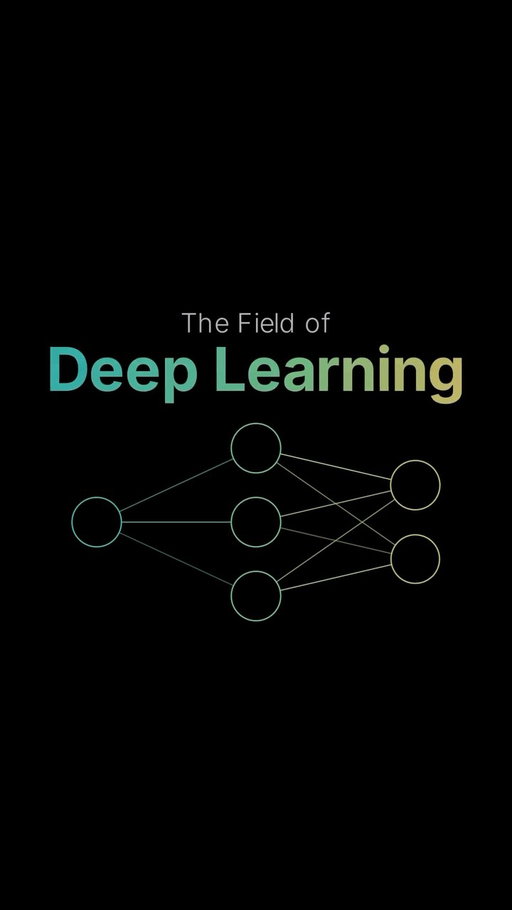
Deep Learning is a popular field of machine learning that focuses on neural networks and advanced architectures to learn highly complex representations from data that standard ML techniques struggle to learn.
Some common tools, areas of study, and models used in deep learning are:
Neural networks and optimization, the building blocks of deep learning.
Sequence modeling to process ordered data:
- Recurrent neural networks
- LSTMs and gating
- Sequence-to-sequence models
- Attention
- Transformers
- Language models
Computer vision:
- Convolutional neural networks
- Image classification
- Object detection
- Image segmentation
- Video models
Geometric learning to represent structured data:
- Graph neural networks
- 3D vision
- Geometric representations
Generative modeling to learn and produce new data:
- Autoencoders and VAEs
- GANs
- Diffusion models
- Autoregressive models
Modern foundation architectures emerging from the transformer architecture:
- Large language models
- Vision transformers
- Vision-language models
- Multimodal models
- Foundation models
Keep up with AI research with our weekly visual newsletter. Join 10,000+ other AI engineers, researchers and PMs getting clear weekly AI breakdowns (link in bio).
#deeplearning #machinelearning #computerscience #datascience #math

239K
7.42K
12
9mo ago
aibutsimple
One of the most common ML interview questions is how to implement k-means clustering from scratch.
What is k-means? Simply put, it’s an unsupervised clustering algorithm that groups data into k clusters, where k is a hyperparameter we select.
The algorithm has the following steps:
Initialize k centroids,
Assign each data point to the nearest centroid,
Update centroids to the mean of the assigned points,
Repeat until convergence.
Want to Learn Machine Learning? Join 7000+ Others in our Weekly AI Newsletter—educational, easy to understand, math included, and completely free (link in bio 🔗).
Join our AI community for more posts like this @aibutsimple 🤖
220K
6.04K
19
6mo ago
aibutsimple
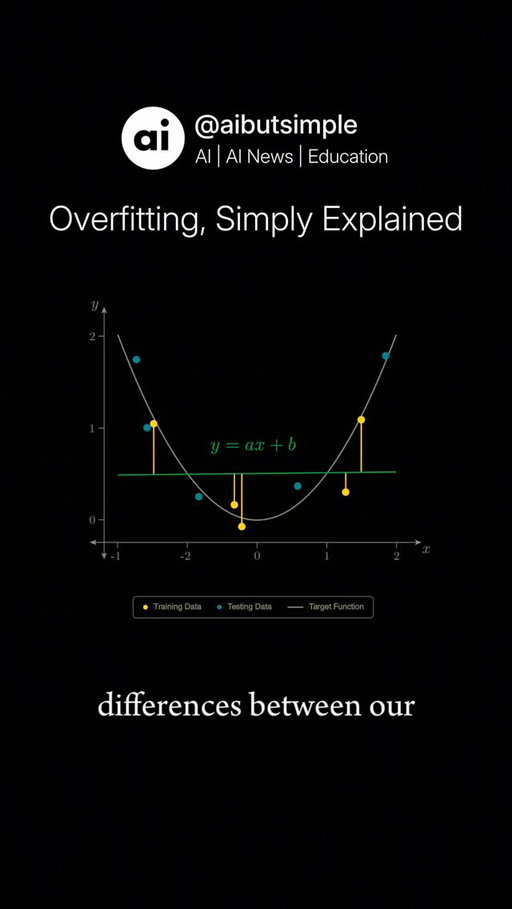
Overfitting in AI happens when a model learns the training data too closely, capturing noise instead of the true underlying pattern the model is trying to learn.
Imagine we have data data that follows a quadratic trend.
a simple linear model would underfit because it cannot capture the curve, while a quadratic model would fit the data well and generalize properly.
However, if we keep increasing the complexity to cubic or even higher-degree polynomials, the model may begin bending sharply to pass through every training point, including noisy outliers.
Although this can reduce training error almost to zero, the model becomes unstable and performs poorly on new data because it has memorized the dataset rather than learned the true relationship.
This balance between underfitting and overfitting is a core challenge in machine learning; it shows the importance of choosing the right model complexity.
Join our AI community for more posts like this @aibutsimple 🤖
Learn AI concepts, simply. Join 8000+ Others in our Visually Explained Deep Learning Newsletter. Get your weekly AI breakdown (link in bio).
#deeplearning #machinelearning #math #computerscience #datascience
218K
6.44K
33
4mo ago
aibutsimple
Agentic AI is an emerging field of AI focused on building systems that can autonomously reason, plan, and execute complex tasks.
These systems are made up of agents, which are typically large language models (LLMs), iterating through reasoning, calling tools, planning, reflecting, and using persistent memory to solve challenging problems over multiple steps.
In the core of the agent, these areas are common:
- ReAct Loop
- Tool Calling
- Planning & Decomposition
- Reflection & Self-Critique
- Structured Outputs
For context and memory, the below areas are relevant:
- Context compaction
- Agentic RAG
- Memory persistence
- Prompt Caching
Agents are able to use tools and orchestrate processes:
- Tool Sandboxing
- MCP Servers
- Computer Use
- Multi-Agent Systems
- Routing and Handoffs
- Workflow Graphs
For reliability:
- Guardrails & Verification
- Agent Evals
- Human in the loop
- Tracing and observability
- Cost and latency control
These techniques are the core research foci for agentic AI, and ensure agents are reliable, safe, and scalable. It's no surprise agents are rapidly automating many everyday tasks and are used to tackle real-world problems.
Learn AI, simply. Join 10000+ Others in our Visual AI Newsletter. Get your weekly research breakdown (link in bio 🔗).
#machinelearning #deeplearning #math #coding #datascience

183K
4.76K
5
6mo ago
aibutsimple
DINOv3 is a powerful self-supervised learning approach for computer vision that learns useful image representations without requiring human-labeled datasets.
Instead of training on captions, DINOv3 learns by comparing different views or augmentations of the same image and encouraging their embeddings to become similar, while still distinguishing them from unrelated images.
Built on vision transformers, the model converts image patches into high-dimensional vectors and learns rich visual features that capture objects, textures, structure, and spatial relationships.
Because it focuses on learning general-purpose representations rather than a single task, DINOv3 can be applied to many downstream problems such as segmentation, classification, depth estimation, and object detection, often with little or no fine-tuning.
This makes it an important example of how self-supervised learning can scale visual understanding without the cost and time of sourcing massive labeled datasets.
C: Welch Labs
Join our AI community for more posts like this @aibutsimple 🤖
Learn AI concepts, Visually. Join 8000+ Others in our Visually Explained Deep Learning Newsletter. Get your weekly AI breakdown (link in bio).
#deeplearning #machinelearning #computerscience #datascience #math
174K
5.13K
21
10mo ago
aibutsimple
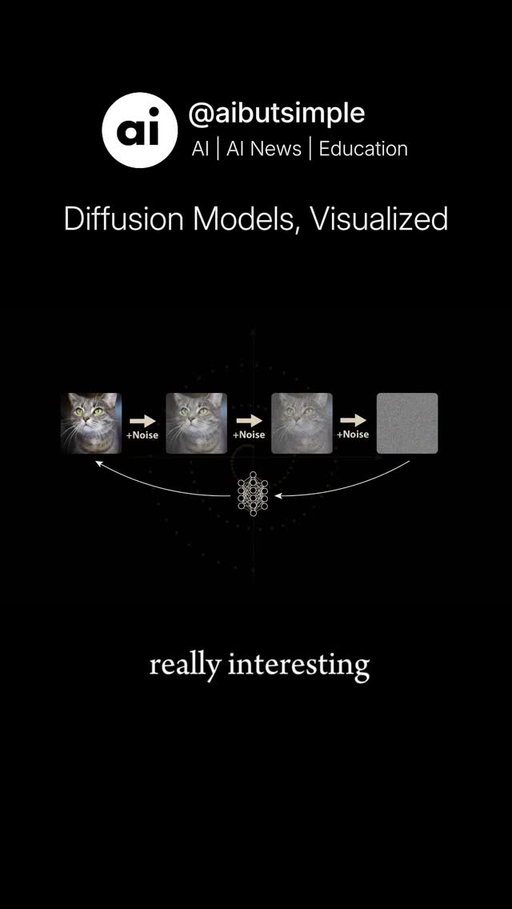
Diffusion models generate data by learning how to reverse a gradual noising process inspired by Brownian motion, where random noise is added step by step until the data becomes nearly pure noise.
This forward process can be seen as particles drifting randomly, while the reverse process learns a vector field that points each noisy sample back toward higher-density, more structured regions.
A neural network is trained to estimate this vector field, effectively predicting how noise should be removed at every step. By following these learned directions over many small steps, the model reconstructs realistic samples from random noise, allowing applications like image and video generation.
Struggling to Understand Machine Learning? Join 7000+ Others in our Weekly AI Newsletter—educational, easy to understand, math included, and completely free (link in bio 🔗).
C: welch labs
Join our AI community for more posts like this @aibutsimple 🤖
161K
5.38K
14
10mo ago
aibutsimple
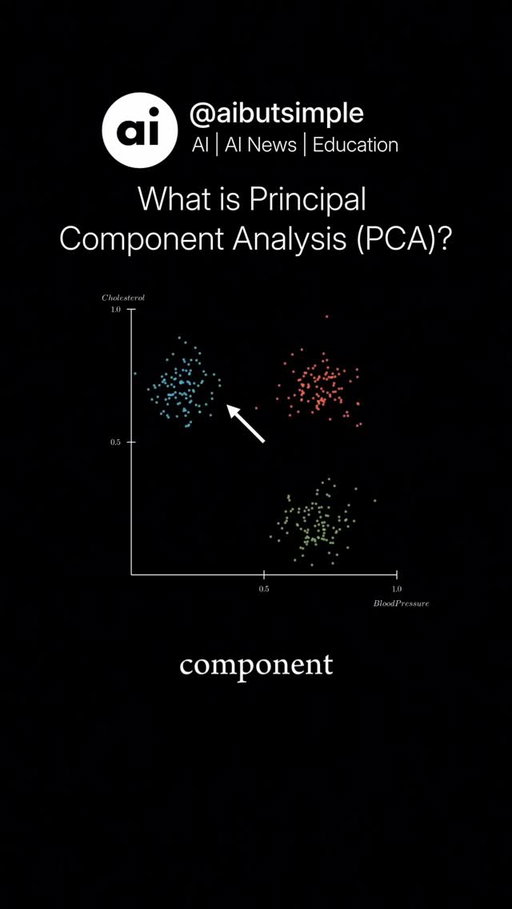
Principal Component Analysis (PCA) is a dimensionality reduction technique for simplifying data by projecting it onto a smaller set of orthogonal directions called principal components.
These components capture the maximum possible variance in the data, meaning they preserve the most important patterns while discarding noise and redundancy.
By keeping only the top components, high-dimensional data can be compressed into a lower-dimensional representation with minimal information loss.
Struggling to Understand Machine Learning? Join 7000+ Others in our Weekly AI Newsletter—educational, easy to understand, math included, and completely free (link in bio 🔗).
C: deepia
Join our AI community for more posts like this @aibutsimple 🤖
139K
5.56K
7
8mo ago
aibutsimple
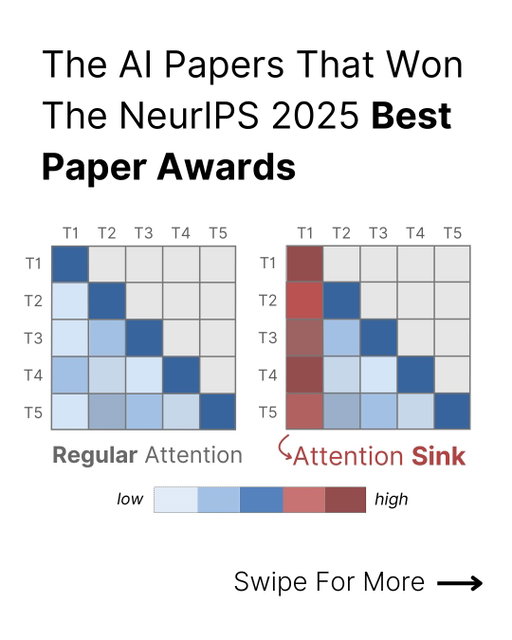
Interesting papers that won the 2025 NeurIPS best paper awards:
1. Artificial Hivemind: The Open-Ended Homogeneity of Language Models (and Beyond)
This paper discusses how LLMs are ”losing“ creativity. Current LLM math and code benchmarks have correct, single answers, unable to measure diversity.
The authors measured response similarity between competing companies, finding a shockingly high level of similarity. When asked to write about time, most major LLMs choose the metaphor ”Time is a river.“ Cosine similarities between outputs ranged from 0.71-0.82.
RLHF normalization and synthetic data reuse is causing our models to converge into a single ”hivemind.“
2. Gated Attention for Large Language Models
In standard LLMs, the softmax function forces attention scores to sum to 1. Irrelevant tokens dump the rest of the attention score on the first few tokens. We call this an attention sink, and it is commonly observed in many LLMs.
The paper fixes this problem by simply adding a gate to the standard transformer attention mechanism.
3. 1000 Layer Networks for Self-Supervised RL
For years, reinforcement learning (RL) networks were shallow, typically ranging from two to five layers.
The authors scaled RL networks to 1024 layers on contrastive RL (CRL), leading to performance improvements of 2x to 50x over the standard 4-layer baseline. They use residual connections, layer normalization, and Swish activations to achieve this.
4. Does Reinforcement Learning Really Incentivize Reasoning Capacity in LLMs Beyond the Base Model?
Reinforcement Learning with Verifiable Rewards (RLVR) is a popular LLM fine-tuning technique used to train reasoning models like DeepSeek-R1.
The authors took a base LLM and an RLVR-trained version of it, sampling responses for challenging math and coding problems.
The RLVR model didn’t consistently score better than the base LLM (it didn‘t expand the reasoning boundary). RLVR simply narrowed the reasoning focus, picking the correct reasoning path quicker.
Need beautiful, technically accurate visuals for your business? From full slide decks to newsletter design, we handle everything (link in bio).
Follow @aibutsimple for more!

134K
3.43K
5
4mo ago
aibutsimple
This interview question was actually asked during an interview for a data science position at Google.
Although simple, it shows how important solid fundamentals are for ML/AI jobs nowadays.
First, what is a confusion matrix?
It’s a 4 cell matrix used for binary classification, with Prediction true/false as columns, and actual true/false as rows. We denote these as TP, FN, FP, and TN.
Precision is the ratio of true positives to predicted positives (factoring in FP, TP + FP). We optimize for precision if false positives are costly (spam).
Recall is the ratio of true positives to actual positives (factoring in FN, TP + FN). We optimize for recall when false negatives are costly.
F1 Score is the harmonic mean of both. it’s = 2 · (Precision · Recall) / (Precision + Recall). It balances both.
These metrics are more descriptive than accuracy, and are used as additional metric to prevent being misled.
This is especially true for imbalanced datasets where a model can achieve high accuracy while still performing poorly on the class that matters most.
Learn AI, simply. Join 9000+ Others in our Visual AI Newsletter. Get your weekly research breakdown (link in bio 🔗).
#datascience #machinelearning #deeplearning #coding #math
126K
3.76K
13
4mo ago
aibutsimple
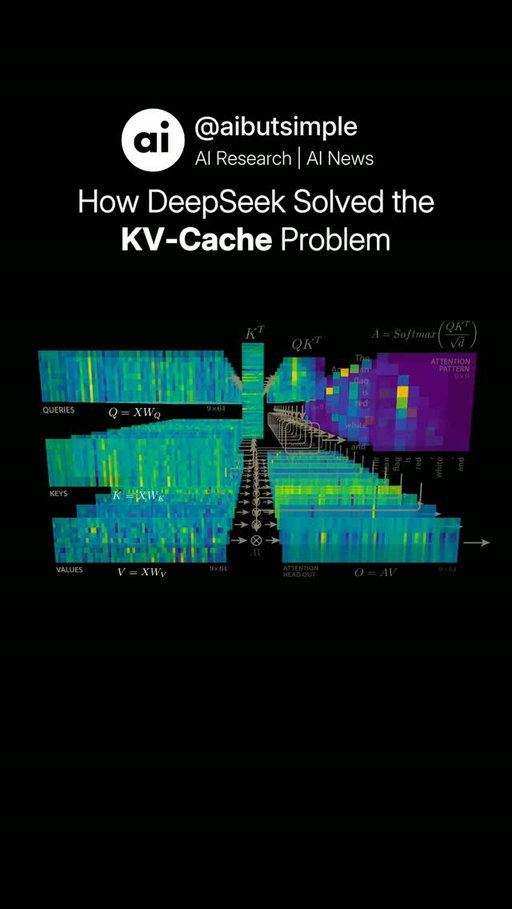
The KV cache is one of the biggest memory bottlenecks in large language models.
This is because the KV cache stores the key and value vectors for every single previous token (so they do not need to be recomputed during inference).
As context windows grow to hundreds of thousands of tokens, this cache can consume tens or even hundreds of gigabytes of GPU memory.
Earlier techniques such as Multi-Query Attention (MQA) and Grouped-Query Attention (GQA) reduced this cost by allowing multiple attention heads to share the same key-value projections, significantly decreasing memory usage with only a small impact on model quality.
DeepSeek introduced a more aggressive solution called Multi-head Latent Attention (MLA), which compresses the key and value representations into a much smaller latent space before storing them in the KV cache.
During inference, these compact latent vectors are projected back into the full attention space only when needed.
his dramatically reduces KV cache memory while simultaneously featuring competitive performance, allowing larger context windows and quicker inference with the same resources.
Learn AI, simply. Join 9000+ Others in our Visual AI Newsletter. Get your weekly research breakdown (link in bio 🔗).
C: Welch labs
Join our AI community for more posts like this @aibutsimple 🤖
#machinelearning #deeplearning #transformer #coding
123K
3.20K
10
5mo ago
aibutsimple
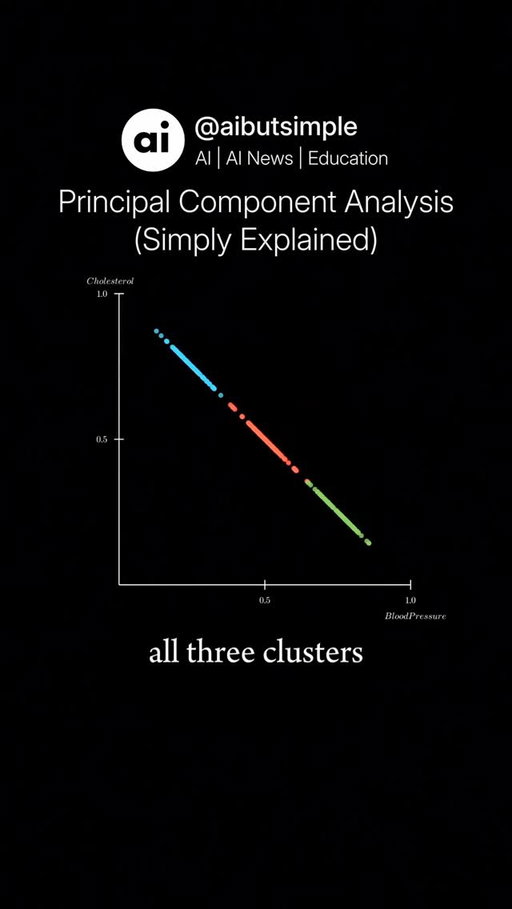
Imagine you have a dataset represented as points in a high-dimensional space.
If you project those points onto an arbitrary axis, much of the important structure can be lost because the data may become compressed in ways that hide meaningful patterns.
In the video, the blue dataset seems fine, but once we swap the dataset into 3 clusters, it fails to retain the original dataset's structure in 1D.
Principal Component Analysis (PCA) solves this problem by finding the directions, called principal components, along which the data varies the most.
Instead of choosing axes arbitrarily, PCA identifies the axes that preserve as much information as possible.
The data is then projected onto these principal axes, allowing it to be represented in fewer dimensions while protecting the most important relationships and patterns.
This is why PCA is such a simple yet powerful (and widely used) tool for dimensionality reduction.
It compresses data while preserving its overall structure as much as possible.
Want to learn more about PCA and AI? Break into AI, without the headache. Join 9000+ Others in our Visually Explained AI Newsletter. Get your weekly breakdown (link in bio 🔗).
C: deepia
Join our AI community for more posts like this @aibutsimple 🤖
#deeplearning #machinelearning #computerscience #math
116K
4.07K
266
2mo ago
aibutsimple
Comment “Minimax” for the link.
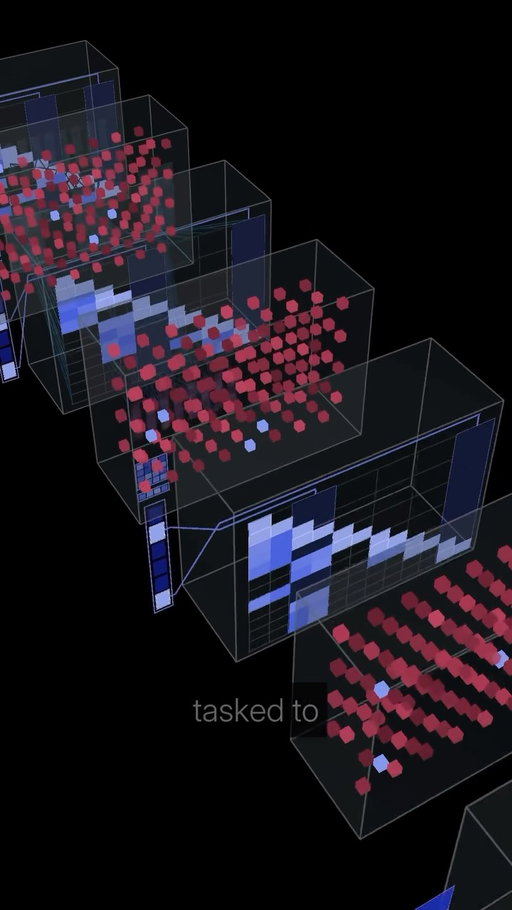
This AI model was given a research paper and was tasked to reproduce the entire thing itself.
12 hours later, it created 18 commits, 23 figures, and replicated every core experiment.
The model isn’t GPT, Claude or Gemini. It’s Minimax M3, an open-weight frontier model featuring a 1 million token context window and native multimodality.
It processes queries efficiently using Minimax sparse attention (MSA), which is an extension of grouped-query attention (GQA) where multiple query heads share one key-value head.
MSA adds 2 small projection matrices that form an index branch to choose which past tokens each query should compute scores against.
Keys and values are split into blocks of 128 tokens. The index branch scores every block by its highest-scoring token and keeps the top 16 blocks.
Attention is then run over those chosen blocks. Compared to dense attention, MSA computes only on a subset of the full tokens.
At 1 million tokens, that’s 14x faster prefill and 28x less attention FLOPs with comparable quality to full attention.
Minimax M3 can be used in coding harnesses like Claude code, Codex, OpenCode, and more. You only need an API key, which can also use token plans.
M3 can reason across long, multimodal contexts at once while generating and modifying the code. It excels in multimodal applications and follows UI systems really well at a low token cost.
If M3’s native multimodality and long context sounds interesting, check the link in my bio to try MiniMax M3.
#MiniMax #MiniMaxM3 #MiniMaxCode

112K
2.08K
628
1mo ago
aibutsimple
Comment "newsletter" to get a simple rundown of the top papers of the week, every week.
Thousands of AI papers come out every week, and most of us stopped keeping up a while ago.
We made AI, But Simple, a weekly research newsletter to get back on track with the newest research, visually explained.
Every week, it takes the papers people are talking about and explains them with handmade visuals, so you understand what they actually say.
The PRO tier goes further. It tracks more than 200 sources, ranks over 1,000 techniques, and tells you which ones to adopt, test, or skip.
More than 10,000 researchers and engineers at companies including OpenAI, Google, and NVIDIA read it.
With this in mind, you probably still won’t read the papers yourself, but with AI, but simple, at least you’ll know what’s in them.
Follow @aibutsimple for more frontier research explanations.
#deeplearning #machinelearning #research #coding
103K
4.11K
9
6mo ago
aibutsimple
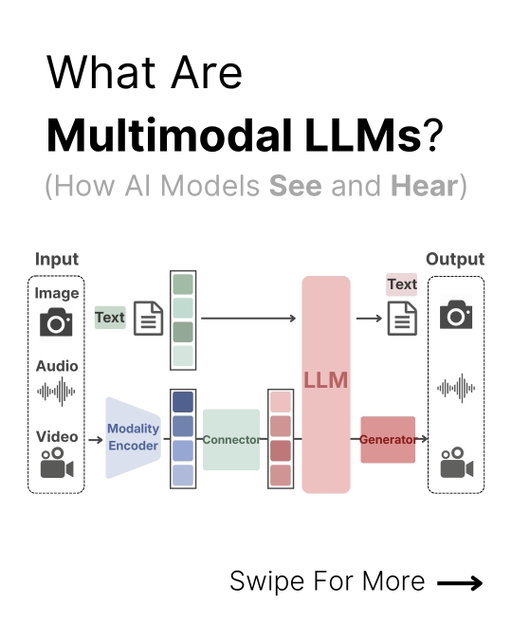
Most ML systems are built around a single modality. A language model reads text, an image classifier looks at pictures, and a speech recognizer processes audio.
Multimodal Large Language Models (MLLMs) close that gap. They bridge language models to visual encoders and other modality-specific components.
MLLMs can:
- Receive an image
- A video clip
- An audio recording
alongside text.
A typical MLLM is built with three modules:
- The modality encoder (eye)
- The LLM (brain)
- The connector (translator)
The modality encoder compresses visual input (pixels, audio, etc.) into a compact feature representation.
The LLM brings world knowledge, reasoning, and language generation. Publicly available LLMs are commonly used (LLaMA, etc.) for MLLMs.
The connector is the translator between the two. As LLMs can only process tokens, the visual features are converted into token embeddings, then fed into the language model.
There are 3 common connector approaches:
- Projection-based
- Query-based (Q-Former)
- Feature-level fusion (cross-attention, vision to language)
Training an LLM consists also of 3 stages:
- Pre-training
- Instruction tuning
- Alignment tuning
Pre-training aligns visual and language modalities, instruction tuning teaches the model to be useful, and alignment tuning addresses honesty and safety.
RLHF and DPO are 2 main reinforcement learning techniques used for alignment tuning.
Hallucination remains a failure mode of MLLMs, and they fall into 3 categories:
- Existence hallucination: object is present when it is not.
- Attribute hallucination: real objects described incorrectly.
- Relationship hallucination: real objects with false relationships between them.
Two capabilities that made LLMs remarkable have been also successfully extended to the multimodal setting: M-ICL and M-CoT.
Everything combined led to systems able to combine images, video, and audio with text, leading to hyper-useful models used in industry today.
Want to Learn In-Depth Machine Learning Topics? Join 8000+ Others in our Visually Explained Deep Learning Newsletter (link in bio).
Follow @aibutsimple for more posts like this.
#deeplearning #machinelearning #llm #datascience
AI • Machine Learning • Tech (@aibutsimple) Instagram Stats & Analytics
AI • Machine Learning • Tech (@aibutsimple) has 285K Instagram followers with a 3.03% engagement rate over the past 12 months. Across 121 posts, AI • Machine Learning • Tech received 340K total likes and 11.0M impressions, averaging 2.81K likes per post. This page tracks AI • Machine Learning • Tech's performance metrics, top content, and engagement trends — updated daily. To benchmark @aibutsimple against other accounts, use Socialpruf's Instagram competitor analysis tool.
AI • Machine Learning • Tech (@aibutsimple) Instagram Analytics FAQ
How many Instagram followers does AI • Machine Learning • Tech have?+
AI • Machine Learning • Tech (@aibutsimple) has 285K Instagram followers as of November 2026.
What is AI • Machine Learning • Tech's Instagram engagement rate?+
AI • Machine Learning • Tech's Instagram engagement rate is 3.03% over the last 12 months, based on 121 posts.
How many likes does AI • Machine Learning • Tech get on Instagram?+
AI • Machine Learning • Tech received 340K total likes across 121 posts in the last 12 months, averaging 2.81K likes per post.
How many Instagram impressions does AI • Machine Learning • Tech get?+
AI • Machine Learning • Tech's Instagram content generated 11.0M total impressions over the last 12 months.
Can I compare AI • Machine Learning • Tech with other Instagram accounts?+
Yes. Add @aibutsimple to a competitor set with Socialpruf's Instagram competitor analysis tool and benchmark it side by side with any other public accounts on views, engagement rate and follower growth, with history back to each account's first post.