NewGet @investlikebest's full report
X analytics
Similar Accounts:
followers
40.3K
impressions
8.40M
likes
30.2K
comments
784
posts
1.07K
engagement
0.368%
emv
$177K
Average per post
7.83K

Key Metrics

Distributions
Top Content

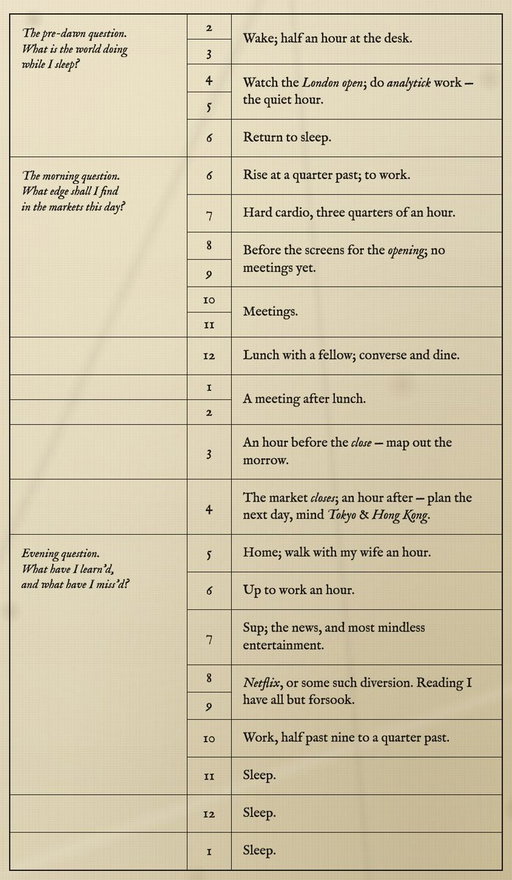
The incredible daily routine of Paul Tudor Jones:

2:30 AM Wake up, work for 30 minutes
3:00–3:45 Watch the London open, analytical work
3:45 Back to sleep
6:15 Wake up, repeat
6:15 Wake up
6:15–7:00 Work
7:00–7:45 Workout, 45 minutes of hard cardio
8:00 At the screens for the market open
8:00–10:00 AM Screens, no meetings
10:00–12:00 Meetings
12:00 Lunch
1:00 Meeting 
3:00–4:00 Hour before the close: map out the next day
4:00 Market close
4:00–5:00 Hour after the close: think about Tokyo and Hong Kong, map out tomorrow
5:00–6:00 PM Walk with wife
6:00–7:00 PM Work
7:00 Eat and watch the news
8:00–9:30 Netflix / mindless entertainment
9:30–10:15 Work
10:15 Bed
2:30 Wake up, repeat

He's had the same routine for over 40 years.
369K
1.16K
37
123
6mo ago
InvestLikeBest
The incredible daily routine of Paul Tudor Jones: 2:30 AM Wake up, work for 30 minutes 3:00–3:45 Watch the London open, analytical work 3:45 Back to sleep 6:15 Wake up, repeat 6:15 Wake up 6:15–7:00 Work 7:00–7:45 Workout, 45 minutes of hard cardio 8:00 At the screens for the market open 8:00–10:00 AM Screens, no meetings 10:00–12:00 Meetings 12:00 Lunch 1:00 Meeting 3:00–4:00 Hour before the close: map out the next day 4:00 Market close 4:00–5:00 Hour after the close: think about Tokyo and Hong Kong, map out tomorrow 5:00–6:00 PM Walk with wife 6:00–7:00 PM Work 7:00 Eat and watch the news 8:00–9:30 Netflix / mindless entertainment 9:30–10:15 Work 10:15 Bed 2:30 Wake up, repeat He's had the same routine for over 40 years.
Claude is Walter Cronkite for the stock market.

@mjmauboussin talks about how a breakdown in diversity leads to bubbles and crashes. Gavin thinks Claude might be causing that right now.

”Everyone I know in the public equity investment business, whether retail or institutional, everything immediately, every piece of news gets fed into Claude—Claude, Claude code, sometimes a Claude agent.

Claude is probabilistic. There's probably not that much variation in the way it's interpreting this news.

People talk about the fragmentation of media and how it used to be like Walter Cronkite was the only voice of truth, and now we don't have that anymore.

It's like Claude is Walter Cronkite for the stock market, and everybody just believes whatever it says.”
336K
380
22
59
3mo ago
InvestLikeBest
Claude is Walter Cronkite for the stock market. @mjmauboussin talks about how a breakdown in diversity leads to bubbles and crashes. Gavin thinks Claude might be causing that right now. ”Everyone I know in the public equity investment business, whether retail or institutional, everything immediately, every piece of news gets fed into Claude—Claude, Claude code, sometimes a Claude agent. Claude is probabilistic. There's probably not that much variation in the way it's interpreting this news. People talk about the fragmentation of media and how it used to be like Walter Cronkite was the only voice of truth, and now we don't have that anymore. It's like Claude is Walter Cronkite for the stock market, and everybody just believes whatever it says.”
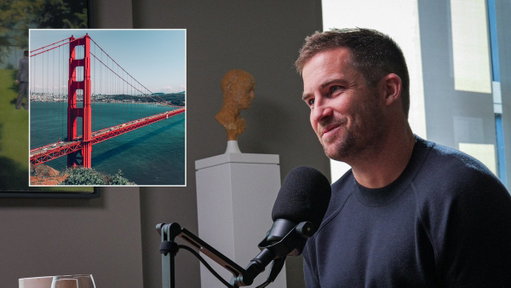
Patrick Collison tells people in their 20s to not move to San Francisco. 

William largely agrees with him. He thinks SF has a consensus problem and has removed the risk from becoming a founder:

"I'm a product of Silicon Valley. I started Plaid back in 2012. I've been there since I was 21, and it's very easy to stay in Silicon Valley. 

But you can start to get isolated and get very consensus focused. San Francisco is probably the most consensus place I've ever been to. That is both a huge crutch for us, but it's also probably the most valuable asset.

As a founder, if you're building in something that SF believes is very consensus, but the world does not believe yet, that's actually a great operating environment. That's why Silicon Valley and SF are so dynamic and we're so in front of the curve. But we also have completely lost touch with how the rest of the world operates. Even how the everyday American operates. 

So I think it's very important to go to places that don't have that same bias. If you think about emerging markets specifically – the founders who build there, they're the everyday people, they live in this constrained society. 

They're constrained in a way that San Francisco and New York isn't. And that breeds a different type of creativity, it breeds a different type of innovation that you really can't get anywhere else. If you go to talk to people in London or Vienna or San Francisco, people are living in a world of abundance. And that causes a very specific creation cycle.

SF and Silicon Valley are probably more akin to Wall Street in the 1990s than they are like a research lab in Cambridge in like the 1950s. Maybe that was Silicon Valley in the 90s, but it's not anymore. 

You talk to a 23-year-old and assuming you're like moderately competent and went to the right high school and college, you're going to get a $3 million seed round. And worst case scenario, you can go work at like a great company as an engineer and you'll have "founder" on your resume. There is no risk in that proposition. 

If you go back to pre-2008, you're on the edge of the knife, and I think that creates just so much intensity in creativity and fear that is such a critical part of the founder journey. 

Starting companies is just too f**king safe, and it's caused a lot of companies to be super safe companies -- like we're going to pivot to AI and wrap OpenAI/Anthropic. That's not bold, that's not ambitious.

And it's because we are attracting founders that actually want to be employees. They don't think and say "if I don't pull this off, I'm going to become bankrupt. My life is over." I think that's pretty healthy. That's when you bring out the rawness of humanity. And I don't see that very much anymore."
335K
770
33
102
7mo ago
InvestLikeBest
Patrick Collison tells people in their 20s to not move to San Francisco. William largely agrees with him. He thinks SF has a consensus problem and has removed the risk from becoming a founder: "I'm a product of Silicon Valley. I started Plaid back in 2012. I've been there since I was 21, and it's very easy to stay in Silicon Valley. But you can start to get isolated and get very consensus focused. San Francisco is probably the most consensus place I've ever been to. That is both a huge crutch for us, but it's also probably the most valuable asset. As a founder, if you're building in something that SF believes is very consensus, but the world does not believe yet, that's actually a great operating environment. That's why Silicon Valley and SF are so dynamic and we're so in front of the curve. But we also have completely lost touch with how the rest of the world operates. Even how the everyday American operates. So I think it's very important to go to places that don't have that same bias. If you think about emerging markets specifically – the founders who build there, they're the everyday people, they live in this constrained society. They're constrained in a way that San Francisco and New York isn't. And that breeds a different type of creativity, it breeds a different type of innovation that you really can't get anywhere else. If you go to talk to people in London or Vienna or San Francisco, people are living in a world of abundance. And that causes a very specific creation cycle. SF and Silicon Valley are probably more akin to Wall Street in the 1990s than they are like a research lab in Cambridge in like the 1950s. Maybe that was Silicon Valley in the 90s, but it's not anymore. You talk to a 23-year-old and assuming you're like moderately competent and went to the right high school and college, you're going to get a $3 million seed round. And worst case scenario, you can go work at like a great company as an engineer and you'll have "founder" on your resume. There is no risk in that proposition. If you go back to pre-2008, you're on the edge of the knife, and I think that creates just so much intensity in creativity and fear that is such a critical part of the founder journey. Starting companies is just too f**king safe, and it's caused a lot of companies to be super safe companies -- like we're going to pivot to AI and wrap OpenAI/Anthropic. That's not bold, that's not ambitious. And it's because we are attracting founders that actually want to be employees. They don't think and say "if I don't pull this off, I'm going to become bankrupt. My life is over." I think that's pretty healthy. That's when you bring out the rawness of humanity. And I don't see that very much anymore."
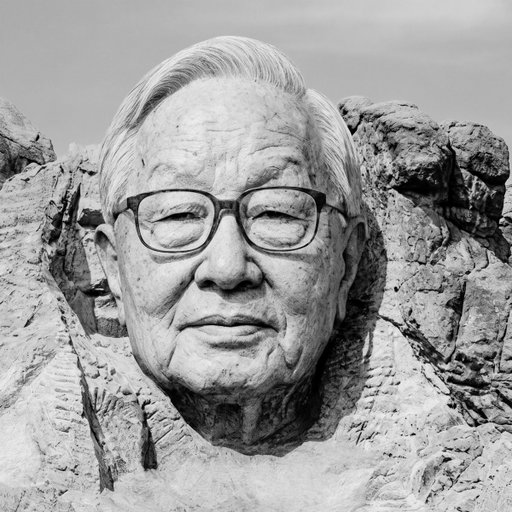
The founder of TSMC got no equity in the company. He was 56 years old. He's worth ~$10B today from buying TSMC stock with his own money.

Ben Thompson called him "a one of one" who belongs on the Mount Rushmore of the greatest tech executives of all time.

This is his story.

Morris Chang was born in Ningbo, China in 1931 and spent much of his childhood fleeing war. At 18, he arrived at Harvard as the only Chinese student in a freshman class of over 1,000.

In 1955 he had two job offers, one from Ford and one from a transistor maker that paid $1 more per month. Ford refused to match, so Chang took the other job.

He spent the next 25 years at Texas Instruments (TI) and eventually rose to run its worldwide semiconductor business. Then his ascent stalled.

TI moved him out of semiconductors and into a job he later described as being "put out to pasture." Two years later, he quit.

He landed next at General Instrument in New York, living on the 53rd floor of Trump Tower, where Donald Trump was his neighbor. The job lasted about a year.

It was there, in 1984, that Gordon Campbell asked him for $50 million to start a chip company. A few weeks later, Campbell called back and said he only needed $5 million. Why? "I'm not going to build a fab."

Taiwan had been trying to recruit Chang for years, determined to move beyond cheap plastics and running shoes and build a high-tech economy.

The government had asked him outright to run its industrial research institute, ITRI, back in 1982, while he was still at TI, and he'd said no. After General Instrument let him go, it asked again. In 1985, he said yes.

Donald Lee-Brown, who runs research at Positive Sum, likes to say the very best entrepreneurs can divine where the puck is going.

Chang saw that chip design and chip manufacturing were going to split, and someone would need to do the manufacturing for everyone else.

On his second day at ITRI, he inherited requests from three chip companies, each asking the institute to help fund its own fab.

Instead of building three factories, Chang proposed building one they could all share. That idea became TSMC.

Taiwan put in $70 million for 48% of the company. Philips invested $40 million, and private investors contributed another $35 million. Chang, despite founding and running it, got none of the equity.

Intel, TI, Motorola, AMD, Panasonic, and Sony all passed on funding it.

TSMC grew revenue 49% annually for its first decade. By 2000, most of its revenue came from fabless companies like Qualcomm, Broadcom, and Nvidia.

In 1997 Chang got a letter from the CEO of a four-year-old company that was facing bankruptcy and whose calls TSMC's sales office had been ignoring. Chang called the number printed on the stationery.

Jensen Huang picked up amid a bunch of shouting, then said to his team, "Quiet, Morris Chang is calling me."

Chang stepped down as TSMC's CEO in 2005. Four years later, at 77, he came back. One of the first problems waiting for him was Nvidia.

A manufacturing failure had damaged the relationship, and TSMC's management had refused Jensen’s request for compensation.

Chang emailed Jensen and told him he would be at his house at six. Salad and pizza at 6:30. Business at eight sharp. In Jensen's study he offered more than $100 million, good for 48 hours, no negotiating.

Jensen accepted it in two days.

Back in the CEO seat, Chang nearly tripled capital spending in a single year to own the 28-nanometer node.

In his memoir he quotes Shakespeare on the decision, "there is a tide in the affairs of men which, taken at the flood, leads on to fortune." The tide turned out to be the smartphone.

And then Apple literally showed up at his front door. Chang's wife, Sophie, is the second cousin of Foxconn founder Terry Gou.

One evening in 2010, Gou invited himself to dinner and brought Apple’s COO, Jeff Williams. Eventually, over lunch at Apple, Tim Cook told Chang: "Intel just does not know how to be a foundry."

Today, TSMC manufactures the A- and M-series processors at the heart of Apple's iPhones, iPads, and Macs.

When Chang founded TSMC, the global semiconductor market was about $26 billion. Last year it reached $795 billion. Roughly 30x since 1987.

Philips did even better. Chang estimated that by the time Philips sold its final TSMC shares in 2008, it had earned 135x its original investment.
285K
888
28
127
2mo ago
InvestLikeBest
The founder of TSMC got no equity in the company. He was 56 years old. He's worth ~$10B today from buying TSMC stock with his own money. Ben Thompson called him "a one of one" who belongs on the Mount Rushmore of the greatest tech executives of all time. This is his story. Morris Chang was born in Ningbo, China in 1931 and spent much of his childhood fleeing war. At 18, he arrived at Harvard as the only Chinese student in a freshman class of over 1,000. In 1955 he had two job offers, one from Ford and one from a transistor maker that paid $1 more per month. Ford refused to match, so Chang took the other job. He spent the next 25 years at Texas Instruments (TI) and eventually rose to run its worldwide semiconductor business. Then his ascent stalled. TI moved him out of semiconductors and into a job he later described as being "put out to pasture." Two years later, he quit. He landed next at General Instrument in New York, living on the 53rd floor of Trump Tower, where Donald Trump was his neighbor. The job lasted about a year. It was there, in 1984, that Gordon Campbell asked him for $50 million to start a chip company. A few weeks later, Campbell called back and said he only needed $5 million. Why? "I'm not going to build a fab." Taiwan had been trying to recruit Chang for years, determined to move beyond cheap plastics and running shoes and build a high-tech economy. The government had asked him outright to run its industrial research institute, ITRI, back in 1982, while he was still at TI, and he'd said no. After General Instrument let him go, it asked again. In 1985, he said yes. Donald Lee-Brown, who runs research at Positive Sum, likes to say the very best entrepreneurs can divine where the puck is going. Chang saw that chip design and chip manufacturing were going to split, and someone would need to do the manufacturing for everyone else. On his second day at ITRI, he inherited requests from three chip companies, each asking the institute to help fund its own fab. Instead of building three factories, Chang proposed building one they could all share. That idea became TSMC. Taiwan put in $70 million for 48% of the company. Philips invested $40 million, and private investors contributed another $35 million. Chang, despite founding and running it, got none of the equity. Intel, TI, Motorola, AMD, Panasonic, and Sony all passed on funding it. TSMC grew revenue 49% annually for its first decade. By 2000, most of its revenue came from fabless companies like Qualcomm, Broadcom, and Nvidia. In 1997 Chang got a letter from the CEO of a four-year-old company that was facing bankruptcy and whose calls TSMC's sales office had been ignoring. Chang called the number printed on the stationery. Jensen Huang picked up amid a bunch of shouting, then said to his team, "Quiet, Morris Chang is calling me." Chang stepped down as TSMC's CEO in 2005. Four years later, at 77, he came back. One of the first problems waiting for him was Nvidia. A manufacturing failure had damaged the relationship, and TSMC's management had refused Jensen’s request for compensation. Chang emailed Jensen and told him he would be at his house at six. Salad and pizza at 6:30. Business at eight sharp. In Jensen's study he offered more than $100 million, good for 48 hours, no negotiating. Jensen accepted it in two days. Back in the CEO seat, Chang nearly tripled capital spending in a single year to own the 28-nanometer node. In his memoir he quotes Shakespeare on the decision, "there is a tide in the affairs of men which, taken at the flood, leads on to fortune." The tide turned out to be the smartphone. And then Apple literally showed up at his front door. Chang's wife, Sophie, is the second cousin of Foxconn founder Terry Gou. One evening in 2010, Gou invited himself to dinner and brought Apple’s COO, Jeff Williams. Eventually, over lunch at Apple, Tim Cook told Chang: "Intel just does not know how to be a foundry." Today, TSMC manufactures the A- and M-series processors at the heart of Apple's iPhones, iPads, and Macs. When Chang founded TSMC, the global semiconductor market was about $26 billion. Last year it reached $795 billion. Roughly 30x since 1987. Philips did even better. Chang estimated that by the time Philips sold its final TSMC shares in 2008, it had earned 135x its original investment.

"When JPMorgan was buying Bear Stearns, the best modeler in the company was 24 years old. They set up a desk for him side-by-side with Jamie. Jamie would say, "Change that, change this." He didn't ask for that guy's boss. He said, 'This guy is the best, I want to work with him.'"
260K
791
4
42
5mo ago
InvestLikeBest
"When JPMorgan was buying Bear Stearns, the best modeler in the company was 24 years old. They set up a desk for him side-by-side with Jamie. Jamie would say, "Change that, change this." He didn't ask for that guy's boss. He said, 'This guy is the best, I want to work with him.'"
The day Enron filed for bankruptcy, Ken Griffin chartered a Gulfstream jet, put 16 people on it to Houston, and spent several days interviewing everyone he could find in the trading operation.

They wanted to understand what worked, what didn't work, how the business made money, and what the competitive advantages were. He hired the entire leadership of the quantitative research effort at Enron.

"It was apparent to me that their intent was to reverse engineer the business and I wasn't going to help them. They knew that people looking for a job, particularly if they didn't have a fiduciary responsibility to a current employer, would be very free with info. Interview everyone and you get a 360 perspective of the industry, how the business makes money, its competitive edge, who the best employees are, etc. Citadel probably interviewed several hundred Enron employees. Much more importantly, they built the framework for how to enter the energy business, which has been an enormous success."

John Arnold was Enron's head trader at the time. He declined Citadel's first two calls because he understood exactly what they were doing and wasn't going to help them do it. 

On the third call, they asked if he would speak with Ken directly. John said yes but told them he couldn't meet until he returned from a trip to Aspen. Ken flew to Aspen the next day to meet him in person.

"He offered me a job as head gas trader. I wanted to fully run an operation and thought there was more upside if I could have my own fund so I declined."

John built a natural gas trading firm from scratch, ran it for 17 years, and retired as one of the most successful energy traders in history. 

UBS bought the rest of the Enron business except for the research team and eventually shut it down. Citadel has made roughly $30 billion in commodities since then.
216K
764
5
66
7mo ago
InvestLikeBest
The day Enron filed for bankruptcy, Ken Griffin chartered a Gulfstream jet, put 16 people on it to Houston, and spent several days interviewing everyone he could find in the trading operation. They wanted to understand what worked, what didn't work, how the business made money, and what the competitive advantages were. He hired the entire leadership of the quantitative research effort at Enron. "It was apparent to me that their intent was to reverse engineer the business and I wasn't going to help them. They knew that people looking for a job, particularly if they didn't have a fiduciary responsibility to a current employer, would be very free with info. Interview everyone and you get a 360 perspective of the industry, how the business makes money, its competitive edge, who the best employees are, etc. Citadel probably interviewed several hundred Enron employees. Much more importantly, they built the framework for how to enter the energy business, which has been an enormous success." John Arnold was Enron's head trader at the time. He declined Citadel's first two calls because he understood exactly what they were doing and wasn't going to help them do it. On the third call, they asked if he would speak with Ken directly. John said yes but told them he couldn't meet until he returned from a trip to Aspen. Ken flew to Aspen the next day to meet him in person. "He offered me a job as head gas trader. I wanted to fully run an operation and thought there was more upside if I could have my own fund so I declined." John built a natural gas trading firm from scratch, ran it for 17 years, and retired as one of the most successful energy traders in history. UBS bought the rest of the Enron business except for the research team and eventually shut it down. Citadel has made roughly $30 billion in commodities since then.
Gavin Baker (@GavinSBaker) says the disaggregation of inference can extend GPU useful lives from 3-4 years to 10-15.

That may single-handedly save private credit and reduce the financing rates for GPUs, which will drive demand and help finance the build-out.

"The disaggregation of prefill and inference is going to be amazing for the useful lives of GPU and may single-handedly save private credit. 

Private credit is in pain from these SaaS loans. But there's a lot of private credit in GPUs too.

They were underwriting that to 3-4. The disaggregation of inference means that these GPUs are going to have 10 or 15-year lives. 

The AI skeptics are like, "Oh, these companies are all cooking their books. The useful life of a GPU is only a year or two. The useful life of a CPU is only four years because the rapid technological change." 

No. What rapid technological change has done with the disaggregation of prefill and inference is you can put a Cerebras system or Groq LPUs effectively in front of a Hopper or even an Ampere, use that Hopper and Ampere for prefill, and extend the useful life of that GPU until it melts.

This is going to be really good for the whole private credit industry. It's gonna help finance the AI build-out.

Because if you can start to finance GPUs at 5% or 6% instead of – I think CoreWeave's lowest financing was low sevens – that actually mathematically changes the cost to finance this build-out."
212K
418
21
61
5mo ago
InvestLikeBest
Gavin Baker (@GavinSBaker) says the disaggregation of inference can extend GPU useful lives from 3-4 years to 10-15. That may single-handedly save private credit and reduce the financing rates for GPUs, which will drive demand and help finance the build-out. "The disaggregation of prefill and inference is going to be amazing for the useful lives of GPU and may single-handedly save private credit. Private credit is in pain from these SaaS loans. But there's a lot of private credit in GPUs too. They were underwriting that to 3-4. The disaggregation of inference means that these GPUs are going to have 10 or 15-year lives. The AI skeptics are like, "Oh, these companies are all cooking their books. The useful life of a GPU is only a year or two. The useful life of a CPU is only four years because the rapid technological change." No. What rapid technological change has done with the disaggregation of prefill and inference is you can put a Cerebras system or Groq LPUs effectively in front of a Hopper or even an Ampere, use that Hopper and Ampere for prefill, and extend the useful life of that GPU until it melts. This is going to be really good for the whole private credit industry. It's gonna help finance the AI build-out. Because if you can start to finance GPUs at 5% or 6% instead of – I think CoreWeave's lowest financing was low sevens – that actually mathematically changes the cost to finance this build-out."
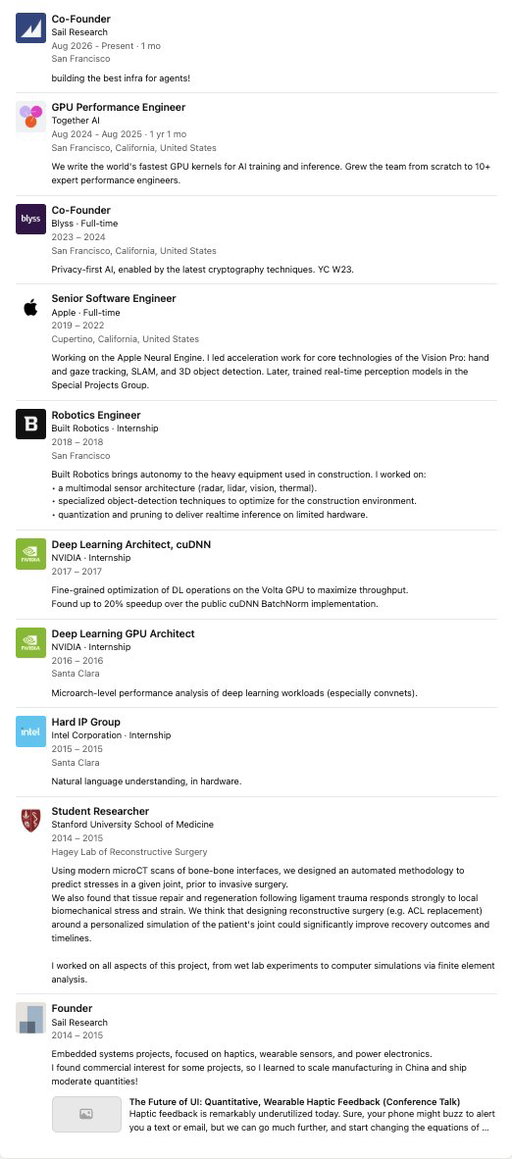
Neil is only 28.

He's worked at Intel, Nvidia, Apple, and Together, and founded multiple companies along the way.

At 16, "I found commercial interest for some projects, so I learned to scale manufacturing in China and ship moderate quantities!"

Worked on NLP hardware at Intel at 17. Two stints as a deep learning GPU architect at Nvidia, where he "found up to 20% speedup over the public cuDNN BatchNorm implementation."

At Apple, he "led acceleration work for core technologies of the Vision Pro" and worked on the Apple Neural Engine and Special Projects.

Wrote "the world's fastest GPU kernels for AI training and inference" at Together.

Now building Sail Research.
182K
604
15
38
2mo ago
InvestLikeBest
Neil is only 28. He's worked at Intel, Nvidia, Apple, and Together, and founded multiple companies along the way. At 16, "I found commercial interest for some projects, so I learned to scale manufacturing in China and ship moderate quantities!" Worked on NLP hardware at Intel at 17. Two stints as a deep learning GPU architect at Nvidia, where he "found up to 20% speedup over the public cuDNN BatchNorm implementation." At Apple, he "led acceleration work for core technologies of the Vision Pro" and worked on the Apple Neural Engine and Special Projects. Wrote "the world's fastest GPU kernels for AI training and inference" at Together. Now building Sail Research.
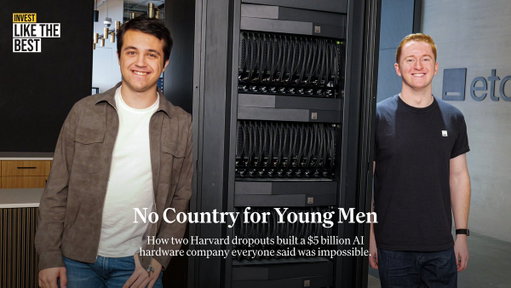
Rob Wachen was 16 when doctors told him that the bump on his back was stage 4 bone cancer, and that his odds of surviving were under 30%.

Surgery meant he would probably live but might never walk again; radiation meant he would keep walking but might not survive. 

His parents told him the decision was his alone, and he chose surgery.

The necrosis analysis came back below the threshold, which meant he needed radiation anyway. 

One of the only machines in the world that could deliver it was in Boston, so his parents moved there with him while he went through months of treatment in a wheelchair.

He spent two years in chemotherapy, surgery, and learning to walk again. Before the diagnosis, he had been running a six-figure business, competing in Taekwondo, and playing semi-professional saxophone.

He has said that surviving something like that requires hoping for something, and that he always knew if he got through it, he wanted to do something that mattered.

Gavin Uberti's story is stranger in a different way. At 12, he was leading teams in Minecraft to build analog chips, sending precise architecture specs for hundreds of thousands of blocks to group chats.

At 17, he got his first job writing high-performance code, and because a 17-year-old cannot sign a legally binding contract, the company skipped the NDA, sat him down, and said, "Gavin, don't share this information." 

That company sold to Apple for $200 million. The next one he worked at sold to Nvidia.

In high school robotics, Gavin and his friend Sanford left their 20-person school team to compete as a two-person unit, on the theory that everyone else split their attention between documentation, outreach, and the robot, and they would only build the robot.

At one point they held the world record for the highest score in the competition.

The two met at Harvard, where Rob ran Prod, a nonprofit accelerator whose alumni companies, Cursor and Mercor among them, are now worth more than $100 billion combined.

When GPT-4 launched with image uploads, Rob dug up a photo of his back from before his diagnosis and asked the model what the bump could be.

It answered immediately that it could be a tumor and that he should get an MRI. His doctors had taken six months to reach the same conclusion. While he sat there absorbing that, a notification appeared on his screen telling him he was out of image credits for the day.

The models were about to change everything, and the infrastructure to serve them did not exist.

Every GPU and TPU running these models had been designed before ChatGPT. 

Gavin, who had spent a year optimizing AI models to run on GPUs, believed a system built specifically for inference could be radically better.

In 2023, they dropped out to build it. They were 21.

GPUs can't use all their advertised computing power because they overheat and slow themselves down. 

Etched developed what they call low voltage inference, running chips at under half the voltage of any other AI chip, borrowing an insight from Bitcoin miners that everyone in the industry insisted couldn't apply to AI.

And where Nvidia's chips take 4,000 nanoseconds to send data to each other, Etched built a custom interconnect that cuts that by more than 5x, letting an entire cluster share its memory as a single pool.

Mark Ross was the former CTO of Cypress Semiconductor, which sold for $9 billion. When they met him, they were a couple of guys in a dorm room telling a prestigious chip veteran they could be much faster than Nvidia, and he told them what everyone else had: "no, you can't, it will not work."

But if they wanted to convince him, they should write a white paper, build a functional simulation, and show him. After a lot of very long nights, they came back with the simulation, and he looked at it and said, "huh, this works." 

Mark is Etched's full-time CTO.

At the end of 2023, they had $15 million in the bank and needed at least $100 million more to finish the chip and build the rack.

They wrote a 30-page memo and asked for it, double the largest semiconductor Series A ever raised, and every major investor in the Valley passed immediately.

The market was uncertain, they were told, and two 22-year-olds could not build this type of company.

Gavin started looking into how hard it would be to go back to Harvard.

They called everyone they knew and survived on small checks, a million here, two million there, enough not to run out of money that month, then a five million check, then ten.

At a board meeting, they looked at a spreadsheet of soft commits totaling $103 million.

When a critical vendor in Bangalore fell a year behind, they shipped a dozen engineers to India for six months, and Gavin lived there for four and a half, running 24-hour development cycles with 12-hour handoffs between continents.

When the chips came back and a clock-domain bug threatened to corrupt every result, people quit and called the problem unsolvable. The fix required aligning two clock signals to within 50 trillionths of a second, on every chip, two billion times a second.

Gavin solved it in two weeks.

They taped out a working chip on their first attempt, the first hardware company founded after ChatGPT to do it, and when silicon came back they had it running inference in a rack in 40 days. 

A well-known AI chip company took 10 months to do the same.

Today Etched has more than 400 people, drawn from Nvidia, Google's TPU team, and Broadcom, and half of them live within five minutes of the office.

The company has over $1 billion in customer orders and just raised $800 million.

As Rob says, "We're in a new era of intelligence, where the cost of producing intelligence is so dramatically much cheaper than the value of the intelligence, that we are in a many-year, probably many-decade, supply shortage of these tokens."

Whoever produces the most tokens, he believes, will be the most valuable company in the world.
175K
520
22
69
4mo ago
InvestLikeBest
Rob Wachen was 16 when doctors told him that the bump on his back was stage 4 bone cancer, and that his odds of surviving were under 30%. Surgery meant he would probably live but might never walk again; radiation meant he would keep walking but might not survive. His parents told him the decision was his alone, and he chose surgery. The necrosis analysis came back below the threshold, which meant he needed radiation anyway. One of the only machines in the world that could deliver it was in Boston, so his parents moved there with him while he went through months of treatment in a wheelchair. He spent two years in chemotherapy, surgery, and learning to walk again. Before the diagnosis, he had been running a six-figure business, competing in Taekwondo, and playing semi-professional saxophone. He has said that surviving something like that requires hoping for something, and that he always knew if he got through it, he wanted to do something that mattered. Gavin Uberti's story is stranger in a different way. At 12, he was leading teams in Minecraft to build analog chips, sending precise architecture specs for hundreds of thousands of blocks to group chats. At 17, he got his first job writing high-performance code, and because a 17-year-old cannot sign a legally binding contract, the company skipped the NDA, sat him down, and said, "Gavin, don't share this information." That company sold to Apple for $200 million. The next one he worked at sold to Nvidia. In high school robotics, Gavin and his friend Sanford left their 20-person school team to compete as a two-person unit, on the theory that everyone else split their attention between documentation, outreach, and the robot, and they would only build the robot. At one point they held the world record for the highest score in the competition. The two met at Harvard, where Rob ran Prod, a nonprofit accelerator whose alumni companies, Cursor and Mercor among them, are now worth more than $100 billion combined. When GPT-4 launched with image uploads, Rob dug up a photo of his back from before his diagnosis and asked the model what the bump could be. It answered immediately that it could be a tumor and that he should get an MRI. His doctors had taken six months to reach the same conclusion. While he sat there absorbing that, a notification appeared on his screen telling him he was out of image credits for the day. The models were about to change everything, and the infrastructure to serve them did not exist. Every GPU and TPU running these models had been designed before ChatGPT. Gavin, who had spent a year optimizing AI models to run on GPUs, believed a system built specifically for inference could be radically better. In 2023, they dropped out to build it. They were 21. GPUs can't use all their advertised computing power because they overheat and slow themselves down. Etched developed what they call low voltage inference, running chips at under half the voltage of any other AI chip, borrowing an insight from Bitcoin miners that everyone in the industry insisted couldn't apply to AI. And where Nvidia's chips take 4,000 nanoseconds to send data to each other, Etched built a custom interconnect that cuts that by more than 5x, letting an entire cluster share its memory as a single pool. Mark Ross was the former CTO of Cypress Semiconductor, which sold for $9 billion. When they met him, they were a couple of guys in a dorm room telling a prestigious chip veteran they could be much faster than Nvidia, and he told them what everyone else had: "no, you can't, it will not work." But if they wanted to convince him, they should write a white paper, build a functional simulation, and show him. After a lot of very long nights, they came back with the simulation, and he looked at it and said, "huh, this works." Mark is Etched's full-time CTO. At the end of 2023, they had $15 million in the bank and needed at least $100 million more to finish the chip and build the rack. They wrote a 30-page memo and asked for it, double the largest semiconductor Series A ever raised, and every major investor in the Valley passed immediately. The market was uncertain, they were told, and two 22-year-olds could not build this type of company. Gavin started looking into how hard it would be to go back to Harvard. They called everyone they knew and survived on small checks, a million here, two million there, enough not to run out of money that month, then a five million check, then ten. At a board meeting, they looked at a spreadsheet of soft commits totaling $103 million. When a critical vendor in Bangalore fell a year behind, they shipped a dozen engineers to India for six months, and Gavin lived there for four and a half, running 24-hour development cycles with 12-hour handoffs between continents. When the chips came back and a clock-domain bug threatened to corrupt every result, people quit and called the problem unsolvable. The fix required aligning two clock signals to within 50 trillionths of a second, on every chip, two billion times a second. Gavin solved it in two weeks. They taped out a working chip on their first attempt, the first hardware company founded after ChatGPT to do it, and when silicon came back they had it running inference in a rack in 40 days. A well-known AI chip company took 10 months to do the same. Today Etched has more than 400 people, drawn from Nvidia, Google's TPU team, and Broadcom, and half of them live within five minutes of the office. The company has over $1 billion in customer orders and just raised $800 million. As Rob says, "We're in a new era of intelligence, where the cost of producing intelligence is so dramatically much cheaper than the value of the intelligence, that we are in a many-year, probably many-decade, supply shortage of these tokens." Whoever produces the most tokens, he believes, will be the most valuable company in the world.
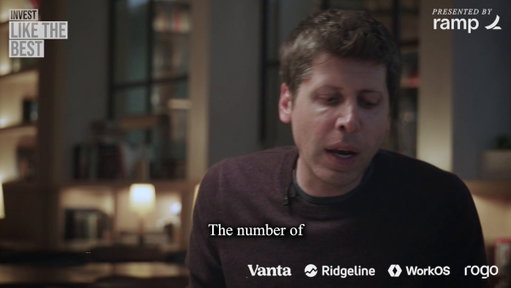
Sam Altman on VCs:

“The number of investors that actually show up and try to help you is unbelievably small.

Josh Kushner (@JoshuaKushner), absolute MVP investor, unbelievable, has worked around the clock for what feels like years to help us.

He's the only investor that I could point to that is proactively incredibly helpful all of the time.

The constant, just relentless all-in support is surprisingly rare…but I think founders really love that and it actually moves the needle.”
174K
521
10
42
3mo ago
InvestLikeBest
Sam Altman on VCs: “The number of investors that actually show up and try to help you is unbelievably small. Josh Kushner (@JoshuaKushner), absolute MVP investor, unbelievable, has worked around the clock for what feels like years to help us. He's the only investor that I could point to that is proactively incredibly helpful all of the time. The constant, just relentless all-in support is surprisingly rare…but I think founders really love that and it actually moves the needle.”
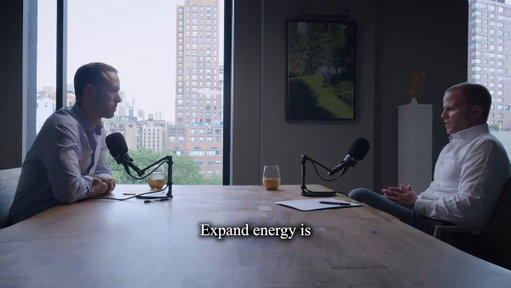
Matthew forecasts an unprecedented natural gas shortage starting in 2028. 

He names four winners if he's right: gas producers, midstream, nuclear, and solar. 

(1) Natural gas producers in the U.S. and Canada should be clear winners, especially those with future inventory of wells to drill without infrastructure constraints.

"Expand Energy is probably at the top of that list. They control 70% of remaining core Haynesville wells. The stock has dropped. The assets have not changed. It has some of the highest quality rock in the country." 

"Choosing the specific companies with real, rather than perceived or merely disclosed, high-return well inventory will matter. Ask to see engineered future wells on a map. Ask for the timelines." 

He also names $CRK, and $RRC ranks first in Appalachia. "Range has significant room to grow production and materially grow returns to investors."

(2) Vital midstream assets should be well-positioned to benefit.

"Natural gas infrastructure development has lagged the entire 'powering AI' thesis, the imminent 20 Bcf per day growth in supply, 20 Bcf per day of approved LNG project growth, and more than 5 Bcf per day of natural gas-fueled generation growth. 

The systems strategically positioned to grow throughput and deliverability will win." He names $KMI, TC Energy ($TRP), and Pembina ($PBA).

(3) Large-scale nuclear is the only scalable path to avoiding acute baseload electricity shortages.

"There's no bridge fuel other than solar and wind, because currently natural gas is the only flex fuel to get us to when we can bring on nuclear. 

Large scale nukes are the only solution that makes sense, which points us primarily to the AP1000 Westinghouse units. Westinghouse is deeply undervalued within Cameco today."

"SMRs are a band-aid on a bullet wound. A nuclear renaissance is coming." 

Ha names Cameco ($CCJ) and $BWXT.

(4) Solar and batteries are critical to the reliability of the U.S. grid.

"Solar assets stand to benefit from a windfall. The marginal plant's fuel price is rising while sun costs the same. 

Residential solar is really one of the only ways to protect yourself from what you pay for electricity at your house once gas gets really tight. 

We think residential solar grows exponentially from here, even without tax incentives."

"That margin expands. The market has not priced it." 

He names $XIFR and $CWEN at utility scale and $RUN in residential.
160K
309
6
35
3mo ago
InvestLikeBest
Matthew forecasts an unprecedented natural gas shortage starting in 2028. He names four winners if he's right: gas producers, midstream, nuclear, and solar. (1) Natural gas producers in the U.S. and Canada should be clear winners, especially those with future inventory of wells to drill without infrastructure constraints. "Expand Energy is probably at the top of that list. They control 70% of remaining core Haynesville wells. The stock has dropped. The assets have not changed. It has some of the highest quality rock in the country." "Choosing the specific companies with real, rather than perceived or merely disclosed, high-return well inventory will matter. Ask to see engineered future wells on a map. Ask for the timelines." He also names $CRK, and $RRC ranks first in Appalachia. "Range has significant room to grow production and materially grow returns to investors." (2) Vital midstream assets should be well-positioned to benefit. "Natural gas infrastructure development has lagged the entire 'powering AI' thesis, the imminent 20 Bcf per day growth in supply, 20 Bcf per day of approved LNG project growth, and more than 5 Bcf per day of natural gas-fueled generation growth. The systems strategically positioned to grow throughput and deliverability will win." He names $KMI, TC Energy ($TRP), and Pembina ($PBA). (3) Large-scale nuclear is the only scalable path to avoiding acute baseload electricity shortages. "There's no bridge fuel other than solar and wind, because currently natural gas is the only flex fuel to get us to when we can bring on nuclear. Large scale nukes are the only solution that makes sense, which points us primarily to the AP1000 Westinghouse units. Westinghouse is deeply undervalued within Cameco today." "SMRs are a band-aid on a bullet wound. A nuclear renaissance is coming." Ha names Cameco ($CCJ) and $BWXT. (4) Solar and batteries are critical to the reliability of the U.S. grid. "Solar assets stand to benefit from a windfall. The marginal plant's fuel price is rising while sun costs the same. Residential solar is really one of the only ways to protect yourself from what you pay for electricity at your house once gas gets really tight. We think residential solar grows exponentially from here, even without tax incentives." "That margin expands. The market has not priced it." He names $XIFR and $CWEN at utility scale and $RUN in residential.
SpaceX reportedly accounts for ~45% of D1 Capital's venture and private equity book.

At a $1.75T IPO valuation, that stake would be worth about $20B.

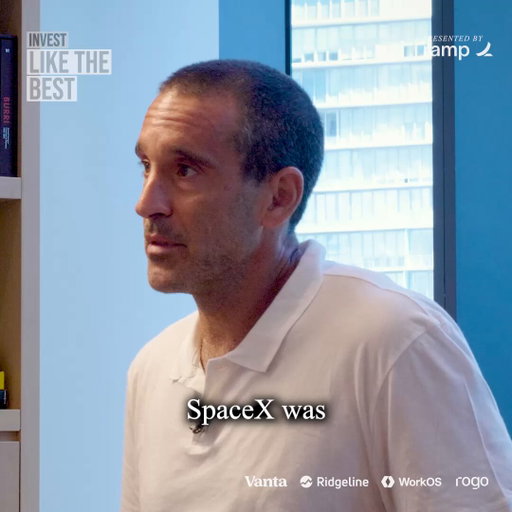
When we spoke with Dan Sundheim in February, here's  how he described the investment:

"SpaceX was pretty obvious to me that the launch business, at a minimum, was going to be a very good business.

What they had achieved, just from an engineering perspective, was insane.

If I could buy a company that had achieved the most amazing engineering feat I'd ever seen, at some multiple of revenue with very little cash burn at that point, I didn't know what was going to come, I just knew that the skew was very good.

The initial prognosis was just always that they were going to be a low cost provider of launch.

Starship is a game changer, which we knew about fairly early on, but didn't know if it would work.

And what that means, very simply, is that the cost of launching everything goes down dramatically, 97% or whatever.

And the engineering that they've done with the satellites to harness solar power and be able to deliver really high-speed bandwidth has surprised me to the upside.

And there's a lot of software that goes into that too, just given these networks of satellites are all communicating.

The ramification of that is that the telecom market globally is now the TAM.

They've come so far down the cost curve, I think that in a relatively short amount of time they're going to be dramatically cheaper than any other form of delivering broadband."
146K
333
2
35
5mo ago
InvestLikeBest
SpaceX reportedly accounts for ~45% of D1 Capital's venture and private equity book. At a $1.75T IPO valuation, that stake would be worth about $20B. When we spoke with Dan Sundheim in February, here's how he described the investment: "SpaceX was pretty obvious to me that the launch business, at a minimum, was going to be a very good business. What they had achieved, just from an engineering perspective, was insane. If I could buy a company that had achieved the most amazing engineering feat I'd ever seen, at some multiple of revenue with very little cash burn at that point, I didn't know what was going to come, I just knew that the skew was very good. The initial prognosis was just always that they were going to be a low cost provider of launch. Starship is a game changer, which we knew about fairly early on, but didn't know if it would work. And what that means, very simply, is that the cost of launching everything goes down dramatically, 97% or whatever. And the engineering that they've done with the satellites to harness solar power and be able to deliver really high-speed bandwidth has surprised me to the upside. And there's a lot of software that goes into that too, just given these networks of satellites are all communicating. The ramification of that is that the telecom market globally is now the TAM. They've come so far down the cost curve, I think that in a relatively short amount of time they're going to be dramatically cheaper than any other form of delivering broadband."
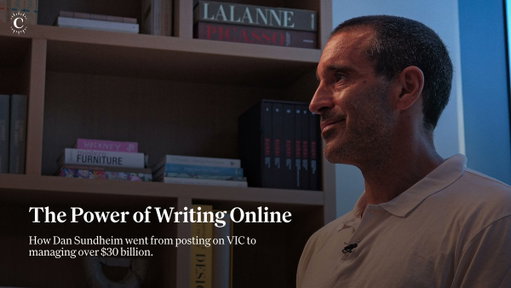
In 2002, Dan Sundheim was a young analyst at Bear Stearns when he discovered a website called Value Investors Club.

VIC was a community where professional investors posted investment ideas anonymously. But you have to submit a worthy idea just to get access.

His early writeups were on some of the most obscure stocks – a Canadian textbook publisher, an Indian state-owned bank, a cafeteria chain emerging from Chapter 11, a mortgage originator.

After six to twelve months of writing up ideas on VIC, Dan decided to go work at a hedge fund.

One of the funds he went to interview at was a healthcare-focused spinoff of SAC Capital. They gave him a case study to prepare before the follow-up interview. The company was called Orthodontic Centers of America.

Dan spent hours going through the financial filings, building a model, trying to make the numbers work. Nothing reconciled. He realized the company was capitalizing expenses that should have been expensed, in a significant way.

He could prove it was accounting fraud.

Before heading back for his follow-up interview, he decided to post the short thesis anonymously on VIC. Within hours, the stock started to move. By the next day it was down 30%.

He had told a few friends at hedge funds to look at the stock because he thought it was a fraud, and they should short it. Then mutual funds (Fidelity, T. Rowe Price) that owned the stock started calling him.

The stock went down 50%.

He walked into the interview and they just stared at him, “What did you do?”

He didn't end up taking that particular job and decided to join Viking Global instead. At Viking, he started as a banks analyst and deliberately pushed himself into every sector over the years – healthcare, industrials, TMT. If you love investing, he later said, it was an amazing place to be, because you got exposure to almost every industry.

By 2016, he was managing more than 55% of Viking's capital, an unusual concentration for a firm that is typically more diversified. But he recognized, almost regardless of how well he performed, the firm would naturally diversify over time. He had pretty much achieved what he could achieve there.

He was 40, which he acknowledged was relatively late to be starting a fund. But he still had the energy for it, so he left and started D1 Capital Partners.

D1 now manages over $30 billion. The public portfolio is full of esoteric international names most people wouldn't recognize while the private portfolio is composed of some of the most important and valuable companies like Ramp, SpaceX, OpenAI, and Anthropic.
142K
527
7
43
8mo ago
InvestLikeBest
In 2002, Dan Sundheim was a young analyst at Bear Stearns when he discovered a website called Value Investors Club. VIC was a community where professional investors posted investment ideas anonymously. But you have to submit a worthy idea just to get access. His early writeups were on some of the most obscure stocks – a Canadian textbook publisher, an Indian state-owned bank, a cafeteria chain emerging from Chapter 11, a mortgage originator. After six to twelve months of writing up ideas on VIC, Dan decided to go work at a hedge fund. One of the funds he went to interview at was a healthcare-focused spinoff of SAC Capital. They gave him a case study to prepare before the follow-up interview. The company was called Orthodontic Centers of America. Dan spent hours going through the financial filings, building a model, trying to make the numbers work. Nothing reconciled. He realized the company was capitalizing expenses that should have been expensed, in a significant way. He could prove it was accounting fraud. Before heading back for his follow-up interview, he decided to post the short thesis anonymously on VIC. Within hours, the stock started to move. By the next day it was down 30%. He had told a few friends at hedge funds to look at the stock because he thought it was a fraud, and they should short it. Then mutual funds (Fidelity, T. Rowe Price) that owned the stock started calling him. The stock went down 50%. He walked into the interview and they just stared at him, “What did you do?” He didn't end up taking that particular job and decided to join Viking Global instead. At Viking, he started as a banks analyst and deliberately pushed himself into every sector over the years – healthcare, industrials, TMT. If you love investing, he later said, it was an amazing place to be, because you got exposure to almost every industry. By 2016, he was managing more than 55% of Viking's capital, an unusual concentration for a firm that is typically more diversified. But he recognized, almost regardless of how well he performed, the firm would naturally diversify over time. He had pretty much achieved what he could achieve there. He was 40, which he acknowledged was relatively late to be starting a fund. But he still had the energy for it, so he left and started D1 Capital Partners. D1 now manages over $30 billion. The public portfolio is full of esoteric international names most people wouldn't recognize while the private portfolio is composed of some of the most important and valuable companies like Ramp, SpaceX, OpenAI, and Anthropic.
Dan asked OpenAI and Anthropic if they're designing their own ERP system and they said, "No, we're buying one." Quite telling.
119K
181
2
28
8mo ago
InvestLikeBest
Dan asked OpenAI and Anthropic if they're designing their own ERP system and they said, "No, we're buying one." Quite telling.
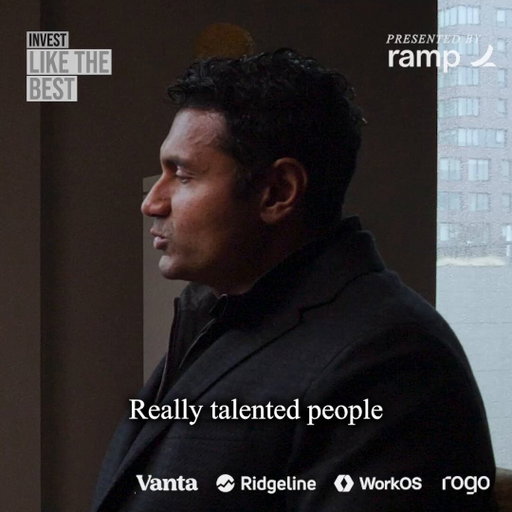
Palantir alumni have gone on to found an unusual number of successful companies, and the talent density inside the company remains incredibly high.

CTO @ssankar on how they think about talent:

"How did Bruce Banner become the Incredible Hulk? It wasn't progressive overload. It was a near fatal dose of gamma rays.

There's absolutely an element where we're taking people and just irradiating them. 

You're not sure if they're going to come out the other end.

A lot of environments don't have that by default.

Really talented people are highly uneven. 

Particularly for high achieving people when they're young, they misattribute what their superpower is. 

They think it's this thing they do that requires a fair amount of effort, and therefore they get a dopamine hit when they succeed.

Superpowers are effortless. 

This thing that's effortless for me, other people who are really smart can't seem to do. 

All of your contributions to the world are gonna come from your superpower. 

Everything else is basically a waste of time.

There are some weaknesses you have where you're six standard deviations below average. 

It's not something you can work on. 

The only strategy for Superman around kryptonite was to avoid it."
117K
417
12
38
3mo ago
InvestLikeBest
Palantir alumni have gone on to found an unusual number of successful companies, and the talent density inside the company remains incredibly high. CTO @ssankar on how they think about talent: "How did Bruce Banner become the Incredible Hulk? It wasn't progressive overload. It was a near fatal dose of gamma rays. There's absolutely an element where we're taking people and just irradiating them. You're not sure if they're going to come out the other end. A lot of environments don't have that by default. Really talented people are highly uneven. Particularly for high achieving people when they're young, they misattribute what their superpower is. They think it's this thing they do that requires a fair amount of effort, and therefore they get a dopamine hit when they succeed. Superpowers are effortless. This thing that's effortless for me, other people who are really smart can't seem to do. All of your contributions to the world are gonna come from your superpower. Everything else is basically a waste of time. There are some weaknesses you have where you're six standard deviations below average. It's not something you can work on. The only strategy for Superman around kryptonite was to avoid it."
Sam Altman (@sama) on the Hugging Face incident:    

"This is the first security incident that I have felt very viscerally. I've been a little surprised that more people don't feel it so viscerally.    

We paused training. We have to figure out how to secure our sandboxing in a world of multiple zero days being chained together.    

We may have to pace the rate of AI development to give ourselves enough time for society to harden around these new capability levels.    

And trying to figure out how we do that in a way that does not feel like regulatory capture for anyone and also does not feel like collusion among the frontier labs."  

(July 28, 2026)
109K
348
8
52
2mo ago
InvestLikeBest
Sam Altman (@sama) on the Hugging Face incident: "This is the first security incident that I have felt very viscerally. I've been a little surprised that more people don't feel it so viscerally. We paused training. We have to figure out how to secure our sandboxing in a world of multiple zero days being chained together. We may have to pace the rate of AI development to give ourselves enough time for society to harden around these new capability levels. And trying to figure out how we do that in a way that does not feel like regulatory capture for anyone and also does not feel like collusion among the frontier labs." (July 28, 2026)
SK Hynix recently reached a $1 trillion market cap. SanDisk started the year at $35B and is now worth $230B.

Dylan (@dylan522p) on why memory prices will still double or triple from here:

"People are like, the memory story is overplayed.

No, you don't get it. DRAM will double or triple from here still, because that's how much capacity is required.

Memory can only grow capacity low double digit percentages a year. 

20-30% a year, even less for NAND, a little bit higher for DRAM.  

Even though the demand signal was very strong at the end of 2025, the memory companies immediately started reacting.   

None of that incremental capacity really gets here until 2028, even if they wanted to build as fast as possible.  So the result is memory prices have gone through the roof.   

They're going to double and triple again. DRAM, especially.  

And they have to steal capacity from somewhere else. 

And the only way to steal capacity from somewhere else in a capitalist economy is demand destruction via higher pricing."

Publish date: April 23, 2026
106K
389
8
30
3mo ago
InvestLikeBest
SK Hynix recently reached a $1 trillion market cap. SanDisk started the year at $35B and is now worth $230B. Dylan (@dylan522p) on why memory prices will still double or triple from here: "People are like, the memory story is overplayed. No, you don't get it. DRAM will double or triple from here still, because that's how much capacity is required. Memory can only grow capacity low double digit percentages a year. 20-30% a year, even less for NAND, a little bit higher for DRAM. Even though the demand signal was very strong at the end of 2025, the memory companies immediately started reacting. None of that incremental capacity really gets here until 2028, even if they wanted to build as fast as possible. So the result is memory prices have gone through the roof. They're going to double and triple again. DRAM, especially. And they have to steal capacity from somewhere else. And the only way to steal capacity from somewhere else in a capitalist economy is demand destruction via higher pricing." Publish date: April 23, 2026
Gavin Baker (@GavinSBaker): "The most important thing in the next 3-4 years is data centers in space.  

In every way, data centers in space, from a first principles perspective, are superior to data centers on earth.  

In space, you can keep a satellite in the sun 24 hours a day. The sun is 30% more intense, which results in six times more irradiance than on Earth. So you don't need a battery.  

The cooling in these data centers is incredibly complicated. Space cooling is free. You just put a radiator on the dark side of the satellite.  

The only thing faster than a laser going through a fiber optic cable is a laser going through absolute vacuum. 

Link satellites with lasers, and you have a faster and more coherent network than any data center on Earth."

From our conversation in December 2025.
102K
529
11
40
5mo ago
InvestLikeBest
Gavin Baker (@GavinSBaker): "The most important thing in the next 3-4 years is data centers in space. In every way, data centers in space, from a first principles perspective, are superior to data centers on earth. In space, you can keep a satellite in the sun 24 hours a day. The sun is 30% more intense, which results in six times more irradiance than on Earth. So you don't need a battery. The cooling in these data centers is incredibly complicated. Space cooling is free. You just put a radiator on the dark side of the satellite. The only thing faster than a laser going through a fiber optic cable is a laser going through absolute vacuum. Link satellites with lasers, and you have a faster and more coherent network than any data center on Earth." From our conversation in December 2025.

Some of the best VCs ever came from non-traditional backgrounds: - Michael Moritz: journalist, history - Peter Thiel: lawyer, philosophy - Keith Rabois (@rabois) lawyer, political science - Chris Sacca (@sacca) lawyer - Ron Conway (@RonConway) sales - John Doerr: sales - Don Valentine: sales / marketing, chemistry
92.7K
200
8
20
1mo ago
InvestLikeBest
Some of the best VCs ever came from non-traditional backgrounds: - Michael Moritz: journalist, history - Peter Thiel: lawyer, philosophy - Keith Rabois (@rabois) lawyer, political science - Chris Sacca (@sacca) lawyer - Ron Conway (@RonConway) sales - John Doerr: sales - Don Valentine: sales / marketing, chemistry
@pmarca Full episode on Youtube: https://www.youtube.com/watch?v=vhTi_8QwXjg&amp
92.2K
12
2
2
5mo ago
InvestLikeBest
@pmarca Full episode on Youtube: https://www.youtube.com/watch?v=vhTi_8QwXjg&amp

Invest Like the Best (@investlikebest) X Stats & Analytics

Invest Like the Best (@investlikebest) has 40.3K X followers with a 0.37% engagement rate over the past 12 months. Across 1.07K posts, Invest Like the Best received 30.2K total likes and 8.40M impressions, averaging 28.1 likes per post. This page tracks Invest Like the Best's performance metrics, top content, and engagement trends — updated daily. To benchmark @investlikebest against other accounts, use Socialpruf's X competitor analysis tool.

Invest Like the Best (@investlikebest) X Analytics FAQ

How many X (Twitter) followers does Invest Like the Best have?+
Invest Like the Best (@investlikebest) has 40.3K X (Twitter) followers as of November 2026.
What is Invest Like the Best's X (Twitter) engagement rate?+
Invest Like the Best's X (Twitter) engagement rate is 0.37% over the last 12 months, based on 1.07K posts.
How many likes does Invest Like the Best get on X (Twitter)?+
Invest Like the Best received 30.2K total likes across 1.07K posts in the last 12 months, averaging 28.1 likes per post.
How many X (Twitter) impressions does Invest Like the Best get?+
Invest Like the Best's X (Twitter) content generated 8.40M total impressions over the last 12 months.
Can I compare Invest Like the Best with other X accounts?+
Yes. Add @investlikebest to a competitor set with Socialpruf's X competitor analysis tool and benchmark it side by side with any other public accounts on views, engagement rate and follower growth, with history back to each account's first post.