
NewGet @tharrowofapollo's full report
X analytics
Similar Accounts:
followers
2.76K
impressions
207K
likes
2.07K
comments
766
posts
212
engagement
1.37%
emv
$5.62K
Average per post
977

Key Metrics

Distributions

Top Content

RIP @RetentionAdam 

I’m heartbroken.

Top most influential friend I’ve had recently and an entrepreneur I aspired to be like in every way. 

Will keep living in a way to make you and your beautiful family’s memory proud. 

Great man.
43.3K
935
55
35
2d ago
THArrowOfApollo
RIP @RetentionAdam I’m heartbroken. Top most influential friend I’ve had recently and an entrepreneur I aspired to be like in every way. Will keep living in a way to make you and your beautiful family’s memory proud. Great man.

Clay’s new pricing is probably my fault. We were paying $314 a month, but using (based on their new model) $214,087.50 worth of Clay a WEEK. Here’s the story: A year ago Clay's head of product hopped on a call with me. I told him we were hitting their platform 17.3 million times per week. Almost all custom events (i.e. HTTPs) I remember his response being something close to "Holy shit, I think you are the largest user of Clay" I said yeah that doesn't surprise me. But then it also came up that we were only paying $3,769 a year. We talked about HTTPs, custom integrations, how we were basically using Clay as a giant API orchestration layer. I knew his wheels were turning. If you saw my last post, you know we eventually replaced Clay entirely with a $200/mo Claude Code subscription. 272,000 leads per second vs Clay's 27 hours for the same volume. But before we left, we were the perfect case study for why Clay's old pricing was broken. $314/mo for 17.3 million weekly, for what they now call ‘actions’. Run the math. We were paying $0.00001815 per action. Clay announced their new pricing structure. They split everything into Data Credits and ‘Actions.’ Actions are HTTPs, custom integrations, API calls. The exact things we were doing 17.3 million times a week. The new price per action credit works out to about 1.24 cents each. A 681% price increase for us I know you might say, "But Clay is letting people stay on the old pricing if they want," and I hear you but I also don't know how it makes me feel that someone brand new would have to pay $856,350 per month to get the same advantages I had when I was starting out only 3 years ago. I'm not saying that one call caused the entire restructuring. But I am saying their head of product learned that day that someone was running 17 million HTTPs a week for the price of a nice dinner. And now every HTTP costs 1.24 cents. anyways For the last year, we've been trying to figure out how to get off of our dependency on Clay. That was until Cursor / Claude Code / Codex came out My VP of Growth, @James, who doesnt know how to write a single line of code, touched Claude Code for the first time And three weeks later he replaced Clay for us We could process 272k rows per second now for the cost of a Claude Code sub My last post was about that system Then after that post, Clay announces new pricing that specifically monetizes the exact thing we were doing at a massive scale. Coincidence? Maybe. But I may owe everyone using Clay an apology If your Clay bill just went up, you can probably blame me for that one. Sorry! I put together a system blueprint of what I did to replace Clay for myself -- every tool, the tech stack, a Clay vs custom comparison, and a 6-step playbook for building your own. Plus a video walkthrough where I show you the live system and how each tool actually works. Reply CODE below and I'll DM it to you.

33.8K
189
291
4
7mo ago
THArrowOfApollo
Clay’s new pricing is probably my fault. We were paying $314 a month, but using (based on their new model) $214,087.50 worth of Clay a WEEK. Here’s the story: A year ago Clay's head of product hopped on a call with me. I told him we were hitting their platform 17.3 million times per week. Almost all custom events (i.e. HTTPs) I remember his response being something close to "Holy shit, I think you are the largest user of Clay" I said yeah that doesn't surprise me. But then it also came up that we were only paying $3,769 a year. We talked about HTTPs, custom integrations, how we were basically using Clay as a giant API orchestration layer. I knew his wheels were turning. If you saw my last post, you know we eventually replaced Clay entirely with a $200/mo Claude Code subscription. 272,000 leads per second vs Clay's 27 hours for the same volume. But before we left, we were the perfect case study for why Clay's old pricing was broken. $314/mo for 17.3 million weekly, for what they now call ‘actions’. Run the math. We were paying $0.00001815 per action. Clay announced their new pricing structure. They split everything into Data Credits and ‘Actions.’ Actions are HTTPs, custom integrations, API calls. The exact things we were doing 17.3 million times a week. The new price per action credit works out to about 1.24 cents each. A 681% price increase for us I know you might say, "But Clay is letting people stay on the old pricing if they want," and I hear you but I also don't know how it makes me feel that someone brand new would have to pay $856,350 per month to get the same advantages I had when I was starting out only 3 years ago. I'm not saying that one call caused the entire restructuring. But I am saying their head of product learned that day that someone was running 17 million HTTPs a week for the price of a nice dinner. And now every HTTP costs 1.24 cents. anyways For the last year, we've been trying to figure out how to get off of our dependency on Clay. That was until Cursor / Claude Code / Codex came out My VP of Growth, @James, who doesnt know how to write a single line of code, touched Claude Code for the first time And three weeks later he replaced Clay for us We could process 272k rows per second now for the cost of a Claude Code sub My last post was about that system Then after that post, Clay announces new pricing that specifically monetizes the exact thing we were doing at a massive scale. Coincidence? Maybe. But I may owe everyone using Clay an apology If your Clay bill just went up, you can probably blame me for that one. Sorry! I put together a system blueprint of what I did to replace Clay for myself -- every tool, the tech stack, a Clay vs custom comparison, and a 6-step playbook for building your own. Plus a video walkthrough where I show you the live system and how each tool actually works. Reply CODE below and I'll DM it to you.

Clay is charging $0.0124 PER API call now?? Did I read that right? WHOA

7.94K
20
13
0
7mo ago
THArrowOfApollo
Clay is charging $0.0124 PER API call now?? Did I read that right? WHOA

I just got to visit with an infra provider who sends 1 TRILLION emails / week. They told me exactly why I was spending $50k on Instantly / mn which would burn two days later. Here’s what I learned: For context, we now have a private infrastructure provider called Halo. We switched to them after burning through 100’s of 1000’s of dollars on Google and Azure email accounts. It was the same playbook you're probably running right now of "X domains, 3-5 email accounts per domain 10-25 emails per account" Halo is built by a billion dollar B2C email company that you absolutely know the name of, and for the last 2 months we’ve been the only ones allowed to send cold emails on their sending rail. Since they send a TRILLION+ of emails a week, they’re in weekly conversations with Google and Outlook. Hence they have a wild amount of data. I had a deep dive sesh on exactly what we needed to do to get results for our clients. I shouldn’t even be giving this information away since half my followers are competitors. The basic answer was: Google and Outlook know EXACTLY what the cold email community is doing. Think of everything you've been taught that is supposed to help deliverability: The templates sent across hundreds of accounts spread between lookalike domains. The spintax. The AI-written personalization. The warmup networks where a bunch of inboxes suddenly start talking to each other in ways normal employees never would. The A/B tests where you create 1,000 slightly different ways to say the same thing. All the stuff I used to do. All you're doing is training the AIs reading the inbox on the infinite permutations of how you make your offer Halo basically told me that the current cold email deliverability meta is completely BACKWARDS. Everybody is trying to make a cold email look like a normal employee email but Google is not dumb. There’s a CTA in your damn cold email bro. It’s obvious. So now we’re changing how we send. No AI personalization. (which I have known is BS for a year now) No spintax. No warmup. (which I have known is BS for 3 years now) No reply based CTAs (reply X and I’ll get you Y) Y’all are trying to look like the wrong type of email. What is a type of email that can have CTAs all day long? Marketing emails Only basic merge fields, full HTML with images and links to book a call or go to the client's website. For proof, every client we moved from Instantly to Halo had a minimum 30% uplift in sign-ups, meetings booked, and paying customers, and the best client had a 5.1x multiplier. And if your entire strategy is still “buy more inboxes, warm them up, add spintax, use AI personalization, and make it look like a rep wrote it”... I've got bad news for you. We've stopped trying to look like a regular employee email. The game is changing. Like every other trend in the cold email world that hit me 6 to 12 months before it hit everybody else, this one's coming for you too.
6.15K
70
15
2
2w ago
THArrowOfApollo
I just got to visit with an infra provider who sends 1 TRILLION emails / week. They told me exactly why I was spending $50k on Instantly / mn which would burn two days later. Here’s what I learned: For context, we now have a private infrastructure provider called Halo. We switched to them after burning through 100’s of 1000’s of dollars on Google and Azure email accounts. It was the same playbook you're probably running right now of "X domains, 3-5 email accounts per domain 10-25 emails per account" Halo is built by a billion dollar B2C email company that you absolutely know the name of, and for the last 2 months we’ve been the only ones allowed to send cold emails on their sending rail. Since they send a TRILLION+ of emails a week, they’re in weekly conversations with Google and Outlook. Hence they have a wild amount of data. I had a deep dive sesh on exactly what we needed to do to get results for our clients. I shouldn’t even be giving this information away since half my followers are competitors. The basic answer was: Google and Outlook know EXACTLY what the cold email community is doing. Think of everything you've been taught that is supposed to help deliverability: The templates sent across hundreds of accounts spread between lookalike domains. The spintax. The AI-written personalization. The warmup networks where a bunch of inboxes suddenly start talking to each other in ways normal employees never would. The A/B tests where you create 1,000 slightly different ways to say the same thing. All the stuff I used to do. All you're doing is training the AIs reading the inbox on the infinite permutations of how you make your offer Halo basically told me that the current cold email deliverability meta is completely BACKWARDS. Everybody is trying to make a cold email look like a normal employee email but Google is not dumb. There’s a CTA in your damn cold email bro. It’s obvious. So now we’re changing how we send. No AI personalization. (which I have known is BS for a year now) No spintax. No warmup. (which I have known is BS for 3 years now) No reply based CTAs (reply X and I’ll get you Y) Y’all are trying to look like the wrong type of email. What is a type of email that can have CTAs all day long? Marketing emails Only basic merge fields, full HTML with images and links to book a call or go to the client's website. For proof, every client we moved from Instantly to Halo had a minimum 30% uplift in sign-ups, meetings booked, and paying customers, and the best client had a 5.1x multiplier. And if your entire strategy is still “buy more inboxes, warm them up, add spintax, use AI personalization, and make it look like a rep wrote it”... I've got bad news for you. We've stopped trying to look like a regular employee email. The game is changing. Like every other trend in the cold email world that hit me 6 to 12 months before it hit everybody else, this one's coming for you too.
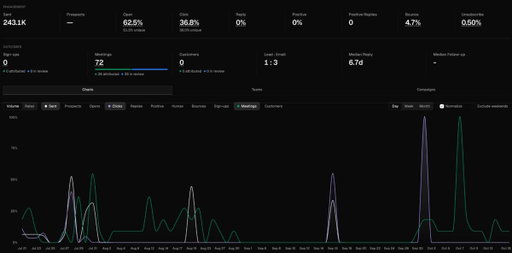
Right now we're booking 25 meetings / mo for WealthReach with ZERO positive replies to our cold emails.

You read that right.

72 meetings in 90 days with zero positive responses. How’s that possible?

Every week I talk to a cold email agency who says their clients are churning because they can't book meetings from the positive responses they get.

We used to have the same problem.

Clients would get HUNDREDS of positive replies that they couldn't respond to fast enough or weren't good at convincing the lead to hop on a call.

Then they'd churn despite an otherwise great campaign.

Since migrating all of our accounts to our private email infrastructure, Halo, we've completely changed what we optimize for.

We don't need to pretend a fake SDR is manually sending 25 emails per day anymore.

We can send 15,000 emails, sometimes 1M, on a single weekday from one domain and one email account. They all go out within minutes of each other.

It’s like how you’d send through Beehiiv or Mailchimp than how cold email agencies have been preaching for the last few years.

People hate when I say this but think about what the filters are actually looking for.

The old cold email meta is thousands of inboxes, lookalike domains, spintax, AI personalization, warmup networks, and a bunch of slightly different emails pretending they came from different employees.

Google and Outlook can see ALL of it. They're not dumb.

It’s much easier to track than a normal-looking marketing email with basic merge fields, HTML, images, links, and a clear CTA.

So we launched WealthReach with no warmup emails.

Each lead only gets one email a month from us, something we had already been doing for years anyway.

The email has images, links to the website, and a button to book a call directly on the calendar.

Why would someone reply, wait for you to respond, go back and forth to find time, then maybe book a call?

They can just book it.

And even with the ability to still send emails the old way, we know this works better because the HTML versions are getting 30% more meetings booked than the plain-text version we were using to optimize for replies.

No spintax and definitely no AI personalization (that one hasn't worked for years)

In the last 90 days, we've sent about 250,000 emails for Wealthreach, with 51% opens and 36% clicks, 

They booked 72 meetings.

More than half of those meetings came in weeks three and four, after the email had been sitting in someone’s inbox for that time.

Reply rate is becoming a vanity metric.

I care more about how many emails it takes to get an actual meeting.

-

PS, see the exact strategy we're using on them here: https://www.salesautomation.systems/docs/private-ad-network-playbook
5.95K
43
15
3
2w ago
THArrowOfApollo
Right now we're booking 25 meetings / mo for WealthReach with ZERO positive replies to our cold emails. You read that right. 72 meetings in 90 days with zero positive responses. How’s that possible? Every week I talk to a cold email agency who says their clients are churning because they can't book meetings from the positive responses they get. We used to have the same problem. Clients would get HUNDREDS of positive replies that they couldn't respond to fast enough or weren't good at convincing the lead to hop on a call. Then they'd churn despite an otherwise great campaign. Since migrating all of our accounts to our private email infrastructure, Halo, we've completely changed what we optimize for. We don't need to pretend a fake SDR is manually sending 25 emails per day anymore. We can send 15,000 emails, sometimes 1M, on a single weekday from one domain and one email account. They all go out within minutes of each other. It’s like how you’d send through Beehiiv or Mailchimp than how cold email agencies have been preaching for the last few years. People hate when I say this but think about what the filters are actually looking for. The old cold email meta is thousands of inboxes, lookalike domains, spintax, AI personalization, warmup networks, and a bunch of slightly different emails pretending they came from different employees. Google and Outlook can see ALL of it. They're not dumb. It’s much easier to track than a normal-looking marketing email with basic merge fields, HTML, images, links, and a clear CTA. So we launched WealthReach with no warmup emails. Each lead only gets one email a month from us, something we had already been doing for years anyway. The email has images, links to the website, and a button to book a call directly on the calendar. Why would someone reply, wait for you to respond, go back and forth to find time, then maybe book a call? They can just book it. And even with the ability to still send emails the old way, we know this works better because the HTML versions are getting 30% more meetings booked than the plain-text version we were using to optimize for replies. No spintax and definitely no AI personalization (that one hasn't worked for years) In the last 90 days, we've sent about 250,000 emails for Wealthreach, with 51% opens and 36% clicks, They booked 72 meetings. More than half of those meetings came in weeks three and four, after the email had been sitting in someone’s inbox for that time. Reply rate is becoming a vanity metric. I care more about how many emails it takes to get an actual meeting. - PS, see the exact strategy we're using on them here: https://www.salesautomation.systems/docs/private-ad-network-playbook

Google/Outlook AI spam filters are here. I've had to hire a full-time human copywriter and now send all our cold emails one day per week. I know I’ve said versions of this before. I’m saying it again because I don’t think people understand how bad the old cold email playbook is about to get. For the last few years, we all tried to make cold email look like it came from a normal employee. 3-5 inboxes per domain. 10-25 emails per inbox. Lookalike domains. Spintax. AI personalization. Warmup networks. Hundreds of almost-identical messages spread across thousands of accounts. Then we lost 31,000 inboxes in a single day. After that, our infrastructure started burning faster and faster. First it lasted a month. Then three weeks. Then two. Then one. Our infrastructure cost went up 13x because we were replacing it every week. We were burning through hundreds of thousands of dollars in Google and Azure accounts. At one point I was spending $50k/month on Instantly infrastructure that would burn within two days of sending emails. Google and Outlook knew EXACTLY what we were doing. A cold email with a CTA is obviously not a normal employee email. The more aggressively you try to disguise it, the more data you give the filters on what cold email looks like. AI-written copy is becoming another signal. New models like Opus, Fable and Sol are now watermarked, by EU law, in ways Google/Outlook can track. So I hired a human copywriter. It sucks because AI was able to write HUNDREDS of variations of copy the second we onboarded a client. Now since we're only sending one email a week, a human who can get us 80% to message-market-fit without being detected is invaluable. We're already seeing it work at insane scale. For one of our clients, the HTML version is getting 30% more meetings than the plain-text version we used when optimizing for replies. They booked 92 meetings from roughly 293,000 emails in 90 days, with zero positive replies. Maybe I’ll be proven wrong about the watermark stuff. I don’t think I’ll be proven wrong about this: The agencies that keep buying more inboxes, adding more spintax, and trying harder to look human are playing a game Google and Outlook already understand.

4.24K
40
11
4
4d ago
THArrowOfApollo
Google/Outlook AI spam filters are here. I've had to hire a full-time human copywriter and now send all our cold emails one day per week. I know I’ve said versions of this before. I’m saying it again because I don’t think people understand how bad the old cold email playbook is about to get. For the last few years, we all tried to make cold email look like it came from a normal employee. 3-5 inboxes per domain. 10-25 emails per inbox. Lookalike domains. Spintax. AI personalization. Warmup networks. Hundreds of almost-identical messages spread across thousands of accounts. Then we lost 31,000 inboxes in a single day. After that, our infrastructure started burning faster and faster. First it lasted a month. Then three weeks. Then two. Then one. Our infrastructure cost went up 13x because we were replacing it every week. We were burning through hundreds of thousands of dollars in Google and Azure accounts. At one point I was spending $50k/month on Instantly infrastructure that would burn within two days of sending emails. Google and Outlook knew EXACTLY what we were doing. A cold email with a CTA is obviously not a normal employee email. The more aggressively you try to disguise it, the more data you give the filters on what cold email looks like. AI-written copy is becoming another signal. New models like Opus, Fable and Sol are now watermarked, by EU law, in ways Google/Outlook can track. So I hired a human copywriter. It sucks because AI was able to write HUNDREDS of variations of copy the second we onboarded a client. Now since we're only sending one email a week, a human who can get us 80% to message-market-fit without being detected is invaluable. We're already seeing it work at insane scale. For one of our clients, the HTML version is getting 30% more meetings than the plain-text version we used when optimizing for replies. They booked 92 meetings from roughly 293,000 emails in 90 days, with zero positive replies. Maybe I’ll be proven wrong about the watermark stuff. I don’t think I’ll be proven wrong about this: The agencies that keep buying more inboxes, adding more spintax, and trying harder to look human are playing a game Google and Outlook already understand.

DOPE. Like I said above, fucking love Clay and everything you guys have been doing. I know you're cooking on some cool shit that's just around the corner. I still think 99% of everybody reading this post should be using you guys but we gotta move fast because we do some big shit for our clients lol.

4.23K
5
3
0
8mo ago
THArrowOfApollo
DOPE. Like I said above, fucking love Clay and everything you guys have been doing. I know you're cooking on some cool shit that's just around the corner. I still think 99% of everybody reading this post should be using you guys but we gotta move fast because we do some big shit for our clients lol.

I’ve noticed cold email gets wayy easier when you stop treating it like a sales sequence. So many people send 3-4 sequences to a few thousand carefully crafted 14 waterfall high intent list. Worst advice ever. Treat it like a private ad channel. 1 email = 1 creative 1 segment = 1 audience The metric = emails needed to get a signup, meeting, or customer For Fyxer, we found that every positive reply was associated with 2.11 signups on average because a bunch of people would see the email, research it themselves, and sign up without replying.
4.10K
47
3
3
2w ago
THArrowOfApollo
I’ve noticed cold email gets wayy easier when you stop treating it like a sales sequence. So many people send 3-4 sequences to a few thousand carefully crafted 14 waterfall high intent list. Worst advice ever. Treat it like a private ad channel. 1 email = 1 creative 1 segment = 1 audience The metric = emails needed to get a signup, meeting, or customer For Fyxer, we found that every positive reply was associated with 2.11 signups on average because a bunch of people would see the email, research it themselves, and sign up without replying.
One of our clients started cold calling people who simply clicked our cold emails. That means they’re booking calls with people who DIDN’T EVEN RESPOND.

I see this as proof of one of the biggest shifts we’re all about to deal with in the cold email game.

It’s no longer a direct sales channel.

Cold email has gotten so commoditized to the point where anyone can have Claude spin up a campaign in minutes and begin sending thousands of emails a day.

Nobody is fooled AT ALL into thinking it’s a real salesperson behind the email.

Problem is, most people are still judging cold email by one thing:

"Did they reply?"

That's missing a massive part of what’s actually happening throughout the 12M+ cold emails we send every month.

For Fyxer, every positive reply led to 2.11 signups.

That means a huge number of people were reading the email, checking out the site, and signing up without ever replying to us.

A click is a website visit.

It’s somebody who saw the offer and decided it was worth checking out.

So now we track every person who clicks an email and send that data to the client in real time.

They get the name and company behind the click, and the event can be pushed into their CRM.

Then they can actually do something with it.

One client took that click data and used it in their ad targeting.

Their CPL dropped 50%.

Another client took roughly their top 200 clickers each day, enriched them, found mobile numbers, and gave them to their cold-call team.

Those calls had a 20% connect rate.

Normal cold calling at 5% is already pretty dope. 20% is ridiculous.

Cold email used to live and die inside an inbox, but ever since we've started using Halo we've unlocked something unreal.

When I say this is the future of cold email, I really mean it.

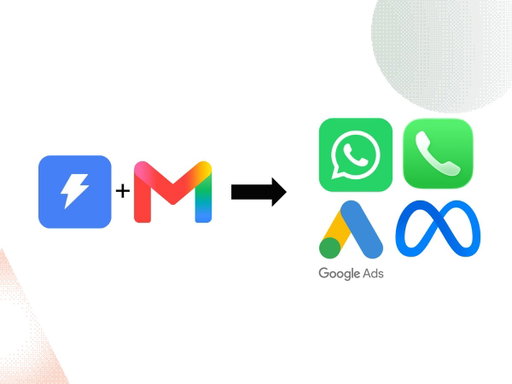
One click is now able to feed ads, sales calls, CRM workflows, ABM, and follow-up.

You can think of it working the same way Meta or Google Ads works, but you have WAY more data on who is actually behind the results.

Instead of 10,000 anonymous people who clicked your ad, you have 10,000 emails, phone numbers, names, and faces to call, follow up with, DM, whatever your sales people are already doing.

Or in most cases for our clients, the prospect will open the email, browse the website, and book a call without ever having to respond or have someone follow up.
3.73K
47
27
4
1w ago
THArrowOfApollo
One of our clients started cold calling people who simply clicked our cold emails. That means they’re booking calls with people who DIDN’T EVEN RESPOND. I see this as proof of one of the biggest shifts we’re all about to deal with in the cold email game. It’s no longer a direct sales channel. Cold email has gotten so commoditized to the point where anyone can have Claude spin up a campaign in minutes and begin sending thousands of emails a day. Nobody is fooled AT ALL into thinking it’s a real salesperson behind the email. Problem is, most people are still judging cold email by one thing: "Did they reply?" That's missing a massive part of what’s actually happening throughout the 12M+ cold emails we send every month. For Fyxer, every positive reply led to 2.11 signups. That means a huge number of people were reading the email, checking out the site, and signing up without ever replying to us. A click is a website visit. It’s somebody who saw the offer and decided it was worth checking out. So now we track every person who clicks an email and send that data to the client in real time. They get the name and company behind the click, and the event can be pushed into their CRM. Then they can actually do something with it. One client took that click data and used it in their ad targeting. Their CPL dropped 50%. Another client took roughly their top 200 clickers each day, enriched them, found mobile numbers, and gave them to their cold-call team. Those calls had a 20% connect rate. Normal cold calling at 5% is already pretty dope. 20% is ridiculous. Cold email used to live and die inside an inbox, but ever since we've started using Halo we've unlocked something unreal. When I say this is the future of cold email, I really mean it. One click is now able to feed ads, sales calls, CRM workflows, ABM, and follow-up. You can think of it working the same way Meta or Google Ads works, but you have WAY more data on who is actually behind the results. Instead of 10,000 anonymous people who clicked your ad, you have 10,000 emails, phone numbers, names, and faces to call, follow up with, DM, whatever your sales people are already doing. Or in most cases for our clients, the prospect will open the email, browse the website, and book a call without ever having to respond or have someone follow up.

@Rpaulindaigle I send about 15 “looms” a day. cap.so/ is by far the best thing out there.
3.08K
45
1
0
1w ago
THArrowOfApollo
@Rpaulindaigle I send about 15 “looms” a day. https://cap.so/ is by far the best thing out there.
Every week I talk to people who think it's cheaper to run cold email themselves. It's not, and here's what I end up showing them.

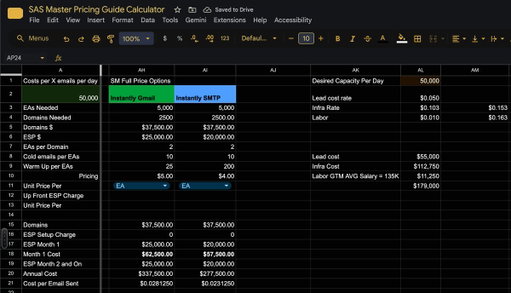
I pull up a stupid simple spreadsheet.

Because people look at 10 cents per email and go, “Wait, why would I pay that? I can buy some inboxes and use Instantly + Apollo.”

Sure. You can.

But if you actually want to run cold email properly, the math doesn’t math pretty fast.

First you need sending infrastructure.

You need Gmail inboxes. Outlook inboxes. SMTP providers. Domains.

I can't even put a price on the fact that nobody besides us has access to Halo, our own infrastructure that lets us send images, links, and track opens + clicks.

Not to mention you can’t buy one batch of domains, set it up once, and pretend that’s your permanent infrastructure.

Your domains burn.

So you have to rotate them and if you want something that will last longer than a month, then you need 4 sets.

Get them directly from Instantly, and you're at 10 cents per email account.

Next, your lead data is probably around 5 cents per lead, especially if you are waterfall enriching it via 13+ providers like we do.

Depends how you're waterfalling it, how much enrichment you're doing, how clean you need it, etc.

That gets us to roughly 15.3 cents per email sent.

And that still doesn't include labor.

So now you need somebody internally managing the data, the sending, the inboxes, the infrastructure, campaign setup, copy, fixing problems when something breaks, all of it.

Put somebody on that for $11k/month (avg GTM salary) and you're around 16.3 cents per email.

So if you're sending 1 million emails a month, you're probably looking at something like $179K/month before you even get into the fact that you might not know what message works yet.

Then factor in your time as a founder trying to figure all of this out, learning from rock bottom, and put a number on that.

Most people want to go straight to scale before proving message market fit.

It's totally backwards

If you want to contact your whole market, cool. But you should first spend a smaller amount testing different offers, audiences, hooks, CTAs, and copy until you actually know what works.

Then you scale it.

Same way you would with ads.

You don't wake up and spend $70k on ads before you've figured out whether the ad converts.

All to say, we're having a big pricing change:

we're moving to 10 cents per email. Minimum to start is 60k emails per month -> $6k per month

That includes us building the lists, the sending infrastructure, the copy, the testing, and the team who has already broken this stuff and proved it among hundreds of clients.

I don't think DIY cold email is cheaper.

I think people are usually comparing our full cost to the price of a few inboxes, then forgetting literally everything else.
2.90K
19
13
1
1w ago
THArrowOfApollo
Every week I talk to people who think it's cheaper to run cold email themselves. It's not, and here's what I end up showing them. I pull up a stupid simple spreadsheet. Because people look at 10 cents per email and go, “Wait, why would I pay that? I can buy some inboxes and use Instantly + Apollo.” Sure. You can. But if you actually want to run cold email properly, the math doesn’t math pretty fast. First you need sending infrastructure. You need Gmail inboxes. Outlook inboxes. SMTP providers. Domains. I can't even put a price on the fact that nobody besides us has access to Halo, our own infrastructure that lets us send images, links, and track opens + clicks. Not to mention you can’t buy one batch of domains, set it up once, and pretend that’s your permanent infrastructure. Your domains burn. So you have to rotate them and if you want something that will last longer than a month, then you need 4 sets. Get them directly from Instantly, and you're at 10 cents per email account. Next, your lead data is probably around 5 cents per lead, especially if you are waterfall enriching it via 13+ providers like we do. Depends how you're waterfalling it, how much enrichment you're doing, how clean you need it, etc. That gets us to roughly 15.3 cents per email sent. And that still doesn't include labor. So now you need somebody internally managing the data, the sending, the inboxes, the infrastructure, campaign setup, copy, fixing problems when something breaks, all of it. Put somebody on that for $11k/month (avg GTM salary) and you're around 16.3 cents per email. So if you're sending 1 million emails a month, you're probably looking at something like $179K/month before you even get into the fact that you might not know what message works yet. Then factor in your time as a founder trying to figure all of this out, learning from rock bottom, and put a number on that. Most people want to go straight to scale before proving message market fit. It's totally backwards If you want to contact your whole market, cool. But you should first spend a smaller amount testing different offers, audiences, hooks, CTAs, and copy until you actually know what works. Then you scale it. Same way you would with ads. You don't wake up and spend $70k on ads before you've figured out whether the ad converts. All to say, we're having a big pricing change: we're moving to 10 cents per email. Minimum to start is 60k emails per month -> $6k per month That includes us building the lists, the sending infrastructure, the copy, the testing, and the team who has already broken this stuff and proved it among hundreds of clients. I don't think DIY cold email is cheaper. I think people are usually comparing our full cost to the price of a few inboxes, then forgetting literally everything else.

Looking for a copywriter for our cold emails. Nothing can be written by Ai. DM me if you know somebody They need to be better at copy then I am

2.56K
21
17
1
1mo ago
THArrowOfApollo
Looking for a copywriter for our cold emails. Nothing can be written by Ai. DM me if you know somebody They need to be better at copy then I am

Everyone will hate AI-generated video until it gives us a proper GOT season 8 based on the books. Pending if GRRM actually finishes the books

2.49K
5
1
0
8mo ago
THArrowOfApollo
Everyone will hate AI-generated video until it gives us a proper GOT season 8 based on the books. Pending if GRRM actually finishes the books

I’m honored by how many people’s first thoughts were “is this a marketing stunt?” The hook would have made Adam so proud.
2.39K
16
0
0
2d ago
THArrowOfApollo
I’m honored by how many people’s first thoughts were “is this a marketing stunt?” The hook would have made Adam so proud.
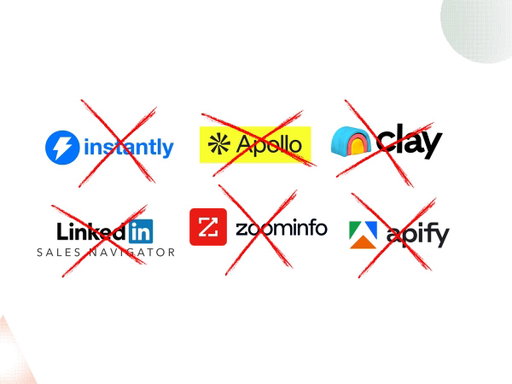
We made our clients $10M+ from cold email last year and have since dropped 99% of the tools most teams still use today. No Apollo. No Instantly. No Clay.

Most teams are still buying leads from the same database, warming inboxes for 3 weeks, paying for AI personalization, then praying they don’t run out of prospects before the campaign works.

It’s expensive.

It’s slow.

And it’s why so many teams never get past sending emails to actually booking calls and closing customers.

So we've stopped building campaigns around inboxes.

We built a stack around 2 things:

1. Finding fresh leads nobody else has.

2. Getting campaigns live fast enough to test offers before your market gets burned out.

We replaced a Clay workflow that took 27 hours to process 1M leads with a system that does it in 20 minutes.

It waterfalls across the best providers, finds missing contacts with AI, and refills campaigns automatically before clients run out of leads.

That’s why we can launch a campaign in 24 hours without sitting around for a 3-week warmup period.

And why we can keep feeding 10,000+ emails per day into a campaign without hitting a wall.

The results have been insane.

For Fyxer, we sent 2.2M emails and signed up 2,228 users in 90 days before they raised a $10M Series A.

That machine eventually reached 4,275 signups per month and $4.3M in modeled annual pipeline.

For RB2B, cold email drove 42% of revenue.

I put together the full tech stack behind this.

Inside, I included:

- How we save thousands by replacing expensive Apollo, ZoomInfo, Clay, and enrichment workflows

- How to launch a cold email campaign in 24 hours without a 3-week warmup period

- The lead system that finds fresh contacts and keeps campaigns full at scale

- The process for sending 10,000+ emails per day without running out of leads

- The offers we use for high-ticket services, low-ticket SaaS, and PLG products

- How we track campaigns through signups, meetings, customers, and revenue instead of obsessing over reply rates

The exact same stack we use for 100+ clients so you can copy it yourself and begin seeing results with cold email.

Link below
2.33K
12
8
0
6d ago
THArrowOfApollo
We made our clients $10M+ from cold email last year and have since dropped 99% of the tools most teams still use today. No Apollo. No Instantly. No Clay. Most teams are still buying leads from the same database, warming inboxes for 3 weeks, paying for AI personalization, then praying they don’t run out of prospects before the campaign works. It’s expensive. It’s slow. And it’s why so many teams never get past sending emails to actually booking calls and closing customers. So we've stopped building campaigns around inboxes. We built a stack around 2 things: 1. Finding fresh leads nobody else has. 2. Getting campaigns live fast enough to test offers before your market gets burned out. We replaced a Clay workflow that took 27 hours to process 1M leads with a system that does it in 20 minutes. It waterfalls across the best providers, finds missing contacts with AI, and refills campaigns automatically before clients run out of leads. That’s why we can launch a campaign in 24 hours without sitting around for a 3-week warmup period. And why we can keep feeding 10,000+ emails per day into a campaign without hitting a wall. The results have been insane. For Fyxer, we sent 2.2M emails and signed up 2,228 users in 90 days before they raised a $10M Series A. That machine eventually reached 4,275 signups per month and $4.3M in modeled annual pipeline. For RB2B, cold email drove 42% of revenue. I put together the full tech stack behind this. Inside, I included: - How we save thousands by replacing expensive Apollo, ZoomInfo, Clay, and enrichment workflows - How to launch a cold email campaign in 24 hours without a 3-week warmup period - The lead system that finds fresh contacts and keeps campaigns full at scale - The process for sending 10,000+ emails per day without running out of leads - The offers we use for high-ticket services, low-ticket SaaS, and PLG products - How we track campaigns through signups, meetings, customers, and revenue instead of obsessing over reply rates The exact same stack we use for 100+ clients so you can copy it yourself and begin seeing results with cold email. Link below

People are telling me my last post made Clay change their pricing? Is that right?

2.14K
4
5
0
7mo ago
THArrowOfApollo
People are telling me my last post made Clay change their pricing? Is that right?

So everybody in cold email is just copying my “Hit your TAM every 30-60 days” huh? Dope. Always a good sign when everybody starts copying you.

2.10K
40
10
0
1mo ago
THArrowOfApollo
So everybody in cold email is just copying my “Hit your TAM every 30-60 days” huh? Dope. Always a good sign when everybody starts copying you.

@myuan95 Wtf are you talking about? You don’t know how to hit Google Maps? It’s a pretty straightforward api lol

1.90K
3
1
0
8mo ago
THArrowOfApollo
@myuan95 Wtf are you talking about? You don’t know how to hit Google Maps? It’s a pretty straightforward api lol

My rule of thumb is 100,000 emails before making a serious call on whether cold email works. You need real infrastructure, enough volume, multiple variants, and someone willing to say the offer isn't landing. I see far to many people claiming it's a dead channel after hand-picking a list of people they think would be good fits and saying "can I send a loom/audit your current system" Not going to work

1.80K
24
10
2
2w ago
THArrowOfApollo
My rule of thumb is 100,000 emails before making a serious call on whether cold email works. You need real infrastructure, enough volume, multiple variants, and someone willing to say the offer isn't landing. I see far to many people claiming it's a dead channel after hand-picking a list of people they think would be good fits and saying "can I send a loom/audit your current system" Not going to work

Adam Robinson's RB2B is doing $9M/year. 42% of that revenue comes from cold email campaigns we've been running for 2.5 years. He's launching MoltSets next. We're running the cold email again. Here's EXACTLY what our plan is. Steal it. 1st, what is MoltSets. $500/month for unlimited B2B data. Hook it up to Claude Code, Codex, whatever AI agent you're running. Five thousand hits a minute. No caps. The kind of data infrastructure that used to take a full data engineering team. Now one person with an AI agent and a $500 subscription does the same thing. IT'S DOPE. 2nd, why this time is completely different. Cold email is not what it was 9 months ago. Smartlead. Instantly. EmailBison. Great tools for most people. but they basically stopped working for us. So We went and got access to something nobody else in B2B has. We were at Acquisition HQ last week. Hormozi's team told us 3% CTR was good. They lost their fucking minds when we told them we're getting 30%. We call it Halo. Halo is why we're comfortable starting Adam at real volume. 3rd, our plan. We're starting at 1 million emails a month. Volume first, then follow the heat. Test messaging variants at scale. Iterate on offers weekly. Let the marketplace tell us what converts. If I had to guess what's going to work best, it's probably going to be these industries: Information Technology and Services. Marketing and Advertising. Staffing and Recruiting. Management Consulting. Financial Services. Venture Capital and Private Equity. For company size, headcounts between 11 and 200 employees. but I'm probably going to be wrong about that. The market will prove me wrong, and that's the point. We don't guess and commit. We send, we measure, we double down on what the data says. We should sign up thousands of users month one. 4th, what you get from this. We're building this entire MoltSets launch in public. Here on X. Every week we send our clients a Loom: what we learned, what worked, what flopped, and what we're doing next. Emails sent. Copy. Replies. CTR. What printed. What got smoked. Real numbers, straight from the dashboard in Outfound The Loom we send Adam is the Loom we'll post here, for you. Follow me and you'll see the raw data as we go. If a campaign prints, you'll see it. If 95% of the campaigns SUCK (and they will), you'll see it too. No polished case study six months later. I put together a full playbook for you too: our exact MoltSets launch plan plus an intro to Halo. Half strategy. Half weapon reveal. Comment "plan" and I'll DM it to you. P.S. Later this week I'm going deep on how Halo actually works. If you want the infra breakdown behind those numbers, comment "plan" and follow along.

1.79K
20
29
0
4mo ago
THArrowOfApollo
Adam Robinson's RB2B is doing $9M/year. 42% of that revenue comes from cold email campaigns we've been running for 2.5 years. He's launching MoltSets next. We're running the cold email again. Here's EXACTLY what our plan is. Steal it. 1st, what is MoltSets. $500/month for unlimited B2B data. Hook it up to Claude Code, Codex, whatever AI agent you're running. Five thousand hits a minute. No caps. The kind of data infrastructure that used to take a full data engineering team. Now one person with an AI agent and a $500 subscription does the same thing. IT'S DOPE. 2nd, why this time is completely different. Cold email is not what it was 9 months ago. Smartlead. Instantly. EmailBison. Great tools for most people. but they basically stopped working for us. So We went and got access to something nobody else in B2B has. We were at Acquisition HQ last week. Hormozi's team told us 3% CTR was good. They lost their fucking minds when we told them we're getting 30%. We call it Halo. Halo is why we're comfortable starting Adam at real volume. 3rd, our plan. We're starting at 1 million emails a month. Volume first, then follow the heat. Test messaging variants at scale. Iterate on offers weekly. Let the marketplace tell us what converts. If I had to guess what's going to work best, it's probably going to be these industries: Information Technology and Services. Marketing and Advertising. Staffing and Recruiting. Management Consulting. Financial Services. Venture Capital and Private Equity. For company size, headcounts between 11 and 200 employees. but I'm probably going to be wrong about that. The market will prove me wrong, and that's the point. We don't guess and commit. We send, we measure, we double down on what the data says. We should sign up thousands of users month one. 4th, what you get from this. We're building this entire MoltSets launch in public. Here on X. Every week we send our clients a Loom: what we learned, what worked, what flopped, and what we're doing next. Emails sent. Copy. Replies. CTR. What printed. What got smoked. Real numbers, straight from the dashboard in Outfound The Loom we send Adam is the Loom we'll post here, for you. Follow me and you'll see the raw data as we go. If a campaign prints, you'll see it. If 95% of the campaigns SUCK (and they will), you'll see it too. No polished case study six months later. I put together a full playbook for you too: our exact MoltSets launch plan plus an intro to Halo. Half strategy. Half weapon reveal. Comment "plan" and I'll DM it to you. P.S. Later this week I'm going deep on how Halo actually works. If you want the infra breakdown behind those numbers, comment "plan" and follow along.

Taylor Haren (@tharrowofapollo) X Stats & Analytics

Taylor Haren (@tharrowofapollo) has 2.76K X followers with a 1.37% engagement rate over the past 12 months. Across 212 posts, Taylor Haren received 2.07K total likes and 207K impressions, averaging 9.76 likes per post. This page tracks Taylor Haren's performance metrics, top content, and engagement trends — updated daily. To benchmark @tharrowofapollo against other accounts, use Socialpruf's X competitor analysis tool.

Taylor Haren (@tharrowofapollo) X Analytics FAQ

How many X (Twitter) followers does Taylor Haren have?+
Taylor Haren (@tharrowofapollo) has 2.76K X (Twitter) followers as of November 2026.
What is Taylor Haren's X (Twitter) engagement rate?+
Taylor Haren's X (Twitter) engagement rate is 1.37% over the last 12 months, based on 212 posts.
How many likes does Taylor Haren get on X (Twitter)?+
Taylor Haren received 2.07K total likes across 212 posts in the last 12 months, averaging 9.76 likes per post.
How many X (Twitter) impressions does Taylor Haren get?+
Taylor Haren's X (Twitter) content generated 207K total impressions over the last 12 months.
Can I compare Taylor Haren with other X accounts?+
Yes. Add @tharrowofapollo to a competitor set with Socialpruf's X competitor analysis tool and benchmark it side by side with any other public accounts on views, engagement rate and follower growth, with history back to each account's first post.