
Key Metrics
Distributions


I usually eat at chipotle 3-5 times a week. For a while I started tracking how much they would charge me for the same meal. It ranged from $13-21 each time. Same meal. Correct price was ~$18.50 Came down to communication in the assembly line around guac and extra chicken. Just didn’t happen consistently After 50 visits I calculated they lost 8% of their intended revenue capture from poor communication. Move to digital capture and measuring of ingredients with AI as you build the bowl. Let people ask for more of something if they want it. 8% immediate revenue lift across all stores.

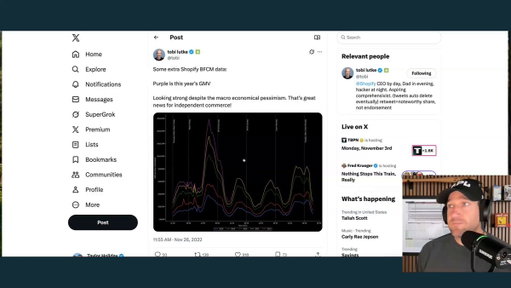
1 hour delivery is a moat most can’t comprehend.
Uhhh is this the beginning of the inevitable breakup between Stripe and Shopify? This is a big deal. It’s also a bunch of my predictions coming to life at once. Here's what's happening: Stripe is powering a native checkout inside Facebook ads. You see an ad, tap "Buy now," and purchase without ever leaving Facebook. Powered by Stripe's new Agentic Commerce Protocol (ACP)*, an open standard built with OpenAI. This is not the breakup. It's worse. It's Stripe building the layer that makes Shopify optional. Here's the threat chain: 1. Checkout moves off the storefront.* If customers buy inside Meta ads via Stripe, they never visit the Shopify store. The store becomes a warehouse backend, not the point of sale. 2. Stripe becomes the merchant of record infrastructure.* ACP lets any AI agent (ChatGPT, Meta, whoever) trigger a purchase. The business keeps merchant of record status, but the commerce infrastructure is Stripe, not Shopify. 3. Shopify Payments IS Stripe under the hood. Shopify's payment processing is a white-labeled Stripe integration. Stripe going direct to Meta means they're routing around their own reseller. Why let Shopify clip the ticket when Stripe can own the relationship directly? 4. The "agentic" angle is the real play. ACP isn't just Meta. OpenAI is the first AI platform to implement it. This means ChatGPT, and eventually every AI assistant, can trigger purchases through Stripe without touching a storefront. That's a future where "browse a website and add to cart" becomes a legacy behavior. For brands specifically This changes the ad-to-purchase funnel fundamentally. If a Prophit Engineer is optimizing Meta ads and the purchase happens inside the ad unit via Stripe checkout, the attribution model changes, the role of the landing page changes, and creative becomes even MORE important because the ad IS the store. Brands should be watching this closely. Short-term, nothing changes. Medium-term (12-18 months), the brands that figure out how to sell inside AI surfaces and ad units via ACP will have a structural advantage. So is it the breakup? Not yet. But it's Stripe signaling that they don't need Shopify as the distribution layer anymore. Stripe + Meta + OpenAI is a commerce stack that doesn't require a storefront. Shopify's response will tell you everything: do they build their own ACP competitor, or do they lean into being "the backend" for agentic commerce?
Joy has built our accelerator program to 100 brands… 100 7-figure stores transparently pursuing predictable profitable growth. Publicly allowing you to grade his homework and decide for yourself if it could help your brand. Check it out.


Do not do this. You have to have an approved app. You will get banned. Meta is enacting the Manus protection plan ;)
VCs just bet $16M that you are lazy enough to break the law. Arcads just raised a massive $16M Seed round. You have seen it all over your feed. The pitch is seductive: "No more expensive UGC creators. Type a script, get a video of a human saying it." It’s impressive tech. The avatars are indistinguishable from reality. But before you fire your content team (or agency) and replace them with AI avatars, read the FTC’s new "Final Rule on Consumer Reviews" (16 CFR Part 465). The trap is in the script. If you type: "This product changed my life" into an AI generator... And the "person" saying it does not exist... And they never used your product... You just committed a federal violation. The Math of Liability: Cost of Arcads Subscription: ~$100/mo FTC Fine per Violation: Up to $51,744. If you generate 100 fake testimonials, you are sitting on a $5M liability. The Safe Path: Use AI actors for announcements, explainers, or skits. Never, ever use them for testimonials or personal experience claims. "I think this brand is cool" = Marketing. "I lost 10 lbs using this" = Fraud. If you thought the ambulance chasing on GDPR and ADA compliance was bad... this is going to be a whole different level.
@CliftonSellers Like it was an essential part of my and my entire organization’s AI adoption process.

The next wave of 9 figure exits in eCommerce won’t be Brands, SaaS or agencies. They’ll be SEANs — Software Enabled AgeNcies. The line between software and service is disappearing, and a new hybrid model is emerging in its place. A SEAN combines the scalability and predictability of SaaS with the human leverage and outcome-orientation of an agency. It’s the inevitable result of two business models, software and agency, collapsing into one. (And yes, the name is a wink to DTC Twitter’s favorite @seanfrank, because he is the hired spokesperson for every “SEAN”.) The convergence is a result of tectonic shifts in our landscape. SaaS is under pressure. In the mid-market and lower tiers of eCommerce, the expectation of value per dollar is so high that monetizing pure software has become nearly impossible. The dream of self-serve software, like Slack, where users can derive value in a completely autonomous manner doesn't exist. Most brands can’t extract value from software without guidance. And the truth is they don’t want tools; they want outcomes. At the same time, agencies are evolving. AI and automation have made them faster, leaner, and more consistent. Internal tools, scripts, and proprietary systems are replacing headcount. The best agencies now behave like SaaS products, predictable, scalable, and data-driven. But they also possess a critical feature that most SAAS doesn't, accountability for the outcome. These two forces are colliding. SaaS companies are adding services: onboarding, customer success, weekly strategy calls. Agencies are adding software: proprietary dashboards, AI layers, internal platforms. Both are converging on the same destination, SEAN. Modern examples include Haus, Fulfill, Fermat, Saras Analytics, Icon and US (CTC) each blending automation, software, and human expertise into a single, productized experience. The economics are the key to understanding what is happening. SaaS was prized for revenue quality and scale, predictable ARR, great retention, and strong LTV/CAC (3:1). SEANs achieve similar economics through a slightly different route and with slightly less total scale. Gross margins drop from 90% to something closer to 60-70% as you add the human component, but net revenue retention still exceeds 100%, growth rates remain healthy, and operating expenses shrink thanks to AI and systemization. The market rewarded SaaS not for its form but for its financial model, and SEANs can come close to replicating that performance through a hybrid structure. The benefit of eCom SAAS becoming SEAN's is that it reframes the pricing comparison for brands. Currently, SaaS sells into a brand’s software budget, maybe 1–3% of revenue. Agencies sell into the labor budget, often more like 10–12%. SEANs have the potential to reframe pricing around labor replacement, not software cost, expanding TAM and aligning pricing with true value delivered. Investors are beginning to see it too. Many “SaaS” businesses are actually SEANs pretending to be pure software for the multiple, but the market is catching up. SAAS multiples are experiencing compression. Meanwhile, agencies that leverage technology are seeing multiple expansion as their margin and predictability increase. The two curves are converging toward a shared financial reality. Ultimately, customers don’t care whether it’s software or service, they care if it works. The delivery model that can guarantee outcomes through automation, human intelligence, and proprietary systems will win. The best SaaS companies will look like agencies. The best agencies will look like SaaS. The winners will be SEANs, Software Enabled AgeNcies, owning the middle ground where revenue quality meets operational leverage and customer's take home the lion's share of surplus value creation.
Another example why brand is a worse business model than agency. This service business gets $20M in an acquisition. And the main reason is very simple… You can service debt with the cash flow of a service business this size but you can’t with a physical goods business carrying inventory. So the buyer can use leverage. *Yes, a thousand caveats about the specifics of these hypothetical businesses matter, but save that for substack. This is X*
Taylor Holiday (@taylorholiday) X Stats & Analytics
Taylor Holiday (@taylorholiday) has 59.4K X followers with a 0.35% engagement rate over the past 12 months. Across 1.47K posts, Taylor Holiday received 24.0K total likes and 8.18M impressions, averaging 16.3 likes per post. This page tracks Taylor Holiday's performance metrics, top content, and engagement trends — updated daily. To benchmark @taylorholiday against other accounts, use Socialpruf's X competitor analysis tool.