
Key Metrics
Distributions
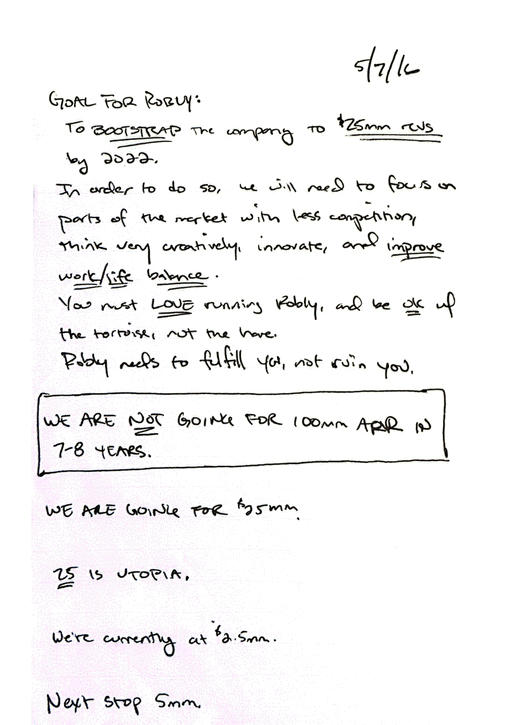
$10M ARR is the FU MONEY of SaaS. At $10M ARR bootstrapped, you and your co-founder clear $1M+/year in salary and dividends easily. You can sell instantly for $30-40M. There are hundreds of EBITDA buyers at this level vs. a handful at $1B valuations. From here, you can do whatever you want. Hire a CEO and work 1 hour/week. Grind 100 hours if that's your thing. Raise $50M from a position of strength. Scale to $25M ARR with 25 people and pay yourself $10-15M/year. Most companies never get here because VCs show up early with decacorn dreams and money you don't need. That capital interferes with the one thing that makes you great: product-market fit. Bootstrapping to $10M ARR is easier and less risky than creating a VC-backed unicorn, with a far higher probability-weighted outcome. If you can find PMF and use customer money to get to $10M, you can do anything you want with your life.

x.com/i/article/201444973…
Me in 2019: > Drinking 2-4 beers/drinks every night > Getting hammered once a week with friends > Drinking was 100% of my stress relief AND social life > Weighed 225 (20lbs heavier than now) > Looked like I was 45, when I was 39 > Business stuck at $3M ARR for the third year in a row Me in 2026: > Zero booze or drugs of any kind in 5.5 years > Stress relief is sauna, cold plunge, and wakesurfing > Social life is hanging out with people who have kids > Weigh 205 (20lbs lighter) > Look like I did when I was 34 (and I'm 44) > Personally making 10x > Happily married, two young kids, settled in Aspen Every founder I know drinks. It's just what you do. Drinks at business dinners, celebrations…nobody questions it. I'd been drinking so much for so long that when I stopped, it felt like I had a superpower. For anybody who drinks every day: if you take 3 months off, you will notice an ENORMOUS difference in the quality of your life. You'll feel like you got 25% of your life back. You'll be more present in all of your relationships. You'll be far more intentional in everything you do. You'll be much better at home and at work. I only wish I did it sooner.
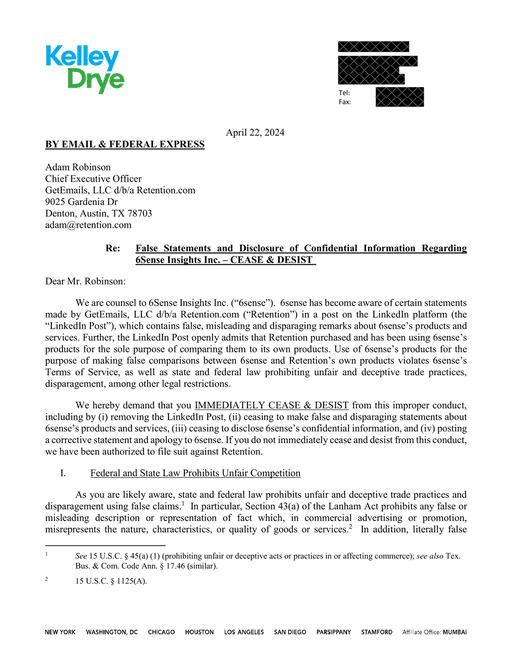
In 2017, a CEO friend told me I was "wasting my life" on my tiny startup. He had raised $30M in VC. His co-founders' families had put in $2M. They were supposed to be on their way to $1B. He tried to recruit me. Here's what happened: Him: "We'll be worth a billion soon. A small piece of equity here will be worth way more than your big stake in that tiny thing you're building." I told him no. Him: "You're not ambitious enough. It's been 5 years and your startup isn't going anywhere. You're too talented to be thinking so small." Me: "Maybe you're right. But it's MY startup. You work for the VCs. I'd rather stay stuck on my own thing than work on yours." I told him what I wanted: mid-20s ARR SaaS with under 40 people. He thought I was crazy. Eventually, he shut down his VC-backed company after burning through $30M. That same month, I booked my first $1M profit month. This is what I took from that: t Stay in the game. If you're small but profitable, you can outlast almost everyone. Time is your biggest advantage. Most VC-backed companies have 18-36 months of runway. You have forever. The world beats you down when you're small. Everyone told me I was thinking too small. That I should raise money. That I'd never build anything meaningful bootstrapped. They were all wrong. Skills compound. Every year you spend building, you get better at product, sales, hiring, and understanding customers. It’s invisible for years. Then suddenly it's not. Survival is the strategy. Most founders quit at year 3 or 5. Stay alive long enough and your odds skyrocket. You just need one breakthrough. Don't let anyone tell you you're wasting your life. The CEO who said I wasn't ambitious enough? He doesn't say that anymore. You don’t need VC money. You need time and one breakthrough. Keep building.
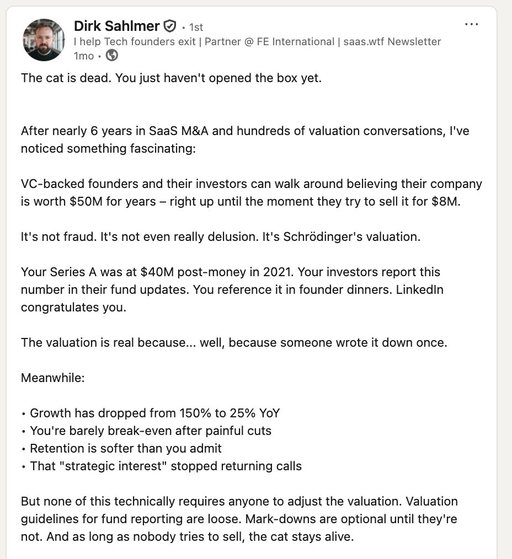
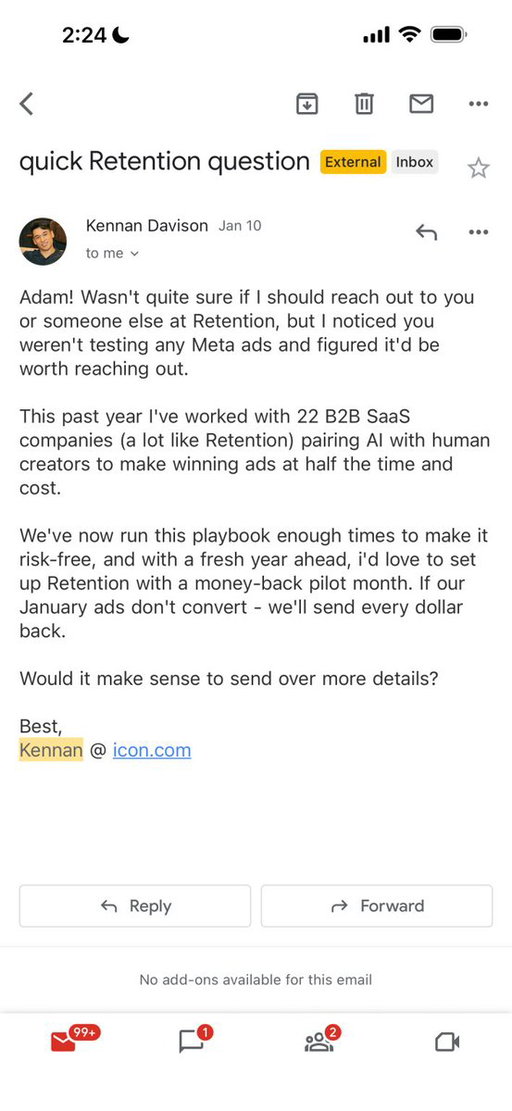
THIS IS AN INCREDIBLY IMPORTANT ACQUISITION FOR FOUNDERS: What's not said in this "we only raised $8M and sold for $105M" is the little-known fact that the reason they only raised $8M was that several years ago, nobody would do a Series A for that biz. Which is why Kennan replaced himself as CEO and moved on to ICON. He was upset about it at the time. That moment he couldn't raise was the single best thing that ever happened to him. Here's why this matters for founders: > Selling a business for $105M when you only raised $8M is LIFE CHANGING. > For the same reason he couldn't get the Series A done, I'm not sure a business like that (sticky but sells to a small TAM of elite Shopify brands at $500/mo) is saleable at $500M+. > Had he been "lucky enough" to get the A done and raised at a $200-250M valuation, the exit hurdle would've been $600-750M. > Recharge likely wouldn't be a buyer there ($2.1B val at absolute peak valuations). Not sure anyone would be because if you're buying Skio at $600-750M, you think it's going to $2B. > Skio (which would be the same, GREAT business) would very likely be stuck in a zombie state, pushing for a valuation it was never meant to reach. Like so many others. Ryan Allis said something on my show that's stuck with me: "If you have to raise money, keep it at 1x your ARR at the time." All because it maximizes your optionality. You can sell a great biz for $100-150M and go do whatever you want. You can keep running it. Or you can keep the equity, hire someone else to run it, and go bigger (like Kennan). If you're a founder, keeping a low 9-fig exit on the table is an incredibly smart move. Kennan did it by accident. You should do it on purpose. You only need to get rich once. Have as many paths to that place as possible. (Oh, and PS: the other reason he was able to sell? They were a growing, profitable business. Why do more people not live life this way?!?!)
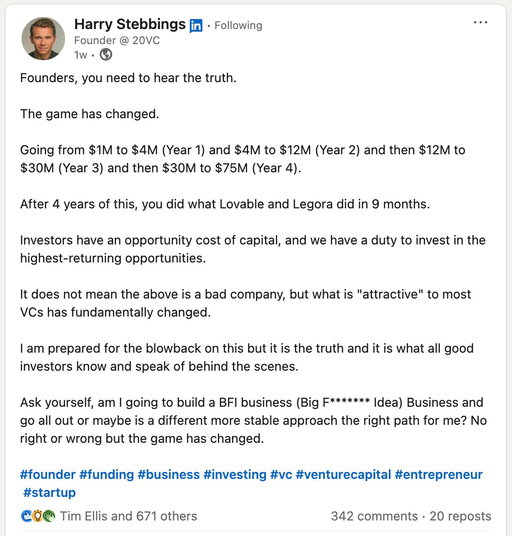
Until you have PMF, there are only 4 things you should be doing: > talking to customers > improving the product > creating content > finding more customers to talk to That's it.
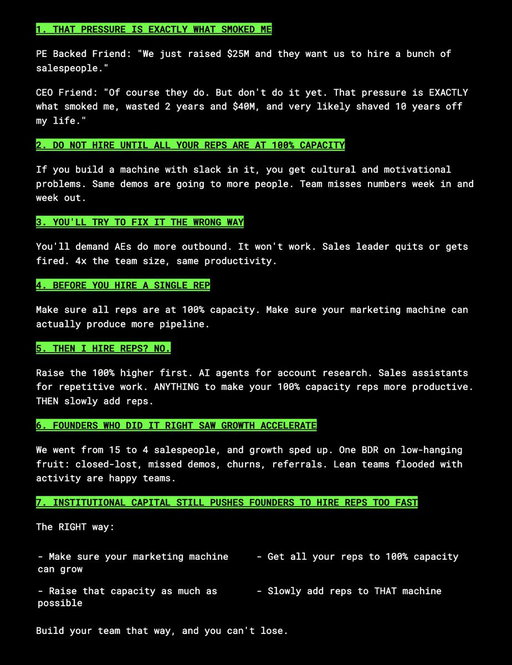
YC’s best advice is “default alive” - have enough cash to survive without the next raise. Great advice… nobody f*cking does it. Paul Graham (the founder of YC) once said he’d raise $500K, get ramen profitable, and probably never raise again. The guy who’s seen more VC deployed than ANY human alive basically says he wouldn’t use it more than he absolutely has to. But the reason no one listens to this advice is because founders are delusional about their own companies. We think what we have is better than what it actually is, and we can’t help ourselves. Our startups are our babies. We have a totally unrealistic and out-of-touch view of them. It’s way too easy when you have a little bit of traction to go out there and raise way too much money. Then you’re set on a path to burn forever. “Default alive” is a great concept. Maybe 1/100 YC companies actually do this. YC knows it, and they fund them anyway.
Every founder should be creating content and that’s a hill I’ll die on. Your content is a landing page for literally everyone. - Investors - Agencies - Partners - People you want to hire They are all going to your profile to figure out what you’re about before they do any kind of business with you. I built RB2B to $6.6M ARR in 18mo almost entirely from posting on LinkedIn. I hear it over and over. Founders start posting, and 6 months later, they all say the same sh*t. “Doors opened that I didn’t know existed.” TLDR: Create more content.
COLD EMAIL IS DEAD. People doing outbound right now are only sending more emails to fix the exact problems that sending more emails caused. We went the other direction. Our campaign is dead simple: Someone lands on RB2B(.)com We identify them And we send an email. “Hey, saw you on our site. Do you have any questions?” That campaign converts at over 10%. One signup for every 10 emails sent. For context, standard cold email right now converts at about 1 in 500. And getting worse. Stop emailing strangers and focus on those people who already know you exist. Tools like Clay, Smartlead, and Instantly made high-volume personalized outbound so easy that everyone started doing it at the same time. What used to be a competitive advantage became noise. Spam filters got smarter. More volume going out, harder filters coming in. The only response most people have is to send even more email, which makes the problem worse for everyone. What converts 10 to 30 times better is inbound-led outbound. Drive people to your site first, identify who they are, then reach out while they're still warm. RB2B makes the middle step possible. The moment someone lands on your website, you get their… > Full name > Job title > Company > LinkedIn profile > Every page they visited …pushed to Slack or your CRM instantly. If someone was just on your pricing page, that's high intent. If they looked at three case studies, they're doing research. You know exactly who to prioritize and exactly what to say. From there, use Clay to enrich the data and filter by ICP, then push to Instantly or Smartlead for sending. The email goes out while they're still warm. AND KEEP YOUR COPY SIMPLE. Our prospecting email has some light AI personalization about who the customer is actually targeting, but the core message is completely plain. “We have a product that identifies anonymous website visitors and sends their LinkedIn profiles to your Slack in real time. It's free. Reply yes if you're interested, reply no if you're not.” Yes gets a signup link. No gets an unsubscribe. That's the whole system.
Every time I feel bad about my business - which is often - I get dinner with a VC backed Founder in the $20-30m ARR range who has raised over $50m. I share my complaints, then they share theirs👇 - They are unprofitable - They’re either stuck or not growing fast enough for their investors - Their investors send them all the Clay and AI financing news weekly - They have 5x the team size I do (and execs) - They are on planes at least 1x/week (I hardly travel) - They are being forced to add product complexity - They face intense new-entrant competition despite superior product - They are under an incredible amount of stress and don’t see a way out After they are done… it always kicks off the same dialogue: CEO: “But you’re making money, right?” Me: “Yea, we will probably do $12-14m profit this year." CEO: “That sounds like the absolute dream.” To which I always get reminded that... Yes, it actually is! But when you’re in the middle of it all, it’s so easy to lose sight of. Startups are hard. Some things get easier, but in my 12 years of experience, it almost always feels like shit. But if you can last long enough as a bootstrapper: 1. You will end up being enormously profitable (mini exits every year) 2. You will have total freedom to design the life you want for yourself Raising money is exciting and validating, but most of the time you end up stuck with no way out. The reality? $10m ARR is the FU Money of SaaS. In 2026, it takes fewer FTE’s than ever before. At RB2B we’re about to cross $9.6m ARR growing with a team of 3. 99% of VC backed founders would kill for that business. If you can bootstrap, bootstrap.
x.com/i/article/201095332…
x.com/i/article/202455866…
VCs convincing founders to take money with a 90%+ probability they will fail. They call it a treadmill for a reason. The second you take capital, you're on it, and it's set at a speed that works for them, not necessarily for you. VC IS A SCAM FOR MOST
Every one of the 3,950 failed YC founders thought they were special. So do you.
Adam Robinson (@retentionadam) X Stats & Analytics
Adam Robinson (@retentionadam) has 10.8K X followers with a 0.72% engagement rate over the past 12 months. Across 304 posts, Adam Robinson received 18.4K total likes and 2.95M impressions, averaging 60.5 likes per post. This page tracks Adam Robinson's performance metrics, top content, and engagement trends — updated daily. To benchmark @retentionadam against other accounts, use Socialpruf's X competitor analysis tool.