YouTube forces hard limits onto every major social management tool, which is why new channels can take up to 72 hours to backfill. Here's a plain breakdown of how each platform handles YouTube's gate, why the delay exists, and how public-data tracking bypasses it.
As a social media manager, agency owner, or brand marketer, you've felt this exact frustration. You link a new YouTube channel to a major management tool, and you have to wait up to 72 hours for your data to backfill.
In this guide, we're breaking down the hard limits that YouTube forces onto major social platforms, explaining the "why" behind these API restrictions, and exploring how modern tracking platforms bypass these headaches entirely.
The industry breakdown: how different platforms handle YouTube's gate
Third-party social media management platforms are not all-powerful. They are entirely dependent on what each social network's official gate, the API, allows them to see.
When it comes to YouTube, the experience varies wildly depending on which tool you pay for. Here is what actually happens when you connect a YouTube channel to the industry's most popular platforms.
| Product / Platform | Initial Onboarding Wait Time | Historical Backfill Limit | Stat Availability & Native Restrictions |
|---|---|---|---|
| Sprout Social | 36 to 72 hours | Up to 2 Years | Delayed demographics: Fetches your video list and the last 30 days of basic metrics immediately. Deep history takes up to 3 days, while detailed audience demographics must be "polled" slowly in 3-day increments backward. |
| Hootsuite | Up to 24–48 hours | 12 Months | The "every-other-day" gap: YouTube only allows Hootsuite to collect data every two days, causing minor data gaps for the days in between. Total subscriber count is heavily restricted and cannot backfill at all. |
| Buffer | 48 Hours | 90 Days - 2 Years | Insights vs Analyze: Buffer has two separate levels of data that they display as different tools. Backfill, Cost and Data Recency vary across the two tools. |
| Metricool | 7 Days | 30 Days | Budget option: The longest backfill wait across varied plans, reflecting its lower pricing. |
| Sprinklr | 24-48 Hours | 60 Days | One of the best: Sprinklr YouTube analytics update every four hours to once a day depending on recency and scrapes in social listening insights |
API limitations explained simply
Why does this delay exist? To understand it, you have to understand how the YouTube Data API operates.
The quota system
Google doesn't charge tools money to read your data, it charges them in quota units. Every action carries a fixed weight, and here's what that actually looks like:
- The budget is 10,000 units a day. Every developer project gets exactly that, resetting at midnight Pacific Time. Burn through it by 2:00 AM on a heavy backfill and the dashboard freezes for the next 22 hours.
- Units aren't requests. 10,000 units is not 10,000 calls. Costs range from 1 - 100 units depending on how hard the operation strains Google's servers.
- Reads are cheap: pulling views, likes, and comments for 50 videos or basic channel info costs just 1 unit.
- Search is expensive: one keyword lookup costs 100 units, and an upload does too.
Companies can request higher usage but must go through lengthy security and data compliance audits. This means that major social platforms have to budget their units and make requests over a number of days.
Reporting jobs
For deep history, YouTube doesn't let apps search its live database. Instead, the tool must register a reporting job, and here's what that actually looks like:
- The request goes in a queue. The tool asks YouTube for the client's historical data, then waits for a bulk file to be built.
- The validation lag is structural: YouTube starts a 48-to-72-hour validation window that filters out bot traffic, scrubs fraudulent views, and verifies ad metrics before publishing the final numbers.
- Download is the fast part. Once the file is generated, Google issues a secure, temporary
downloadUrl. Only then can the tool pull the raw packet down, parse it, and display it in your dashboard.
Traditional platforms are structurally bound to wait on this 3-day validation pipeline. This combined with quota limits is what breaks platforms speed, they are at the mercy of the YouTube API.
How to get by
When client deadlines are tight, waiting three days for an API to package a report isn't an option. This is where the concept of data scraping comes in.
The scraping alternative
Data scraping uses automated scripts to mimic a human browser. It visits a public page (like a YouTube channel or Instagram profile), reads the HTML code, and grabs the views, follower counts, and public stats in real-time.
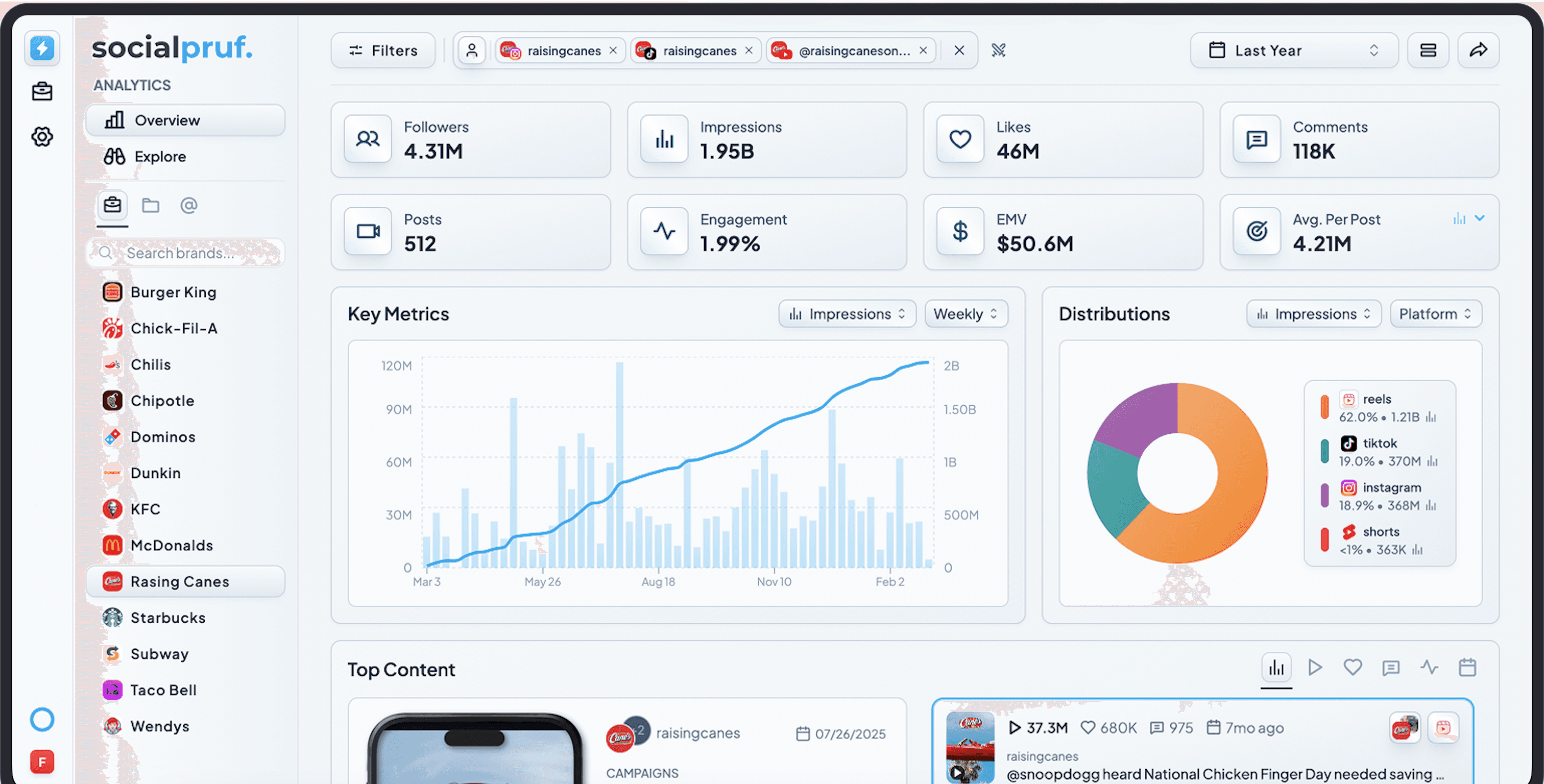
Some social media tools use 3rd party data providers but at Socialpruf we scrape all the data ourselves. Our data systems are robust and designed specifically for quick, partner-ready reporting.
Instead of demanding complex OAuth logins, password sharing, or making you wait 72 hours for API authorization, Socialpruf tracks public metrics in real-time.
- No authentication: You can track any public account instantly, including your competitors, without needing their login credentials.
- Instant reports: It bypasses the multi-day backfill queue by aggregating public-facing performance data immediately, turning raw results into clean, shareable case studies in seconds.
- Zero account risk: Because it doesn't hook deeply into private account tokens, your brand and creator profiles are completely insulated from API flagging.
For social agencies scaling fast, utilizing public-data engines is becoming the go-to method to bypass the API bottlenecks.
To wrap up
Unfortunately there are no ways to bypass the API restrictions without using separate data collection systems, but tools like Socialpruf close this gap and package all the complex data work into a platform more powerful than any API based tool.