Influencer discovery tools show stale data because of three hidden variables: how old the number is, how small the sample is, and where it came from. Here's what HypeAuditor, Modash, Favikon and others actually disclose, and the three questions to ask any vendor.
Why your influencer search tool shows the same creators every month
You open your creator search tool, and it's just showing you the same 10 creators as last month. The numbers haven't moved in months, and tone, trends and audience don't match what you saw scrolling your actual feed five minutes ago. Every influencer search tool eventually produces this moment.
The "why" is buried in the same handful of undisclosed variables across every vendor: sample size, cadence, and source. So I went looking for what the industry actually discloses about how its numbers are made.
How influencer platforms collect data: public scraping vs. opt-in
Almost all of these platforms build their databases primarily from public data, the same posts, captions, and counts anyone can see without an account. That's the only way to cover millions of creators without asking each one for permission individually. A handful of platforms also have direct data partnerships with platforms like YouTube and Meta that they use alongside scraped data. A smaller number of platforms (think Upfluence) instead ask the creator to connect their account and authorize access, trading full-database coverage for verified, first-party numbers on the accounts that opt in. This is a different model, with its own pros and cons.
Everything a discovery tool shows you is either (1) authorized by the creator, which limits scale; (2) obtained through third-party APIs, which limits control; or (3) scraped internally, which increases costs. In this article we will focus on influencer tools that use public data, because they are the vast majority.
Refresh cadence: how often influencer tools actually update data
When platforms call their third-party data provider to get up-to-date data, they do so on a cadence. Whether a company is buying the data or collecting it on their own, the shorter the cadence, the higher the costs will be. As a result, we see big delays for updated influencer data on almost all of the big platforms.
Here's how often HypeAuditor, Modash, Favikon, Influencity, and Heepsy refresh their influencer data, based on each platform's own documentation:
| Platform | Refresh cadence (their own docs) |
|---|---|
| HypeAuditor | All report data recalculated every 30 days (Instagram); TikTok major metrics daily, full recalc every 30 days; YouTube daily except audience demographics, once a month |
| Modash | Three-tier cycle: "very basic" data (followers, username) at least weekly; "basic" data (bio, engagements, engagement rate) every two weeks; "analyzed" data (audience demographics, average likes, growth trends) every 30 days |
| Favikon | Tiered by how closely you follow a creator: all profiles every 30 days, CRM profiles every 15 days, actively-tracked/list profiles every 72 hours; the Authenticity Score can only be regenerated once every 30 days |
| Influencity | KPIs (followers, engagement) only refresh when you do it manually, taking up credit each time; content tracking auto-refreshes every 8 hours |
| Heepsy | Automated content tracking refreshes every 7 days. |
Almost every platform lands on "cheap data updates fast, expensive data updates monthly." It's a cost structure, and no vendor frames it that way to the buyer. That's one of the biggest problems: there's no effort at disclosure.
For example, Socialinsider's documentation states that if a creator hides their like count, every like from before the hide still displays, while every like after is invisible. So it becomes a stale number that looks live. No tool I found displays a "last updated" timestamp next to the metric itself. That's a one-line feature. Its absence is a choice, made independently by every vendor in the space.
How statistics are calculated (and why no two tools agree)
Whatever number a tool prints is only ever drawn from a slice of the posts and followers underneath it, and each vendor draws that slice differently, from a different place, and rarely tells you which.
Here's how HypeAuditor, Modash, Favikon, Influencity, and Heepsy each describe the way their influencer scores and metrics are calculated, in their own documentation:
| Platform | What the number is actually built from (their own docs) |
|---|---|
| HypeAuditor | HypeAuditor uses a proprietary formula that runs creator profiles through AI and scores them on the creator's influence, audience quality, channel credibility, and viewer engagement. |
| Modash | Modash uses its own AI-powered search and filters by location, niche, audience demographics, and engagement metrics. |
| Favikon | Favikon uses a formula based on these factors: Post Content (15%), AI Content (30%), Engagement Quality (25%), Expertise (20%), and Follower Growth (10%). |
| Influencity | Influencity uses natural language processing, image recognition, AI, and location tagging to identify brand affinity, interests, and content topics. It guarantees a minimum 90% accuracy rate on each metric. |
| Heepsy | Heepsy uses filters such as category, location, engagement rate, and audience demographics to match influencers. It also uses its own Audience Quality Score (AQS), a proprietary metric that scores an influencer's audience based on authenticity, activity levels, and engagement patterns. |
Two things stand out:
- No two windows match. Every tool uses a "proprietary" equation or score to vet influencers for you, with very little disclosure.
- Not one of them prints the sample size. The vendors explain how the analytics work but stay silent on how much was actually evaluated, and what share of the total audience that represents. It's like having a blank formula.
Where influencer data really comes from: resellers, scrapers & platform APIs
The first two problems, delay and sample size, assume the tool has some control over its own data — and most don't, which decides a lot about the tool.
There are three ways a discovery tool gets its numbers:
1. Bought wholesale from a data provider (the most common). Rather than build and maintain a scraper for every platform, most tools buy finished creator data through an API and put their own logo on top. So the "proprietary statistics" behind three different tools may be one database, or a chain of them. When you buy from a reseller you also inherit its refresh cadence, its sampling and its costs.
2. Scraped in-house. A few vendors do run their own collection, like Modash and HypeAuditor. That's not automatically fresher, but at least the delay and sample decisions are theirs to answer for. HypeAuditor also sells that data onward as an API, so it's a consumer product and a supplier, meaning the same data may reach you through its dashboard or through someone else's. Although this route gives the platforms more freedom, it also incentivizes them to scrape less because they incur all of the scraping costs. Modash, for example, states it only collects public creator profiles several times a month.
3. Pulled from an official platform API. CreatorIQ was the launch partner for Instagram's Creator Marketplace API and an early partner on YouTube's Creator Partnership API, which delivers first-party demographics and statistics that are measured. That YouTube directory has since grown to roughly 24 named partners, including Sprout Social and Meltwater. Upfluence's authenticated model belongs here too. This model is great because the number seems more reliable to the consumer, but platform connections are slower, more expensive, and at the mercy of the platforms' ever-changing policies.
How Socialpruf keeps influencer data fresh: hourly refresh, full history
The three problems above, delay, calculations, and source, are the same three we had to answer, so here's how we do it:
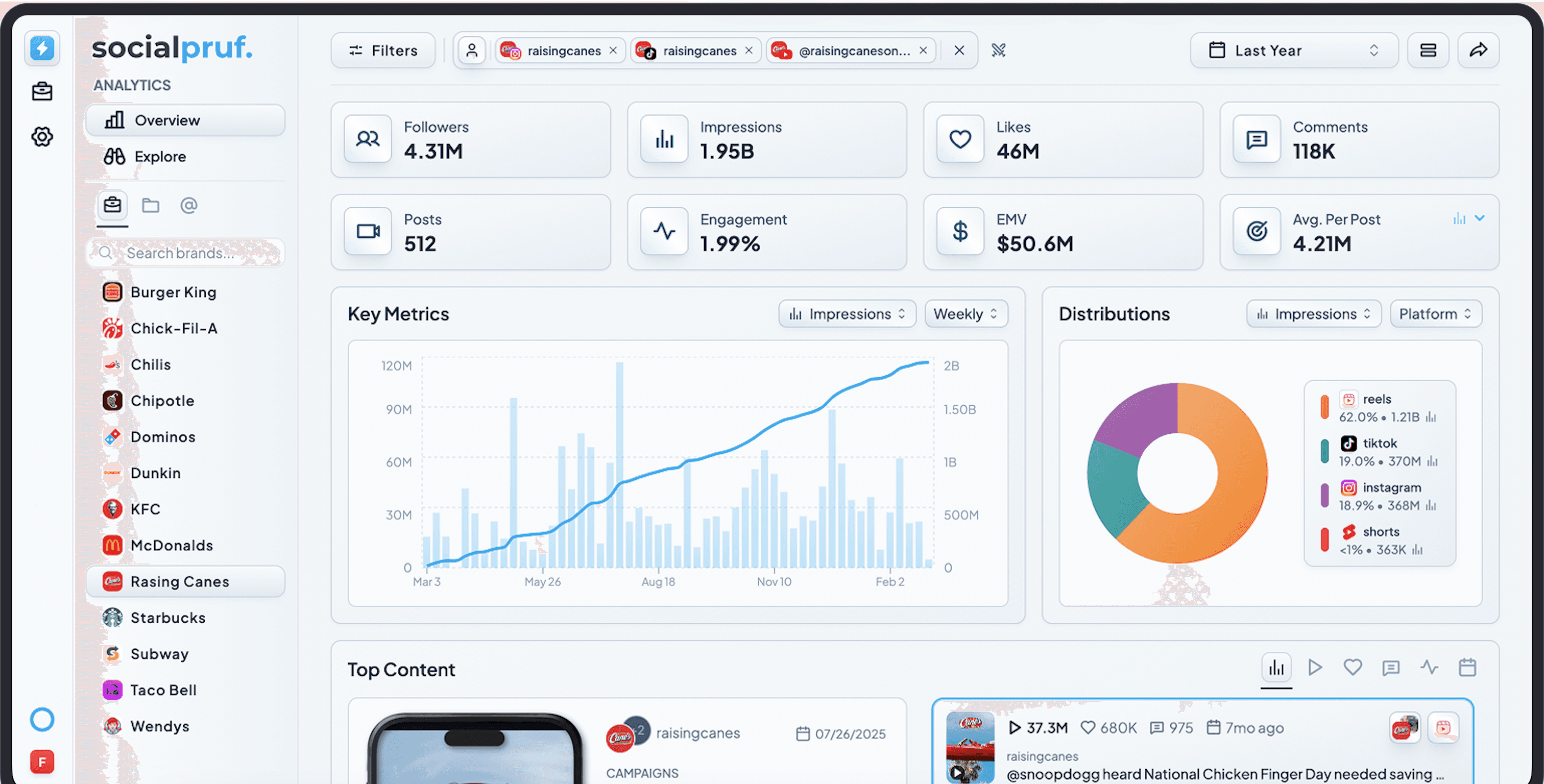
Delay. Every post and every stat we track refreshes every hour, the whole record on the same cadence. We can do that because we're not paying a reseller per refresh; we have complete control over our data. And every post carries a last-updated timestamp, so you can see when a number was actually pulled instead of trusting that it's live.
Calculations and Sample size. We pull every post an account has published, all time, then let you set the date range yourself. So an engagement rate isn't a set median or roughly the last two months, it's whatever slice you choose, computed off the full history underneath it. When the number is drawn from everything, there's no hidden window deciding the answer for you. You could check every single post if you wanted to.
Source. We scrape every platform ourselves, with our own systems. That matters for two reasons. First, control: the refresh cadence and the sample are our decisions to make and answer for. Second, we don't cap how much we collect to protect a data bill.
In summary what changed at Socialpruf was this: full history instead of a sample, an hourly refresh instead of a monthly one, and our own pipeline instead of a reseller's. The three questions at the top of this article, how recent the number is, how much it's drawn from, and where it comes from, are the ones we built to be able to answer.