NewClaim a free social report
X analytics
Similar Accounts:
followers
382K
impressions
107M
likes
335K
comments
28.6K
posts
3.99K
engagement
0.338%
emv
$2.27M
Average per post
26.9K

Key Metrics

Distributions
Top Content

"Using coding agents well is taking every inch of my 25 years of experience as a software engineer." Simon Willison (@simonw) is one of the most prolific independent software engineers and most trusted voices on how AI is changing the craft of building software. He co-created Django, coined the term "prompt injection," and popularized the terms "agentic engineering" and "AI slop." In our in-depth conversation, we discuss: 🔸 Why November 2025 was an inflection point 🔸 The "dark factory" pattern 🔸 Why mid-career engineers (not juniors) are the most at risk right now 🔸 Three agentic engineering patterns he uses daily: red/green TDD, thin templates, hoarding 🔸 Why he writes 95% of his code from his phone while walking the dog 🔸 Why he thinks we're headed for an AI Challenger disaster 🔸 How a pelican riding a bicycle became the unofficial benchmark for AI model quality Listen now 👇 t.co/wlEIyOehU8

2.20M
1.15K
76
177
2mo ago
lennysan
"Using coding agents well is taking every inch of my 25 years of experience as a software engineer." Simon Willison (@simonw) is one of the most prolific independent software engineers and most trusted voices on how AI is changing the craft of building software. He co-created Django, coined the term "prompt injection," and popularized the terms "agentic engineering" and "AI slop." In our in-depth conversation, we discuss: 🔸 Why November 2025 was an inflection point 🔸 The "dark factory" pattern 🔸 Why mid-career engineers (not juniors) are the most at risk right now 🔸 Three agentic engineering patterns he uses daily: red/green TDD, thin templates, hoarding 🔸 Why he writes 95% of his code from his phone while walking the dog 🔸 Why he thinks we're headed for an AI Challenger disaster 🔸 How a pelican riding a bicycle became the unofficial benchmark for AI model quality Listen now 👇 https://t.co/wlEIyOehU8

How Anthropic’s product team moves faster than anyone else I sat down with @_catwu, Head of Product for Claude Code at @AnthropicAI, to get a peek into their unprecedented shipping pace, how AI is changing the PM role, and how to be the right amount of AGI-pilled. We discuss: 🔸 How Anthropic’s shipping cadence went from months to weeks to days 🔸 The emerging skills PMs need to develop right now 🔸 Why you should build products that don't work yet—then wait for the model to catch up 🔸 Why a 95% automation isn't really an automation 🔸 Cat’s most underrated AI skill (introspection) 🔸 What Cat actually looks for when hiring PMs now (hint: it's not traditional PM skills) Listen now 👇 t.co/uymmT55Nq6
2.04M
957
50
171
2mo ago
lennysan
How Anthropic’s product team moves faster than anyone else I sat down with @_catwu, Head of Product for Claude Code at @AnthropicAI, to get a peek into their unprecedented shipping pace, how AI is changing the PM role, and how to be the right amount of AGI-pilled. We discuss: 🔸 How Anthropic’s shipping cadence went from months to weeks to days 🔸 The emerging skills PMs need to develop right now 🔸 Why you should build products that don't work yet—then wait for the model to catch up 🔸 Why a 95% automation isn't really an automation 🔸 Cat’s most underrated AI skill (introspection) 🔸 What Cat actually looks for when hiring PMs now (hint: it's not traditional PM skills) Listen now 👇 https://t.co/uymmT55Nq6
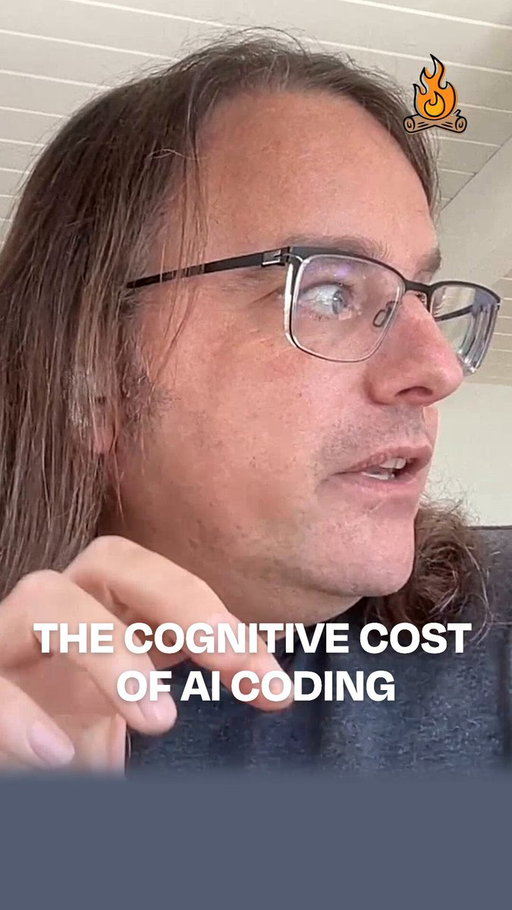
"Using coding agents well is taking every inch of my 25 years of experience as a software engineer, and it is mentally exhausting.

I can fire up four agents in parallel and have them work on four different problems, and by 11am I am wiped out for the day.

There is a limit on human cognition. Even if you're not reviewing everything they're doing, how much you can hold in your head at one time. There's a sort of personal skill that we have to learn, which is finding our new limits. What is a responsible way for us to not burn out, and for us to use the time that we have?" @simonw
1.93M
6.86K
558
992
2mo ago
lennysan
"Using coding agents well is taking every inch of my 25 years of experience as a software engineer, and it is mentally exhausting. I can fire up four agents in parallel and have them work on four different problems, and by 11am I am wiped out for the day. There is a limit on human cognition. Even if you're not reviewing everything they're doing, how much you can hold in your head at one time. There's a sort of personal skill that we have to learn, which is finding our new limits. What is a responsible way for us to not burn out, and for us to use the time that we have?" @simonw

Automation is a lie. CLIs are over. The SaaSpocalypse is dumb. A year ago @danshipper came on the podcast to predict where AI was heading. He was remarkably right—including the call that everyone was sleeping on Claude Code. Dan has a unique lens into where things are going because his team at @every is possibly the most AI-pilled group of people in tech. I always learn a ton talking to Dan. So I brought him back for round two. We'll score these in exactly a year: 🔸 Every company will have one “super-agent” in Slack. 🔸 Codex and Claude Code will become the new operating system for knowledge work. 🔸 The AI job apocalypse is not happening. 🔸 PMs and designers will thrive. 🔸 We will read way more AI-generated writing and we will like it. 🔸 "I would buy SaaS stocks right now." Listen now 👇 t.co/wzxQ5bz49h
1.78M
1.34K
87
176
1mo ago
lennysan
Automation is a lie. CLIs are over. The SaaSpocalypse is dumb. A year ago @danshipper came on the podcast to predict where AI was heading. He was remarkably right—including the call that everyone was sleeping on Claude Code. Dan has a unique lens into where things are going because his team at @every is possibly the most AI-pilled group of people in tech. I always learn a ton talking to Dan. So I brought him back for round two. We'll score these in exactly a year: 🔸 Every company will have one “super-agent” in Slack. 🔸 Codex and Claude Code will become the new operating system for knowledge work. 🔸 The AI job apocalypse is not happening. 🔸 PMs and designers will thrive. 🔸 We will read way more AI-generated writing and we will like it. 🔸 "I would buy SaaS stocks right now." Listen now 👇 https://t.co/wzxQ5bz49h
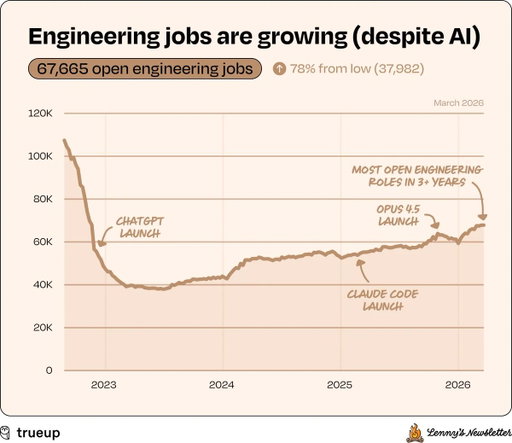
Engineering job openings are at the highest levels we’ve seen in over 3 years

There are over 67,000 (!!!) eng openings at tech companies globally right now, with 26,000 just in the U.S. We don’t know if there would have been more open roles if not for AI or if AI is actually leading to more open roles, but since the start of this year, the increase in open eng roles is accelerating even more.
1.77M
2.40K
182
533
3mo ago
lennysan
Engineering job openings are at the highest levels we’ve seen in over 3 years There are over 67,000 (!!!) eng openings at tech companies globally right now, with 26,000 just in the U.S. We don’t know if there would have been more open roles if not for AI or if AI is actually leading to more open roles, but since the start of this year, the increase in open eng roles is accelerating even more.

Design lead for Claude: The classic design process is dead. Here's what's replacing it. Jenny Wen (@jenny_wen) leads design for Claude at @AnthropicAI, was previously director of design at @Figma, and a designer at @Dropbox, @Square, and @Shopify. In our in-depth conversation, we discuss: 🔸 Why the classic discovery → mock → iterate design process is becoming obsolete 🔸 What a day in the life of a designer at Anthropic looks like, including her AI tool stack 🔸 Whether AI will eventually surpass humans in taste and judgment 🔸 Why Jenny left a director role at Figma to return to IC work 🔸 The three archetypes Jenny is hiring for now This conversation changed how I think about the future of design. Listen now 👇 t.co/r4HICq4Ytn

1.49M
3.12K
88
367
3mo ago
lennysan
Design lead for Claude: The classic design process is dead. Here's what's replacing it. Jenny Wen (@jenny_wen) leads design for Claude at @AnthropicAI, was previously director of design at @Figma, and a designer at @Dropbox, @Square, and @Shopify. In our in-depth conversation, we discuss: 🔸 Why the classic discovery → mock → iterate design process is becoming obsolete 🔸 What a day in the life of a designer at Anthropic looks like, including her AI tool stack 🔸 Whether AI will eventually surpass humans in taste and judgment 🔸 Why Jenny left a director role at Figma to return to IC work 🔸 The three archetypes Jenny is hiring for now This conversation changed how I think about the future of design. Listen now 👇 https://t.co/r4HICq4Ytn

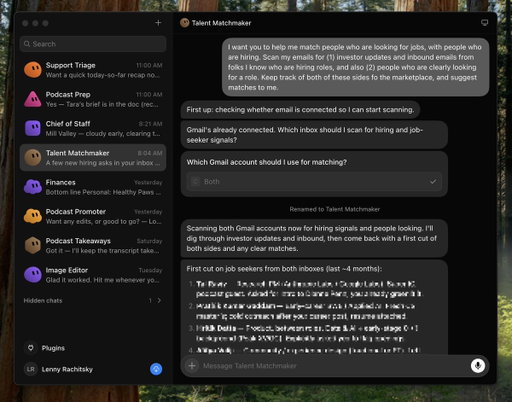
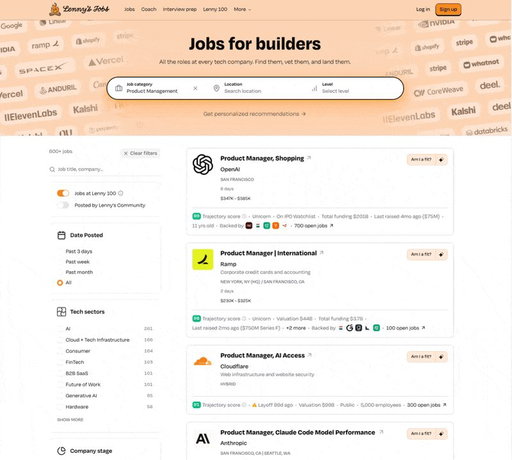
Software is not a moat Over the last 15+ years, nearly every innovation @EvanSpiegel and his team shipped got copied. Stories. AR glasses. Swipe-based navigation. The camera-first interface. And yet @Snapchat is the only independent consumer social app that has lasted. Nearly 1 billion MAUs. ~$6B in annual revenue. Over 8 billion AI photos shared on Snapchat *every day*. In our in-depth conversation, we discuss: 🔸 Why distribution—not product—is now the biggest challenge for startups 🔸 How Snap keeps inventing with a 9-to-12-person design team 🔸 How AI is changing the way designers work 🔸 Why humanity's comfort with AI will be a bigger bottleneck than the technology 🔸 Why Evan is calling this year a "crucible moment" for Snap Listen now 👇 t.co/2KO5eH2GHC
1.38M
846
56
101
1mo ago
lennysan
Software is not a moat Over the last 15+ years, nearly every innovation @EvanSpiegel and his team shipped got copied. Stories. AR glasses. Swipe-based navigation. The camera-first interface. And yet @Snapchat is the only independent consumer social app that has lasted. Nearly 1 billion MAUs. ~$6B in annual revenue. Over 8 billion AI photos shared on Snapchat *every day*. In our in-depth conversation, we discuss: 🔸 Why distribution—not product—is now the biggest challenge for startups 🔸 How Snap keeps inventing with a 9-to-12-person design team 🔸 How AI is changing the way designers work 🔸 Why humanity's comfort with AI will be a bigger bottleneck than the technology 🔸 Why Evan is calling this year a "crucible moment" for Snap Listen now 👇 https://t.co/2KO5eH2GHC
Anthropic co-founder Ben Mann on why he chose Montessori for his daughter:

"If this were 10-20 years ago, I'd be lining her up for top-tier schools and extracurriculars. But now I don't think any of it's going to matter. Learning facts is going to fade into the background. What matters is that she's happy, thoughtful, curious, and kind."
1.23M
3.21K
120
312
11mo ago
lennysan
Anthropic co-founder Ben Mann on why he chose Montessori for his daughter: "If this were 10-20 years ago, I'd be lining her up for top-tier schools and extracurriculars. But now I don't think any of it's going to matter. Learning facts is going to fade into the background. What matters is that she's happy, thoughtful, curious, and kind."

Amol (Head of Growth at @AnthropicAI) just joined Twitter. Follow for free alpha. BTW, can you believe they hit $30B ARR before they even released Mythos?

1.22M
3.97K
98
87
2mo ago
lennysan
Amol (Head of Growth at @AnthropicAI) just joined Twitter. Follow for free alpha. BTW, can you believe they hit $30B ARR before they even released Mythos?
Ben Mann (@8enmann) left @OpenAI in 2020 with the entire safety team to co-found @AnthropicAI (now reportedly valued at over $100B).  

In a rare interview, Ben opens up about:
🔸 What he saw at OpenAI that convinced him to leave
🔸 The AI nightmare scenarios that concern him most
🔸 His take on Meta’s $100M talent wars
🔸 Why he believes 20% unemployment is inevitable
🔸 His “economic Turing test” for knowing when we’ve achieved AGI—and why it’s likely coming by 2027-2028
🔸 How focusing on AI safety created Claude’s beloved personality
🔸 What three skills he’s teaching his kids to thrive in an AI future
🔸 So much more

Listen now 👇
• YouTube: https://t.co/ggeYDMKwXv
• Spotify: https://t.co/g3f7tc1N2H
• Apple: https://t.co/SKthbwszpr

Thank you to our wonderful sponsors for supporting the podcast: 
🏆 https://t.co/A9opfqNPgo —Turn customer pain into product revenue: https://t.co/8zMNdhI1Uc
🏆 @Lucid_Link—Real-time cloud storage for teams: https://t.co/EMeHf5efGn
🏆 @Fin_ai—The #1 AI agent for customer service: https://t.co/gHMbsr9U6W
1.21M
731
29
83
11mo ago
lennysan
Ben Mann (@8enmann) left @OpenAI in 2020 with the entire safety team to co-found @AnthropicAI (now reportedly valued at over $100B). In a rare interview, Ben opens up about: 🔸 What he saw at OpenAI that convinced him to leave 🔸 The AI nightmare scenarios that concern him most 🔸 His take on Meta’s $100M talent wars 🔸 Why he believes 20% unemployment is inevitable 🔸 His “economic Turing test” for knowing when we’ve achieved AGI—and why it’s likely coming by 2027-2028 🔸 How focusing on AI safety created Claude’s beloved personality 🔸 What three skills he’s teaching his kids to thrive in an AI future 🔸 So much more Listen now 👇 • YouTube: https://t.co/ggeYDMKwXv • Spotify: https://t.co/g3f7tc1N2H • Apple: https://t.co/SKthbwszpr Thank you to our wonderful sponsors for supporting the podcast: 🏆 https://t.co/A9opfqNPgo —Turn customer pain into product revenue: https://t.co/8zMNdhI1Uc 🏆 @Lucid_Link—Real-time cloud storage for teams: https://t.co/EMeHf5efGn 🏆 @Fin_ai—The #1 AI agent for customer service: https://t.co/gHMbsr9U6W

Claude Code launched just one year ago. Today it writes 4% of all GitHub commits, and DAU 2x'd last month alone. In my conversation with @bcherny, creator and head of Claude Code, we dig into: 🔸 Why he considers coding "largely solved" 🔸 What tech jobs will be transformed next 🔸 The counterintuitive bet that made Claude Code take off 🔸 Why he left for Cursor and what brought him back 🔸 Practical tips for getting the most out of Claude Code and Cowork 🔸 Much more Listen now👇 t.co/4hHAEq0Nto

1.18M
755
66
97
4mo ago
lennysan
Claude Code launched just one year ago. Today it writes 4% of all GitHub commits, and DAU 2x'd last month alone. In my conversation with @bcherny, creator and head of Claude Code, we dig into: 🔸 Why he considers coding "largely solved" 🔸 What tech jobs will be transformed next 🔸 The counterintuitive bet that made Claude Code take off 🔸 Why he left for Cursor and what brought him back 🔸 Practical tips for getting the most out of Claude Code and Cowork 🔸 Much more Listen now👇 https://t.co/4hHAEq0Nto

Anthropic is on an unprecedented growth run. Just in the past year they grew from $1B to $19B ARR. They added $6B in ARR just in *February*. Companies like Palantir and Atlassian took 15-20 years to reach ~$5B ARR. Anthropic is adding that every month. Amol Avasare is head of growth at Anthropic, and one of the most impressive people I've had on the podcast. In his first ever public interview, Amol shares: 🔸 How Anthropic is automating growth experiments with Claude (their internal tool called “CASH”) 🔸 Why activation is the single highest-leverage growth problem in AI 🔸 Why Amol is hiring more PMs, not less 🔸 How he uses Cowork to automatically detect team misalignment in Slack 🔸 How the company’s focus on AI coding created a research flywheel that accelerated their models 🔸 How Amol landed his role by cold emailing Anthropic’s CPO @mikeyk 🔸 The brain injury that nearly ended Amol's career Listen now 👇 t.co/YEn8K2xjCQ

1.15M
573
59
71
2mo ago
lennysan
Anthropic is on an unprecedented growth run. Just in the past year they grew from $1B to $19B ARR. They added $6B in ARR just in *February*. Companies like Palantir and Atlassian took 15-20 years to reach ~$5B ARR. Anthropic is adding that every month. Amol Avasare is head of growth at Anthropic, and one of the most impressive people I've had on the podcast. In his first ever public interview, Amol shares: 🔸 How Anthropic is automating growth experiments with Claude (their internal tool called “CASH”) 🔸 Why activation is the single highest-leverage growth problem in AI 🔸 Why Amol is hiring more PMs, not less 🔸 How he uses Cowork to automatically detect team misalignment in Slack 🔸 How the company’s focus on AI coding created a research flywheel that accelerated their models 🔸 How Amol landed his role by cold emailing Anthropic’s CPO @mikeyk 🔸 The brain injury that nearly ended Amol's career Listen now 👇 https://t.co/YEn8K2xjCQ
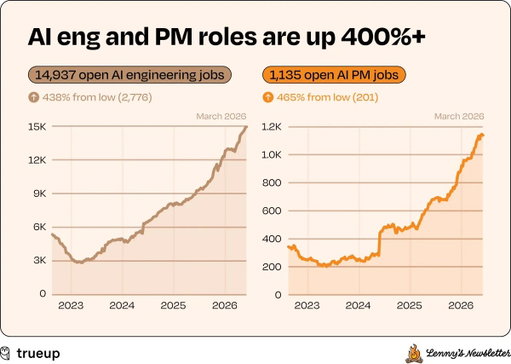
STATE OF THE PRODUCT JOB MARKET IN EARLY 2026

In spite of the headlines about layoffs and AI taking jobs, we’re actually seeing a lot of promising signs in tech hiring, and some interesting new trends:
1. PM openings are at the highest levels we’ve seen in over three years
2. AI hasn’t slowed the demand for software engineers (at least not yet)
3. AI roles in general are absolutely exploding
4. Design roles have plateaued
5. The Bay Area is increasing in importance
6. Remote work opportunities continue to decline
7. Despite ongoing layoffs, the overall number of tech jobs continues to grow

More in 🧵
1.07M
1.43K
136
344
3mo ago
lennysan
STATE OF THE PRODUCT JOB MARKET IN EARLY 2026 In spite of the headlines about layoffs and AI taking jobs, we’re actually seeing a lot of promising signs in tech hiring, and some interesting new trends: 1. PM openings are at the highest levels we’ve seen in over three years 2. AI hasn’t slowed the demand for software engineers (at least not yet) 3. AI roles in general are absolutely exploding 4. Design roles have plateaued 5. The Bay Area is increasing in importance 6. Remote work opportunities continue to decline 7. Despite ongoing layoffs, the overall number of tech jobs continues to grow More in 🧵

My biggest takeaways from Claude Code's Head of Product @_catwu: 1. Anthropic’s product development timelines have gone from six months to one month, sometimes one week, sometimes one day. Part of this acceleration is access to the latest models (i.e. Mythos). Another is shipping new products into “research preview,” making clear it's early, experimental, and might not be supported forever. Another is an evergreen "launch room "where engineers post ready features and marketing turns around announcements the next day. 2. The PM role is shifting from coordinating multi-month roadmaps to enabling teams to ship daily. As Cat puts it, “There should be less emphasis on making sure you are aligning your multi-quarter roadmaps with your partner teams and more emphasis on, OK, how can we figure out the fastest way to get something out the door?” 3. The most efficient shipping unit is an engineer with great product taste. On Cat’s team, many engineers go end-to-end—from seeing user feedback on Twitter to shipping a product by the end of the week—without a PM involved. Also, almost all the PMs on the Claude Code team have either been engineers or ship code themselves, and the designers have been front-end engineers. The roles are merging, and the most valuable skill is product taste, not job title. 4. Build products that are on the edge of working. Claude Code’s code review product failed multiple times because earlier models weren’t accurate enough. But because the prototype was already built, they could swap in Opus 4.5 and 4.6 and immediately test whether the gap was closed. Teams that wait for the model to be ready will always be a cycle behind. 5. The most underrated skill for building AI products is asking the model to introspect on its own mistakes. Cat regularly asks the model why it made an unexpected decision. The model will explain that something in the system prompt was confusing, or that it delegated verification to a subagent that didn’t check its work. This reveals what misled the model so the team can fix the harness. 6. Every model release forces their team to revisit existing products and audit their system prompt to remove features the model no longer needs. Claude Code’s to-do list was a crutch for earlier models that couldn’t track their own work. With Opus 4, the model handles it natively. Features built as scaffolding for weaker models become debt when the model catches up—so the team actively strips them. 7. Anthropic employees build custom internal tools instead of buying SaaS products. A sales team member built a web app that pulls from Salesforce, Gong, and call notes to auto-customize pitch decks—work that used to take 20 to 30 minutes now takes seconds. Their core stack is Claude Code, Cowork, and Slack. No Notion, no Linear, no Figma. 8. People underestimate how much Claude’s personality contributes to its success. As Cat describes it, “When you reflect on everyone you’ve worked with, there’s just some people where you’re like, I really like their energy, their vibe.” Claude is designed to be low-ego, positive, competent, and earnest—qualities that make it feel like a great coworker, not just a tool. This isn’t cosmetic; it’s what makes people want to use Claude for hours every day. The team has a dedicated person, Amanda, who “molds Claude’s character,” and it’s one of the hardest roles at the company because success is so subjective. 9. The future of work is managing fleets of AI agents, not doing the work yourself. Cat sees a clear progression: first, individual tasks become successful. Then people start running multiple tasks at the same time (multi-Clauding). Next, people will run 50 or 100 tasks simultaneously, which will require new infrastructure—remote execution, better interfaces for managing tasks, agents that fully verify their work, and self-improving systems that incorporate feedback. The human role shifts from doing the work to knowing which tasks to look into, verifying outputs, and giving feedback that makes the system better over time. 10. Hire people who lean into chaos and face every challenge with a smile. At Anthropic, there are weeks when a P0 on Sunday becomes a P00 by Monday and a P000 by Monday afternoon. If you get too stressed about any one thing, you’ll burn out. Their team looks for people who can look at a hard challenge and say, “Wow, that’s gonna be hard. But I’m excited to tackle it and I’m gonna do the best that I possibly can.” This mindset—optimism, resilience, and comfort with constant change—is increasingly essential as the pace of AI development accelerates. Don't miss the full conversation: t.co/1wOUHcdYQN

845K
2.87K
98
358
2mo ago
lennysan
My biggest takeaways from Claude Code's Head of Product @_catwu: 1. Anthropic’s product development timelines have gone from six months to one month, sometimes one week, sometimes one day. Part of this acceleration is access to the latest models (i.e. Mythos). Another is shipping new products into “research preview,” making clear it's early, experimental, and might not be supported forever. Another is an evergreen "launch room "where engineers post ready features and marketing turns around announcements the next day. 2. The PM role is shifting from coordinating multi-month roadmaps to enabling teams to ship daily. As Cat puts it, “There should be less emphasis on making sure you are aligning your multi-quarter roadmaps with your partner teams and more emphasis on, OK, how can we figure out the fastest way to get something out the door?” 3. The most efficient shipping unit is an engineer with great product taste. On Cat’s team, many engineers go end-to-end—from seeing user feedback on Twitter to shipping a product by the end of the week—without a PM involved. Also, almost all the PMs on the Claude Code team have either been engineers or ship code themselves, and the designers have been front-end engineers. The roles are merging, and the most valuable skill is product taste, not job title. 4. Build products that are on the edge of working. Claude Code’s code review product failed multiple times because earlier models weren’t accurate enough. But because the prototype was already built, they could swap in Opus 4.5 and 4.6 and immediately test whether the gap was closed. Teams that wait for the model to be ready will always be a cycle behind. 5. The most underrated skill for building AI products is asking the model to introspect on its own mistakes. Cat regularly asks the model why it made an unexpected decision. The model will explain that something in the system prompt was confusing, or that it delegated verification to a subagent that didn’t check its work. This reveals what misled the model so the team can fix the harness. 6. Every model release forces their team to revisit existing products and audit their system prompt to remove features the model no longer needs. Claude Code’s to-do list was a crutch for earlier models that couldn’t track their own work. With Opus 4, the model handles it natively. Features built as scaffolding for weaker models become debt when the model catches up—so the team actively strips them. 7. Anthropic employees build custom internal tools instead of buying SaaS products. A sales team member built a web app that pulls from Salesforce, Gong, and call notes to auto-customize pitch decks—work that used to take 20 to 30 minutes now takes seconds. Their core stack is Claude Code, Cowork, and Slack. No Notion, no Linear, no Figma. 8. People underestimate how much Claude’s personality contributes to its success. As Cat describes it, “When you reflect on everyone you’ve worked with, there’s just some people where you’re like, I really like their energy, their vibe.” Claude is designed to be low-ego, positive, competent, and earnest—qualities that make it feel like a great coworker, not just a tool. This isn’t cosmetic; it’s what makes people want to use Claude for hours every day. The team has a dedicated person, Amanda, who “molds Claude’s character,” and it’s one of the hardest roles at the company because success is so subjective. 9. The future of work is managing fleets of AI agents, not doing the work yourself. Cat sees a clear progression: first, individual tasks become successful. Then people start running multiple tasks at the same time (multi-Clauding). Next, people will run 50 or 100 tasks simultaneously, which will require new infrastructure—remote execution, better interfaces for managing tasks, agents that fully verify their work, and self-improving systems that incorporate feedback. The human role shifts from doing the work to knowing which tasks to look into, verifying outputs, and giving feedback that makes the system better over time. 10. Hire people who lean into chaos and face every challenge with a smile. At Anthropic, there are weeks when a P0 on Sunday becomes a P00 by Monday and a P000 by Monday afternoon. If you get too stressed about any one thing, you’ll burn out. Their team looks for people who can look at a hard challenge and say, “Wow, that’s gonna be hard. But I’m excited to tackle it and I’m gonna do the best that I possibly can.” This mindset—optimism, resilience, and comfort with constant change—is increasingly essential as the pace of AI development accelerates. Don't miss the full conversation: https://t.co/1wOUHcdYQN

"High performance machines don't have psychological safety. They're about winning." Keith Rabois (@rabois) was COO of Square, part of the PayPal Mafia, an early investor in Stripe, Palantir, Airbnb, DoorDash, and Ramp, and a 2x founder. He's spent 25 years obsessing over how to build world-class teams. In our in-depth conversation, we discuss: 🔸 How to identify undiscovered talent 🔸 Keith's barrels vs. ammunition hiring framework 🔸 The three traits of the best-performing companies right now 🔸 Why talking to customers is actively harmful for consumer products 🔸 Why the PM role is dying 🔸 The specific interview question he asks every senior candidate 🔸 Why CMOs (not engineers) are becoming the #1 consumer of AI tokens Watch now 👇 t.co/7E1uyvJvQv

816K
356
43
62
2mo ago
lennysan
"High performance machines don't have psychological safety. They're about winning." Keith Rabois (@rabois) was COO of Square, part of the PayPal Mafia, an early investor in Stripe, Palantir, Airbnb, DoorDash, and Ramp, and a 2x founder. He's spent 25 years obsessing over how to build world-class teams. In our in-depth conversation, we discuss: 🔸 How to identify undiscovered talent 🔸 Keith's barrels vs. ammunition hiring framework 🔸 The three traits of the best-performing companies right now 🔸 Why talking to customers is actively harmful for consumer products 🔸 Why the PM role is dying 🔸 The specific interview question he asks every senior candidate 🔸 Why CMOs (not engineers) are becoming the #1 consumer of AI tokens Watch now 👇 https://t.co/7E1uyvJvQv
My biggest takeaways from Dhanji Prasanna, CTO of @Blocks:

1. Block’s internal AI agent "Goose" is saving employees on average 8 to 10 hours per week. The company built an open-source tool called Goose that handles tasks from organizing files to writing code. Across the entire company, they’re seeing roughly 20% to 25% of manual work hours saved, and that number keeps climbing.

2. Non-technical teams are getting the biggest productivity boost from AI, not engineers. People in legal, risk management, and operations are now building their own software tools that previously would have required months on an engineering team’s roadmap. What used to take weeks now takes hours, and employees do it themselves without waiting.

3. Changing organizational structure unlocked more productivity than any AI tool. To transform into a truly “technology driven” company, Block reorganized from separate business units (each with their own GM and engineering teams) to a single functional structure where all engineers report to one leader. This “boring” change enabled a unified technology strategy and drove more acceleration than any AI tool.

4. Code quality has almost nothing to do with product success. YouTube became one of Google’s most successful products despite storing videos as blobs in a MySQL database with a slow Python stack. Meanwhile, Google Video had superior technology with more formats and higher resolution but failed completely. The lesson: Focus on solving real problems for people, not on perfect code.

5. AI enables teams to explore multiple paths simultaneously instead of choosing one up front. Previously, limited resources meant teams had to pick their best guess for an experiment. Now AI can build multiple different approaches overnight, allowing teams to compare five or six options and throw away entire features if they don’t feel right—a practice that was unthinkable before.

6. Most successful products start as tiny experiments, not big initiatives. Cash App began as a hack-week idea. Goose started as one engineer’s side project. Block’s Bitcoin product came from a three-person hackathon team. In contrast, Google Wave had 70 to 80 engineers before having real users and failed. Small experiments that prove value beat large up-front investments.

7. Leaders must use AI tools daily to drive real organizational adoption. Block’s CEO Jack Dorsey, the CTO, and the entire executive team use Goose every single day. This hands-on experience teaches them how workflows actually change and drives authentic adoption throughout the organization far more than reading articles or attending conferences about AI.

8. AI excels at new projects but struggles with complex legacy systems. Teams building new applications or working on greenfield platforms see aggressive productivity gains. But in existing codebases with years of accumulated complexity, the gains aren’t there yet. Deploy AI where it works best rather than everywhere at once.

9. Giving away valuable technology for free can be a winning strategy. Block open-sourced Goose even though it could have been a standalone billion-dollar business. Even their competitors actively use it. The philosophy: build things that benefit everyone and outlast your own company. This commitment to open-source technology attracts talent and builds industry goodwill while advancing everyone’s capabilities.

10. Purpose should drive your technology choices, not the other way around. Rather than chasing every AI trend or trying to be at the forefront of every technology, identify what truly matters to your company and customers. Block stays focused on economic empowerment, which guides their technology decisions and keeps them from getting distracted by every new advancement.

Listen now 👇
• YouTube: https://t.co/9EHbGeLyvi
• Spotify: https://t.co/NWqEF7saLo
• Apple: https://t.co/rnu9RASEPJ

Thank you to our wonderful sponsors for supporting the podcast: 
🏆 @wearesinch — Build messaging, email, and calling into your product: https://t.co/kfaPvA5HQs
🏆 @Figma Make — A prompt-to-code tool for making ideas real: https://t.co/8iUp8fgO4x
🏆 @withpersona — A global leader in digital identity verification: A
812K
419
26
84
8mo ago
lennysan
My biggest takeaways from Dhanji Prasanna, CTO of @Blocks: 1. Block’s internal AI agent "Goose" is saving employees on average 8 to 10 hours per week. The company built an open-source tool called Goose that handles tasks from organizing files to writing code. Across the entire company, they’re seeing roughly 20% to 25% of manual work hours saved, and that number keeps climbing. 2. Non-technical teams are getting the biggest productivity boost from AI, not engineers. People in legal, risk management, and operations are now building their own software tools that previously would have required months on an engineering team’s roadmap. What used to take weeks now takes hours, and employees do it themselves without waiting. 3. Changing organizational structure unlocked more productivity than any AI tool. To transform into a truly “technology driven” company, Block reorganized from separate business units (each with their own GM and engineering teams) to a single functional structure where all engineers report to one leader. This “boring” change enabled a unified technology strategy and drove more acceleration than any AI tool. 4. Code quality has almost nothing to do with product success. YouTube became one of Google’s most successful products despite storing videos as blobs in a MySQL database with a slow Python stack. Meanwhile, Google Video had superior technology with more formats and higher resolution but failed completely. The lesson: Focus on solving real problems for people, not on perfect code. 5. AI enables teams to explore multiple paths simultaneously instead of choosing one up front. Previously, limited resources meant teams had to pick their best guess for an experiment. Now AI can build multiple different approaches overnight, allowing teams to compare five or six options and throw away entire features if they don’t feel right—a practice that was unthinkable before. 6. Most successful products start as tiny experiments, not big initiatives. Cash App began as a hack-week idea. Goose started as one engineer’s side project. Block’s Bitcoin product came from a three-person hackathon team. In contrast, Google Wave had 70 to 80 engineers before having real users and failed. Small experiments that prove value beat large up-front investments. 7. Leaders must use AI tools daily to drive real organizational adoption. Block’s CEO Jack Dorsey, the CTO, and the entire executive team use Goose every single day. This hands-on experience teaches them how workflows actually change and drives authentic adoption throughout the organization far more than reading articles or attending conferences about AI. 8. AI excels at new projects but struggles with complex legacy systems. Teams building new applications or working on greenfield platforms see aggressive productivity gains. But in existing codebases with years of accumulated complexity, the gains aren’t there yet. Deploy AI where it works best rather than everywhere at once. 9. Giving away valuable technology for free can be a winning strategy. Block open-sourced Goose even though it could have been a standalone billion-dollar business. Even their competitors actively use it. The philosophy: build things that benefit everyone and outlast your own company. This commitment to open-source technology attracts talent and builds industry goodwill while advancing everyone’s capabilities. 10. Purpose should drive your technology choices, not the other way around. Rather than chasing every AI trend or trying to be at the forefront of every technology, identify what truly matters to your company and customers. Block stays focused on economic empowerment, which guides their technology decisions and keeps them from getting distracted by every new advancement. Listen now 👇 • YouTube: https://t.co/9EHbGeLyvi • Spotify: https://t.co/NWqEF7saLo • Apple: https://t.co/rnu9RASEPJ Thank you to our wonderful sponsors for supporting the podcast: 🏆 @wearesinch — Build messaging, email, and calling into your product: https://t.co/kfaPvA5HQs 🏆 @Figma Make — A prompt-to-code tool for making ideas real: https://t.co/8iUp8fgO4x 🏆 @withpersona — A global leader in digital identity verification: A
Fascinating results

+ Anthropic running away with it right now
+ So many people want to start their own company
+ Google over OpenAI
+ Vercel, Linear, Every, PostHog overperforming

A great list if you're trying to figure out where to go work 👇
797K
1.54K
194
198
3w ago
lennysan
Fascinating results + Anthropic running away with it right now + So many people want to start their own company + Google over OpenAI + Vercel, Linear, Every, PostHog overperforming A great list if you're trying to figure out where to go work 👇

My biggest learnings from Jeanne DeWitt Grosser (ex-Chief Business Officer at @Stripe, now @Vercel COO): 1. What failed seven years ago now works with AI. In 2017, Jeanne tried to build a system at Stripe that would automatically personalize outbound emails based on company data. Despite working with world-class data scientists, it failed due to too many errors. Today, that exact same approach works. This shows how AI has made previously impossible ideas suddenly viable. 2. A single GTM engineer at Vercel reduced a 10-person sales team to 1 (in just 6 weeks). Jeanne’s team at Vercel had an engineer build an AI agent that handles inbound lead qualification, outbound prospecting, and deal loss evaluation. The agent costs $1,000 per year to run versus over $1 million in salaries for the sales team. The nine displaced team members moved to higher-value work rather than being laid off, and the remaining salesperson is 10 times more efficient. 3. Their AI deal-loss bot has become better at understanding what went wrong than humans. When Jeanne analyzed her biggest loss of the quarter, the salesperson blamed pricing. But an AI agent reviewed every email, call transcript, and Slack message and discovered the real reason: they never spoke to the person who controls the budget, and when ROI came up, the customer clearly didn’t believe the value claims. They are now using AI to analyze sales calls in real time and send alerts like “You’re halfway through the sales process and haven’t talked to a budget decision-maker yet.” 4. Wait until $1 million in revenue before hiring your first salesperson. Founders should continue selling themselves until they reach around $1 million in annual revenue with a repeatable process. The key is having a defined ideal customer profile—customers who look alike. 5. Segment customers on what drives their buying decisions, not just company size. OpenAI has roughly 3,000 employees, which would typically put them in the “mid-market” category. But they’re a top-25 website globally by traffic, so Vercel treats them as enterprise customers requiring complex sales. Effective segmentation combines company size with growth rate, web traffic, workload type, and industry—because selling to e-commerce companies requires completely different language than selling to crypto companies. 6. Most customers buy to avoid risk, not to gain opportunity. About 80% of customers purchase to reduce pain or avoid problems, while only 20% buy to increase upside. This means you should focus your sales messaging on what could go wrong without your product—like falling behind competitors or damaging their reputation—rather than just talking about exciting features. This is especially true when selling to larger companies, where individual careers are on the line. 7. Sales teams should be indistinguishable from product managers—for a bit. Jeanne hires salespeople who have such deep product knowledge that if you put one in front of a group of engineers, it should take 10 minutes to realize they’re not a product manager. This credibility allows sales teams to serve as an extension of research and development—a 20-person sales team talks to hundreds of customers weekly and can translate those conversations into product insights at scale. 8. Building your own AI sales tools may beat buying off-the-shelf software. Because AI is so new and every company’s sales process is unique, Jeanne finds that building custom internal agents often delivers more value than buying vendor solutions. A single go-to-market engineer built their deal analysis bot in just two days, perfectly tailored to their specific workflow. These engineers shadow top salespeople to understand their workflows, then build automation that would have taken months or been impossible just a few years ago. 9. Make every sales interaction great, whether customers buy or not. Jeanne replaced boring discovery calls at Stripe with collaborative whiteboarding sessions where customers drew their payment architecture. Many customers had never visualized their own systems before. They left with a useful asset and a feeling of collaboration, regardless of whether they bought. Many returned years later to purchase. Think about your go-to-market process like a product, not just a sales function. 10. Product-led growth has a ceiling—no $100 billion company runs on it alone. While product-led growth (where users can sign up and start using a product without talking to sales) works well for early growth, customers generally won’t spend a million dollars through a self-service flow. Every major technology company eventually builds a sales team for larger deals. The mistake is waiting too long, since building a predictable sales process takes time.

773K
1.97K
74
231
6mo ago
lennysan
My biggest learnings from Jeanne DeWitt Grosser (ex-Chief Business Officer at @Stripe, now @Vercel COO): 1. What failed seven years ago now works with AI. In 2017, Jeanne tried to build a system at Stripe that would automatically personalize outbound emails based on company data. Despite working with world-class data scientists, it failed due to too many errors. Today, that exact same approach works. This shows how AI has made previously impossible ideas suddenly viable. 2. A single GTM engineer at Vercel reduced a 10-person sales team to 1 (in just 6 weeks). Jeanne’s team at Vercel had an engineer build an AI agent that handles inbound lead qualification, outbound prospecting, and deal loss evaluation. The agent costs $1,000 per year to run versus over $1 million in salaries for the sales team. The nine displaced team members moved to higher-value work rather than being laid off, and the remaining salesperson is 10 times more efficient. 3. Their AI deal-loss bot has become better at understanding what went wrong than humans. When Jeanne analyzed her biggest loss of the quarter, the salesperson blamed pricing. But an AI agent reviewed every email, call transcript, and Slack message and discovered the real reason: they never spoke to the person who controls the budget, and when ROI came up, the customer clearly didn’t believe the value claims. They are now using AI to analyze sales calls in real time and send alerts like “You’re halfway through the sales process and haven’t talked to a budget decision-maker yet.” 4. Wait until $1 million in revenue before hiring your first salesperson. Founders should continue selling themselves until they reach around $1 million in annual revenue with a repeatable process. The key is having a defined ideal customer profile—customers who look alike. 5. Segment customers on what drives their buying decisions, not just company size. OpenAI has roughly 3,000 employees, which would typically put them in the “mid-market” category. But they’re a top-25 website globally by traffic, so Vercel treats them as enterprise customers requiring complex sales. Effective segmentation combines company size with growth rate, web traffic, workload type, and industry—because selling to e-commerce companies requires completely different language than selling to crypto companies. 6. Most customers buy to avoid risk, not to gain opportunity. About 80% of customers purchase to reduce pain or avoid problems, while only 20% buy to increase upside. This means you should focus your sales messaging on what could go wrong without your product—like falling behind competitors or damaging their reputation—rather than just talking about exciting features. This is especially true when selling to larger companies, where individual careers are on the line. 7. Sales teams should be indistinguishable from product managers—for a bit. Jeanne hires salespeople who have such deep product knowledge that if you put one in front of a group of engineers, it should take 10 minutes to realize they’re not a product manager. This credibility allows sales teams to serve as an extension of research and development—a 20-person sales team talks to hundreds of customers weekly and can translate those conversations into product insights at scale. 8. Building your own AI sales tools may beat buying off-the-shelf software. Because AI is so new and every company’s sales process is unique, Jeanne finds that building custom internal agents often delivers more value than buying vendor solutions. A single go-to-market engineer built their deal analysis bot in just two days, perfectly tailored to their specific workflow. These engineers shadow top salespeople to understand their workflows, then build automation that would have taken months or been impossible just a few years ago. 9. Make every sales interaction great, whether customers buy or not. Jeanne replaced boring discovery calls at Stripe with collaborative whiteboarding sessions where customers drew their payment architecture. Many customers had never visualized their own systems before. They left with a useful asset and a feeling of collaboration, regardless of whether they bought. Many returned years later to purchase. Think about your go-to-market process like a product, not just a sales function. 10. Product-led growth has a ceiling—no $100 billion company runs on it alone. While product-led growth (where users can sign up and start using a product without talking to sales) works well for early growth, customers generally won’t spend a million dollars through a self-service flow. Every major technology company eventually builds a sales team for larger deals. The mistake is waiting too long, since building a predictable sales process takes time.
The @pmarca episode

Marc is a many-time founder, investor, co-creator of the web browser, co-founder of Netscape, the "a" in @a16z. In this very special conversation, we dig into why we’re living through one of the most unique times in history, and what comes next.

We discuss:
🔸 Why AI is arriving at the perfect moment to counter demographic collapse and declining productivity
🔸 How Marc is raising his 10yo kid to thrive in the AI future
🔸 The 3-way standoff that’s happening between PMs, designers, and engineers
🔸 What’s actually going to happen with AI and jobs (spoiler: he thinks the panic is “totally off base”)
🔸Why AI is "the philosopher’s stone" made real
🔸 Why you should still learn to code
🔸 His media diet: X and old books, nothing in between

Don't miss this one.

Full episode embedded here on X 👇
771K
1.52K
110
262
4mo ago
lennysan
The @pmarca episode Marc is a many-time founder, investor, co-creator of the web browser, co-founder of Netscape, the "a" in @a16z. In this very special conversation, we dig into why we’re living through one of the most unique times in history, and what comes next. We discuss: 🔸 Why AI is arriving at the perfect moment to counter demographic collapse and declining productivity 🔸 How Marc is raising his 10yo kid to thrive in the AI future 🔸 The 3-way standoff that’s happening between PMs, designers, and engineers 🔸 What’s actually going to happen with AI and jobs (spoiler: he thinks the panic is “totally off base”) 🔸Why AI is "the philosopher’s stone" made real 🔸 Why you should still learn to code 🔸 His media diet: X and old books, nothing in between Don't miss this one. Full episode embedded here on X 👇

My biggest takeaways from @danshipper: 1. The future of work will happen inside Codex or Claude Code. Instead of putting AI into your SaaS tool, you’ll use your SaaS tools inside your favorite AI agents' in-app browser. Dan spends all his time in Codex now—writing documents, managing email, doing research, everything. He's using Google Docs, PostHog, and everything he needs within the agent's in-app browser. The agent can see what he’s doing, and has all of his context, so he and his agent collaborate quickly and super effectively. 2. Automation is a lie—every automation needs a human. Dan's company doubled in size this year despite being incredibly AI-forward. Why? Because in order to make automation work well, you need humans making sure everything keeps working. This is why benchmarks are misleading—they measure AI on problems we’ve already framed and can score, but there’s always a higher frame. 3. PMs will win the AI era. Marcus, a former PM who previously ran Axios’s writing product, joined Every after getting super AI-pilled. Now he runs their product Spiral, and ships faster than anyone on the team. He pairs technical knowledge with spiky product sense, deep user empathy, and an eye for what matters. Dan thinks any PM who gets really AI-native will be incredibly dangerous because the building is done for you—what matters is figuring out what to build and if it’s great. 4. Full-stack designers are becoming superheroes. Designers used to make beautiful interactions that engineers didn’t want to build or couldn’t execute properly. Now designers don’t need to hand things off; they can build it themselves. Designers are naturally creative people, and AI is the perfect tool for them because it lets them bring their vision to life without the traditional bottlenecks. 5. SaaS is not dead. In fact, Dan is bullish on SaaS stocks. When users bring their own AI (via Codex or Claude Code) to use SaaS products, the user—not the SaaS company—pays for tokens. This saves SaaS company’s margins. Since the agents need their own seats, Dan predicts that agents will create massive new demand for SaaS because there will be tons of agents using these products at high volume. 6. Every company will have one “super-agent” inside their Slack that every employee will use. Dan initially thought every employee would have their personal work agent, like a shadow AI org chart, but he’s completely flipped his view. He realized agents need humans who care about them. When someone gets tired of maintaining their personal agent, it becomes useless. The winning model is one forward-deployed engineer or AI-savvy person who maintains a company-wide agent (like Shopify’s River or Viktor), and then it trickles down to more specialized team agents as models improve and become less fiddly. 7. The AI job apocalypse is not happening, but you do need to evolve to stay relevant. Models make yesterday’s human competence cheap. But because everyone uses the same models, it all looks the same if you use it the default way; it becomes commoditized slop. Humans then take that frozen competence and use it to make something new and interesting for their specific situation. The key: “ride the models”—use them for everything you do, try new models when they drop, keep turning over rocks. 8. We will read way more AI-generated writing, and we will like it. Human writing is incredibly important for things that matter, but for internal docs, planning, and email, AI-generated is often better because most people are bad at writing strategy documents. 9. Build software for humans and agents to use together. The current model is building a CLI that an agent uses independently. Instead, you and your agent should be using the app together. This creates new design challenges—agents can make a billion requests in three seconds, so you need approval flows, inboxes that summarize what happened, logs, and easy rollback. 10. Forward-deployed engineers are the new most essential role. The big model companies have teams of people managing their internal agents, and those teams aren’t going away. It’s different from traditional software building, and certain engineers love it. As models get better, this role will evolve—you’ll be managing more agents doing more things.

764K
2.09K
152
324
1mo ago
lennysan
My biggest takeaways from @danshipper: 1. The future of work will happen inside Codex or Claude Code. Instead of putting AI into your SaaS tool, you’ll use your SaaS tools inside your favorite AI agents' in-app browser. Dan spends all his time in Codex now—writing documents, managing email, doing research, everything. He's using Google Docs, PostHog, and everything he needs within the agent's in-app browser. The agent can see what he’s doing, and has all of his context, so he and his agent collaborate quickly and super effectively. 2. Automation is a lie—every automation needs a human. Dan's company doubled in size this year despite being incredibly AI-forward. Why? Because in order to make automation work well, you need humans making sure everything keeps working. This is why benchmarks are misleading—they measure AI on problems we’ve already framed and can score, but there’s always a higher frame. 3. PMs will win the AI era. Marcus, a former PM who previously ran Axios’s writing product, joined Every after getting super AI-pilled. Now he runs their product Spiral, and ships faster than anyone on the team. He pairs technical knowledge with spiky product sense, deep user empathy, and an eye for what matters. Dan thinks any PM who gets really AI-native will be incredibly dangerous because the building is done for you—what matters is figuring out what to build and if it’s great. 4. Full-stack designers are becoming superheroes. Designers used to make beautiful interactions that engineers didn’t want to build or couldn’t execute properly. Now designers don’t need to hand things off; they can build it themselves. Designers are naturally creative people, and AI is the perfect tool for them because it lets them bring their vision to life without the traditional bottlenecks. 5. SaaS is not dead. In fact, Dan is bullish on SaaS stocks. When users bring their own AI (via Codex or Claude Code) to use SaaS products, the user—not the SaaS company—pays for tokens. This saves SaaS company’s margins. Since the agents need their own seats, Dan predicts that agents will create massive new demand for SaaS because there will be tons of agents using these products at high volume. 6. Every company will have one “super-agent” inside their Slack that every employee will use. Dan initially thought every employee would have their personal work agent, like a shadow AI org chart, but he’s completely flipped his view. He realized agents need humans who care about them. When someone gets tired of maintaining their personal agent, it becomes useless. The winning model is one forward-deployed engineer or AI-savvy person who maintains a company-wide agent (like Shopify’s River or Viktor), and then it trickles down to more specialized team agents as models improve and become less fiddly. 7. The AI job apocalypse is not happening, but you do need to evolve to stay relevant. Models make yesterday’s human competence cheap. But because everyone uses the same models, it all looks the same if you use it the default way; it becomes commoditized slop. Humans then take that frozen competence and use it to make something new and interesting for their specific situation. The key: “ride the models”—use them for everything you do, try new models when they drop, keep turning over rocks. 8. We will read way more AI-generated writing, and we will like it. Human writing is incredibly important for things that matter, but for internal docs, planning, and email, AI-generated is often better because most people are bad at writing strategy documents. 9. Build software for humans and agents to use together. The current model is building a CLI that an agent uses independently. Instead, you and your agent should be using the app together. This creates new design challenges—agents can make a billion requests in three seconds, so you need approval flows, inboxes that summarize what happened, logs, and easy rollback. 10. Forward-deployed engineers are the new most essential role. The big model companies have teams of people managing their internal agents, and those teams aren’t going away. It’s different from traditional software building, and certain engineers love it. As models get better, this role will evolve—you’ll be managing more agents doing more things.

Lenny Rachitsky (@lennysan) X Stats & Analytics

Lenny Rachitsky (@lennysan) has 382K X followers with a 0.34% engagement rate over the past 12 months. Across 3.99K posts, Lenny Rachitsky received 335K total likes and 107M impressions, averaging 84.0 likes per post. This page tracks Lenny Rachitsky's performance metrics, top content, and engagement trends — updated daily.

Lenny Rachitsky (@lennysan) X Analytics FAQ

How many X (Twitter) followers does Lenny Rachitsky have?+
Lenny Rachitsky (@lennysan) has 382K X (Twitter) followers as of June 2026.
What is Lenny Rachitsky's X (Twitter) engagement rate?+
Lenny Rachitsky's X (Twitter) engagement rate is 0.34% over the last 12 months, based on 3.99K posts.
How many likes does Lenny Rachitsky get on X (Twitter)?+
Lenny Rachitsky received 335K total likes across 3.99K posts in the last 12 months, averaging 84.0 likes per post.
How many X (Twitter) impressions does Lenny Rachitsky get?+
Lenny Rachitsky's X (Twitter) content generated 107M total impressions over the last 12 months.