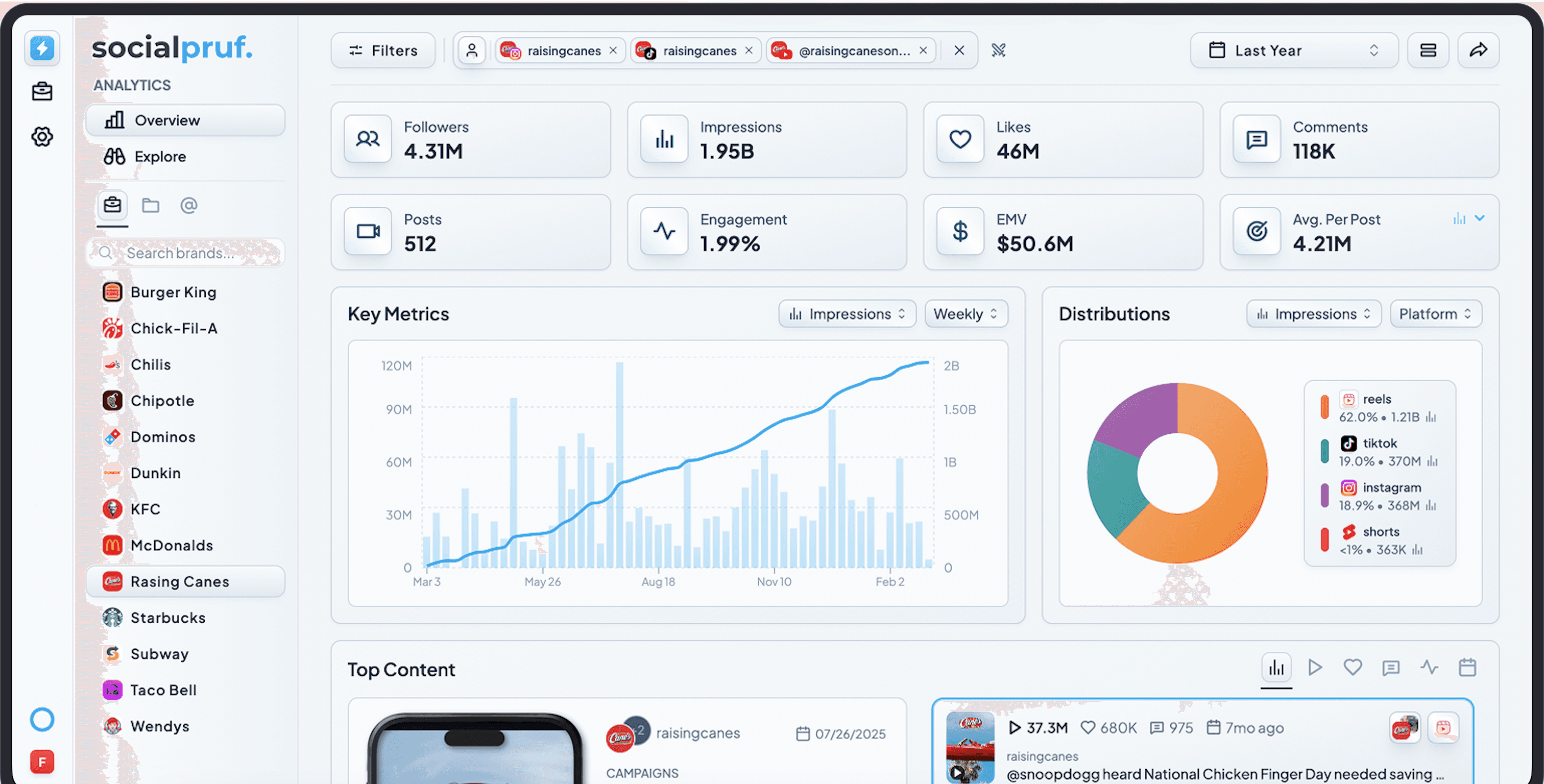



Marketing and social media teams depend on EMV to communicate to executives and finance teams the ‘value’ of organic social media content. It has proven to be a vague and fluff KPI for organic content creators to work towards. Marketers, social media teams and executives alike won't find real value in EMV unless they actually understand it.
The Basics
Earned Media Value is a dollar value assigned to social media content, based on impressions and interactions (comments and likes). It is based on the industry costs for buying impressions from platforms. At Socialpruf we have our own preferred benchmark, $20 CPM, $0.25 per like, and $1.25 each comment. CPM, standing for Cost Per Mile, is the price an advertiser pays for every 1,000 impressions a post or ad receives.
So if a post got 10,000 impressions, 500 likes and 50 comments you would calculate:
(Views / 1000) x 20 + Likes x 0.25 + Comments x 1.25 = EMV
((10,000 / 1000) x 20) + (500 x 0.25) + (50 x 1.25) = $387.5
Here is an example, click on the EMV widget to see our calculation: View
EMV Per Post

Knowing and understanding EMV Per Post and average EMV Per Post is a valuable KPI because you can exclude outliers and see where industry standards really lie. Comparing yourself against Lionel Messi’s newest campaign isn't going to be helpful, but knowing which of your individual posts are producing value will be. When going through the data you start to notice that per post consistency is far more valuable. It indicates an engaged community and a memorable presence. If your goal is to build a brand image and increase awareness, going viral for 30 seconds is not going to achieve anything. Instead with Per Post data you can identify spikes, trends and effectiveness.
Putting a monetary value of content can feel like an abstraction for creators, but with the right data the price becomes real. This is a statistic built into Socialpruf’s dashboard for users but for most is hard to get and even harder to maintain. Instead we’ve put together industry aggregates:
Industry Averages
For the non-Socialpruf users we have created an average across a handful of industries from the past year. Using live data from over 800 accounts we put together a comprehensive guide for 2026 EMV averages.
| Industry | Report | Average EMV Per Post |
|---|---|---|
| Beverages | View | $49,300 |
| Media | View | $30,300 |
| Apparel | View | $20,600 |
| Automotive | View | $19,200 |
| Fast Food | View | $4,870 |
| Beer & Seltzer | View | $1,240 |
| Gambling | View | $108 |
*Reports are live so data may appear different than when written.
With these averages you can discover trends, we see that content including alcohol and gambling, both of which have strict restrictions for social media advertising, average significantly lower than the rest.
How To Use EMV
EMV is a powerful tool for influencer and athlete campaigns. Say you put out 10 videos with an athlete and your campaign's EMV per post rose by 10% across the board, you can see where the value is created. An athlete with a highly engaged community will drive high value comments. Conversely you can pinpoint a fluke spike in impressions that could be overvaluing your influencers. You may be running a give away in your comment section, in which case every interaction is a potential customer and demand indicator. Your comment section then holds much more value, with EMV you can increase your comment dollar value to say $2. Per post EMV is just as powerful for longterm partnerships as well. A decreasing EMV month over month can indicate audience fatigue and changing trends.
Integrating an understanding of your business' social media conversion into your EMV formula makes it all the more important. If you know that 70% of your inbound is coming from TikTok, you would want to increase the value of TikTok interactions or devalue Instagram reach. Having a dynamic EMV that relates to your business model is where EMV shines.
EMV is often used as a post-campaign ROI indicator, and is a powerful one when understood. If you pair your EMV with actual campaign spend you can gauge return and compare ROI for paid, influencer, and organic content. It also helps frame social media spend as an investment to less generous finance teams and can encourage higher budgets when used right.
The bottom line is that understanding EMV makes it an extremely powerful tool that combines the three main interactions into a value that is universally understood. But, it has to be done right.