




instagram analytics
Similar Accounts:
instagram analytics
Similar Accounts:
followers
256K
impressions
12.4M
likes
238K
comments
2.74K
posts
419
engagement
1.92%
emv
$311K
Average per post
29.7K
Key Metrics
Impressions
monthly
Distributions
Content
334K
10.1K
104
10mo ago

startuparchive_
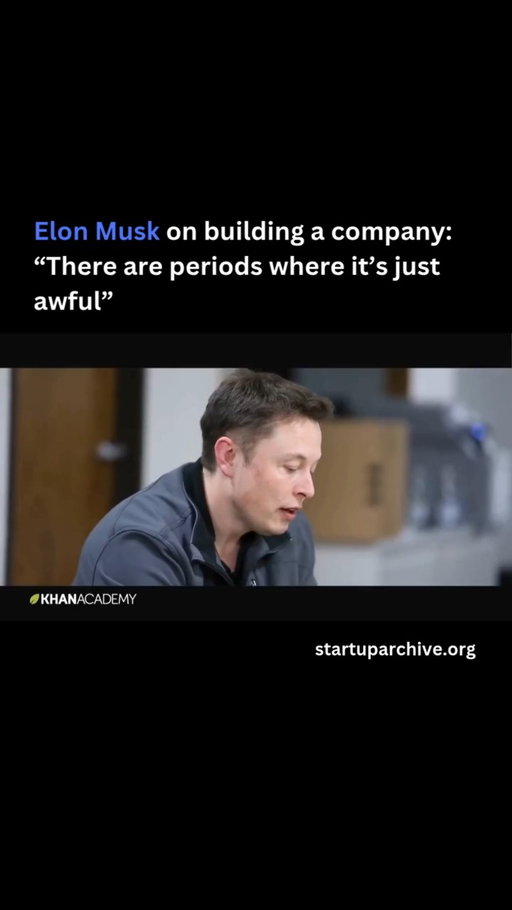
“A lot of times people think creating a company is going to be fun. I would say it’s really not that fun. There are periods of fun, and there are periods where it’s just awful. Particularly if you’re the CEO of the company. You actually have a distillation of all the worst problems in the company. There’s no point in spending your time on things that are going right. So you only spend your time on things that are going wrong that other people can’t take care of… the most pernicious and painful problems.”
Elon believes founders need to have a “fairly high pain threshold” and explains that starting a company is like “staring into the abyss and eating glass.”
“The staring into the abyss part is that you’re going to be constantly facing the extermination of the company because most startups fail… You’re constantly saying, okay, if I don’t get this right, the company will die. It’s going to be quite stressful. And then the eating glass part is you’ve got to work on the problems that the company needs you to work on, not the problems you want to work on. And so you end up working on problems that you’d really wish you weren’t working on… And that goes on for a long time.”
Video source: @khanacademy (2013)
---
Want even more startup insights from the world's best founders?
Join the 11,000+ founders who read the free newsletter at startuparchive.org
229K
3.59K
37
6mo ago
startuparchive_
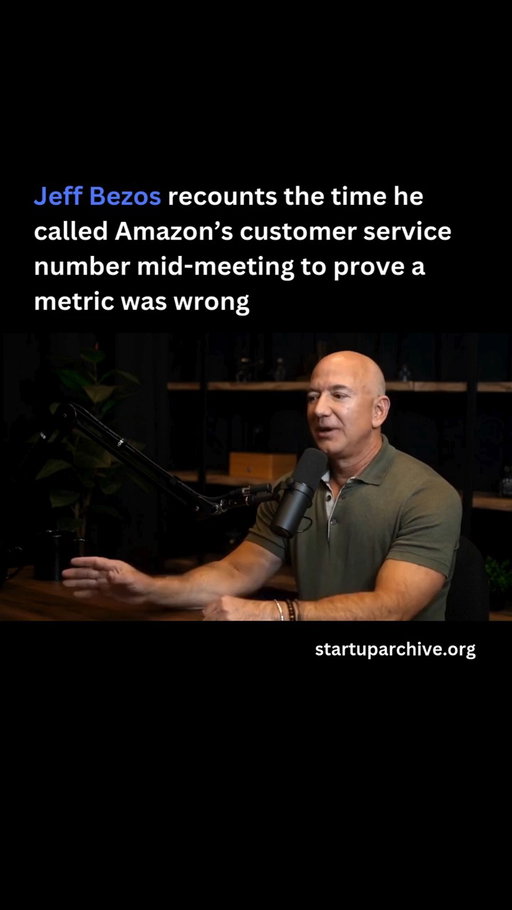
In the clip below, Jeff tells a story from the early days of Amazon when their metrics said customers waited less than 60 seconds after calling customer service. Yet this conflicted with customer complaints, and as Jeff explains:
“I have a saying, which is when the data and the anecdotes disagree, the anecdotes are usually right… If you have a bunch of customers complaining about something, and your metrics look like they shouldn’t be complaining, you should doubt the metrics.”
Then one day in a meeting, the head of customer service was defending the metric, and Jeff said, “Ok, let’s call.”
Jeff picked up the phone and dialed Amazon’s 1-800 customer service number.
Everyone in the meeting proceeded to wait more than 10 minutes before customer service answered.
“It dramatically made the point that something was wrong with the data collection, and that set off a whole chain of events where we started measuring it right… That’s an uncomfortable thing to do, but you have to seek truth even when it’s uncomfortable and you have to get people’s attention and they have to buy into it and they have to get energized around really fixing things.”
Video source: @lexfridman (2023)
---
Want even more startup insights from the world's best founders?
Join the 11,000+ founders who read the free newsletter at startuparchive.org
198K
4.80K
39
11mo ago
startuparchive_
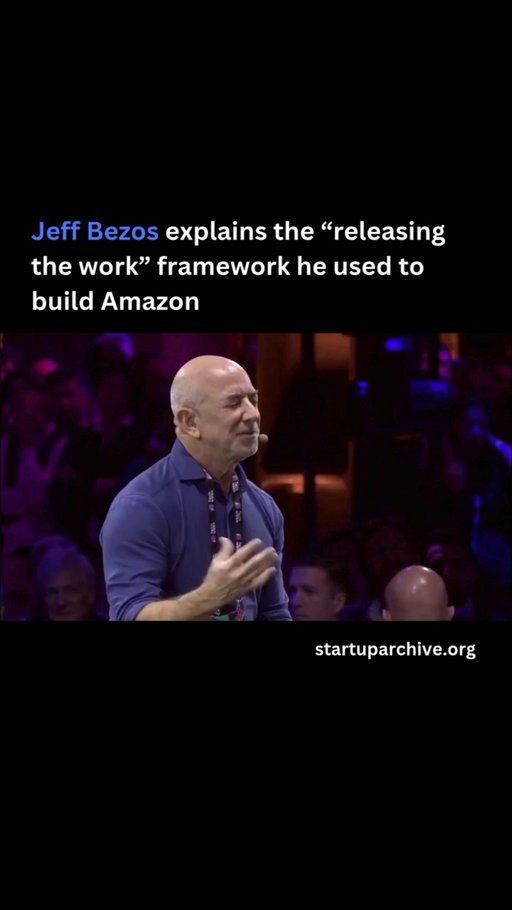
In the early days of Amazon, Jeff Bezos had too many ideas.
Then Jeff Wilke, a new Amazon executive at the time, told his boss, “Jeff, you have enough ideas to destroy Amazon.”
“This was just a shocking idea for me,” Bezos recalls. “As a founder, I had the great luxury of always being able to hire my tutors. I would hire these experienced, senior executives . . . And I would listen to them and they would teach me.”
When Bezos asked Wilke what he meant by this, Wilke responded, “You have to release the work at the right rate so that the organization can accept it.”
Bezos reflects on this point:
“Every time I released an idea, I was creating a backlog of work in process. And because it was just stacking up, it was adding no value. In fact, it was creating distraction . . . This sounds so obvious, but it was not obvious to me at the time. And this was a profound insight for me. So I started prioritizing the ideas better, keeping lists of them, and keeping ideas to myself until the organization was ready for the ideas.”
He continues:
“I also started figuring out how to build an organization that can be ready for more ideas. That’s about having the right senior team and leadership and giving those people the executive bandwidth so they could do more ideas per unit of time. And that is what we built. We built a company that’s very good at inventing and doing more than one thing at a time. And as the company gets bigger, you do want to be able to do more than one thing at a time. But that idea of ‘releasing the work’ was very profound for me. It made us operationally more effective while still being inventive.”
Video source: @reuters (2025)
---
Want even more startup insights from the world's best founders?
Join the 11,000+ founders who read the free newsletter at startuparchive.org
![“Wandering is so important because wandering is a kind of humility,” Jeff Bezos begins. “Wandering sounds so inefficient, but the only way to go straight to your destination is if you know where you’re going.”
Jeff continues:
“Sometimes you know where you’re going. But sometimes you don’t. And wandering is the acknowledgement that — in life, business, invention, and building a company — a lot of the time you can see the mountain top, but you can’t see the trail. So you have to explore and wander. It may feel very inefficient. But it’s actually very valuable.”
Ultimately, Jeff explains, you need to balance execution and exploration:
“When you know where you’re going, yes, you should be very efficient . . . You just need to do both [exploration and determined execution]. And they actually do feed each other. It’s the things that come out of the execution that give you new data and ideas about what the next steps should be in your exploration. The two things don’t work against each other. They work together.”
Video source: @reuters (2025)
---
Want even more startup insights from the world's best founders?
Join the 11,000+ founders who read the free newsletter at startuparchive.org](https://cdn.socialpruf.com/instagram/thumbnails/3738112076871670184_60163851742?optimizer=image&width=512)
179K
4.13K
64
11mo ago
startuparchive_
“Wandering is so important because wandering is a kind of humility,” Jeff Bezos begins. “Wandering sounds so inefficient, but the only way to go straight to your destination is if you know where you’re going.”
Jeff continues:
“Sometimes you know where you’re going. But sometimes you don’t. And wandering is the acknowledgement that — in life, business, invention, and building a company — a lot of the time you can see the mountain top, but you can’t see the trail. So you have to explore and wander. It may feel very inefficient. But it’s actually very valuable.”
Ultimately, Jeff explains, you need to balance execution and exploration:
“When you know where you’re going, yes, you should be very efficient . . . You just need to do both [exploration and determined execution]. And they actually do feed each other. It’s the things that come out of the execution that give you new data and ideas about what the next steps should be in your exploration. The two things don’t work against each other. They work together.”
Video source: @reuters (2025)
---
Want even more startup insights from the world's best founders?
Join the 11,000+ founders who read the free newsletter at startuparchive.org
156K
3.80K
67
9mo ago
startuparchive_
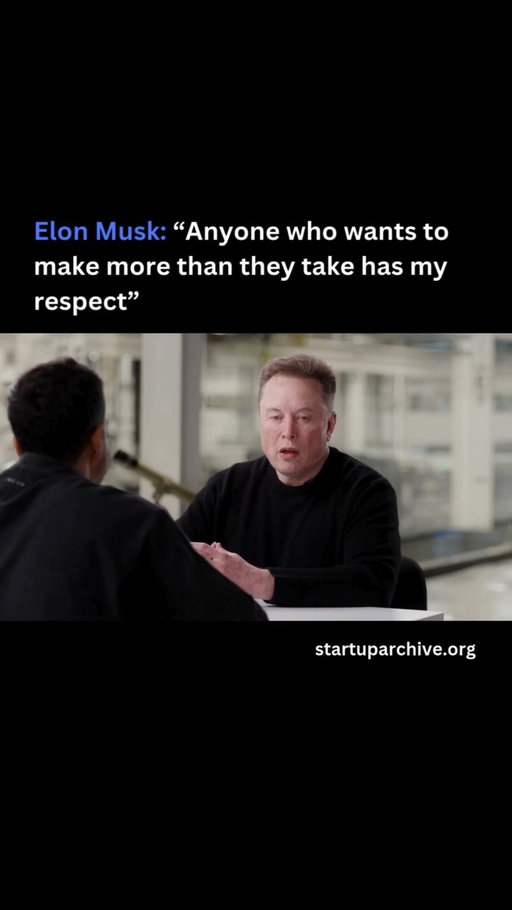
Elon is asked for his advice for entrepreneurs, to which he responds:
“I’m a big fan of anyone who wants to build. Anyone who wants to make more than they take has my respect. That’s the main thing you should aim for: to make more than you take and be a net contributor to society.”
He compares it to the pursuit of happiness:
“If you want to create something valuable financially, you don’t pursue that. It’s best to pursue providing useful products and services. If you do that, money will come as a natural consequence of that rather than pursuing money directly. You can’t pursue happiness directly. You pursue things that lead to happiness — fulfilling work, study, friends, loved ones.”
Elon continues:
“It sounds very obvious, but generally if somebody is trying to make a company work, they should expect to grind super hard and accept that there’s a meaningful chance of failure. Then just focus on having the output be worth more than the input. Are you a value creator? That’s what really matters: making more than you take.”
Video source: @nikhilkamathcio (2025)
---
Want even more startup insights from the world's best founders?
Join the 11,000+ founders who read the free newsletter at startuparchive.org
146K
2.93K
44
12mo ago
startuparchive_
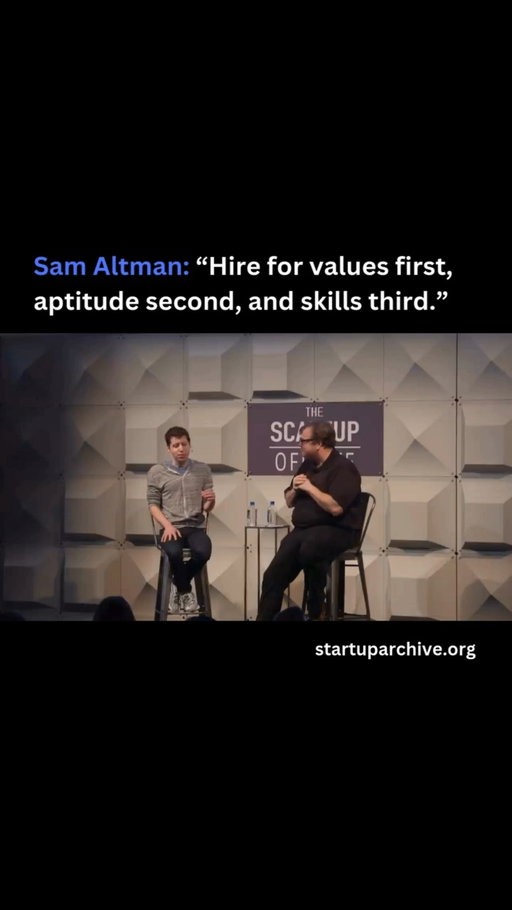
Most executive recruiters, Sam argues, will reverse this order:
“If you say I need to hire a CFO, they will bring you people with 20 years of experience as a CFO at vaguely similar companies. But unfortunately, it’s usually like 20 years of the exact same year of experience over and over again.”
But if you’re trying to scale fast, values are most important:
“You really need someone who is aligned with the values of the company so that when things change or when they have to make a decision, they’ll make the one you would make if you can’t be there or they will be a good team player and go do that thing.”
Sam continues:
“You need someone who has high aptitude because the role is going to constantly shift. And the rate of learning - the rate of improvement - dominates skills.”
And then skills obviously matter, but for Sam it’s third on the list:
“The very best companies take this exceptionally far in how much they’re willing to hire a non-traditionally qualified executive.”
Video source: @ycombinator (2017)
---
Want even more startup insights from the world's best founders?
Join the 11,000+ founders who read the free newsletter at startuparchive.org
134K
2.57K
19
11mo ago
startuparchive_
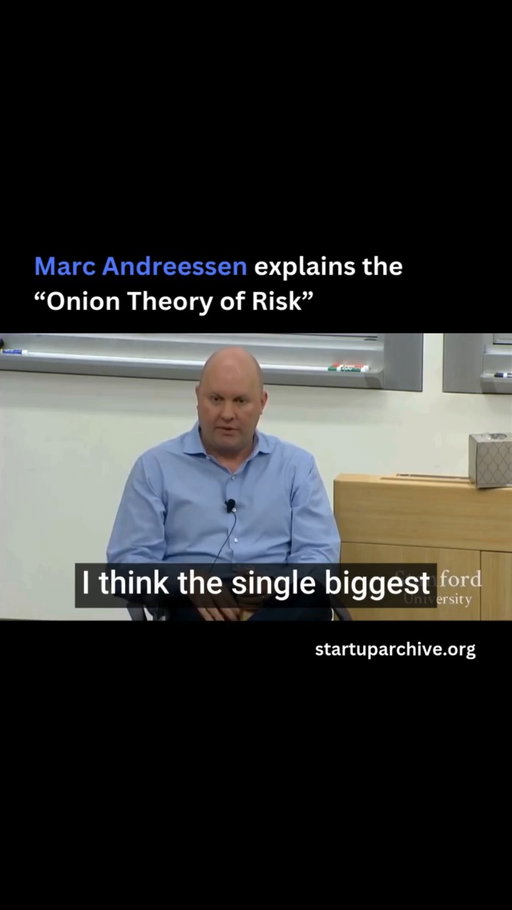
“I think the single-biggest thing entrepreneurs are missing — both on fundraising and how they run their companies — is the relationship between risk and cash. I’ve always been a fan of something Andy Rachleff taught me years ago. He calls it the ‘Onion Theory of Risk.’”
You can think of a day 1 startup as having every conceivable kind of risk: founding team risk, product risk, technical risk, market acceptance risk, revenue risk, cost of sales risk, viral growth risk, etc.
A startup is basically just a long list of risks, and as Marc explains:
"The way I think about running a startup is the way I think about raising money. It's a process of peeling away layers of risk as you go."
You raise seed money to peel away the first two or three risks (e.g. founding team risk, product risk, initial launch risk).
You raise the Series A round to peel away the next layer of risks (e.g. recruiting risk, customer risk, revenue risk, cost of sales risk)
And so on.
Basically, you're peeling away risk as you're achieving milestones. And as you achieve milestones, you're both: making progress on your business and justifying raising more capital.
So in terms of fundraising, you should be calibrating the amount money you're raising to the risks you need to pull out of your business for you to raise your next round.
For example, if you're raising your Series A round, the best way to do that is to say to investors: "I raised a seed round then achieved ____ milestones and eliminated ____ risks. Now I'm going to raise $ X for the Series A to achieve ____ milestones and eliminate ____ risks. This will get the company to ____ state for the Series B round. "
This seems fairly obvious, but as Marc points out, it's a much more systematic way of going about things versus just raising as much money as possible, renting fancy offices, and hiring as many people as you can to grow as fast as you can.
The more money you raise, the more you dilute your ownership stake in your business so it pays to be thoughtful.
Read the full newsletter at startuparchive.org
Video source: @ycombinator (2014)
![“I didn’t expect PayPal’s growth rate to be what it was, and that actually created major problems,” Elon explains. “We started PayPal on University Avenue [in Palo Alto], and after the first month or so of the website being active, we had 100,000 customers.”
As Elon explains, the key to PayPal’s viral growth was it referral program:
“We started off first by offering people $20 if they opened account and $20 if they referred anyone. Then we dropped it to $10, and then we dropped it to $5. As the network got bigger and bigger, the value of the network itself exceeded any sort of carrot that we could offer.”
He continues:
“And then we just did a bunch of things to decrease the friction. It’s like bacteria in a petri dish. What you want to do is try to have one customer generate two customers, or three customers ideally. And then you want that to happen really fast.”
Elon estimates that PayPal spent $60-70 million to fuel this growth, before the company was acquired by eBay for $1.5 billion.
Video source: @khanacademy (2013)
---
Want even more startup insights from the world's best founders?
Join the 11,000+ founders who read the free newsletter at startuparchive.org](https://cdn.socialpruf.com/instagram/thumbnails/3760610529367346486_60163851742?optimizer=image&width=512)
129K
3.16K
120
10mo ago
startuparchive_
“I didn’t expect PayPal’s growth rate to be what it was, and that actually created major problems,” Elon explains. “We started PayPal on University Avenue [in Palo Alto], and after the first month or so of the website being active, we had 100,000 customers.”
As Elon explains, the key to PayPal’s viral growth was it referral program:
“We started off first by offering people $20 if they opened account and $20 if they referred anyone. Then we dropped it to $10, and then we dropped it to $5. As the network got bigger and bigger, the value of the network itself exceeded any sort of carrot that we could offer.”
He continues:
“And then we just did a bunch of things to decrease the friction. It’s like bacteria in a petri dish. What you want to do is try to have one customer generate two customers, or three customers ideally. And then you want that to happen really fast.”
Elon estimates that PayPal spent $60-70 million to fuel this growth, before the company was acquired by eBay for $1.5 billion.
Video source: @khanacademy (2013)
---
Want even more startup insights from the world's best founders?
Join the 11,000+ founders who read the free newsletter at startuparchive.org
118K
3.02K
32
11mo ago
startuparchive_
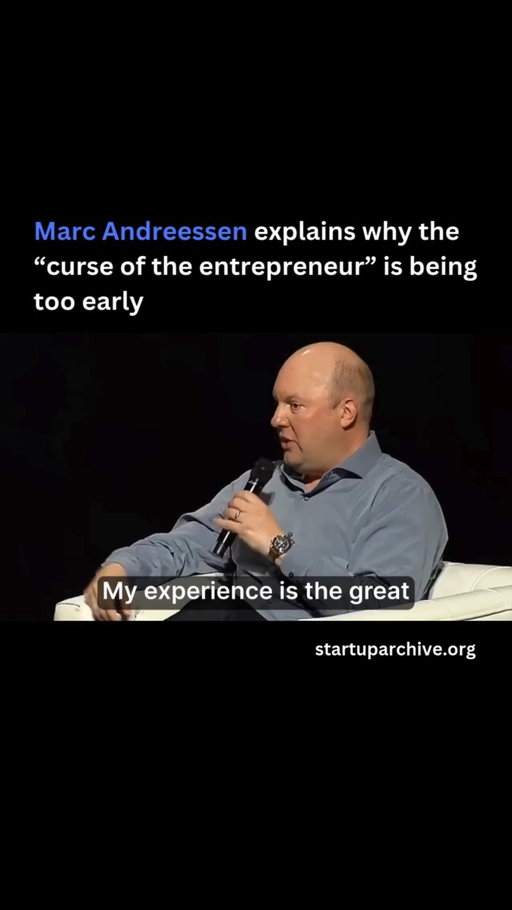
“My experience is the great founders almost always feel like they’re too late, and you’re almost always too early.”
The reason is because the idea seems obvious to the founder:
“You’ve got some idea in your head, and as far as you’re concerned, the world should already work this way, which is why you’re pursuing it. And so it’s a little inexplicable as to why it hasn’t happened to it… It must be just about to happen and I must be too late.”
This is how Marc felt at Netscape when he co-authored the first widely used web browser. But in reality, Marc explains, founders are almost always too early:
“We almost never see a qualified founder fail because they were too late to market. It’s almost always because they’re too early to market. And I don’t say that critically. When we screw up investments, I think that’s often the reason as well.”
It usually turns out that the world just wasn’t ready yet. Marc points out that when Apple launched the Newton in 1989, it was basically the same thing as the iPad. The world just wasn’t ready yet, and the required technologies weren’t in place (e.g. mobile broadband, high-resolution screens, battery technology, etc.).
“It convinced people for 20 years that tablet computing would never work. And then they did it again with the iPad, and it worked. I think that’s the permanent curse of the entrepreneur.”
In a previous YC talk, Marc told founders that if what you’re working on was the hot thing 3-4 years ago, you’re probably right on time because the infrastructure and consumer behavior has now caught up.
Video source: @ycombinator (2016)
---
Want even more startup insights from the world's best founders?
Join the 11,000+ founders who read the free newsletter at startuparchive.org
110K
2.55K
31
9mo ago
startuparchive_
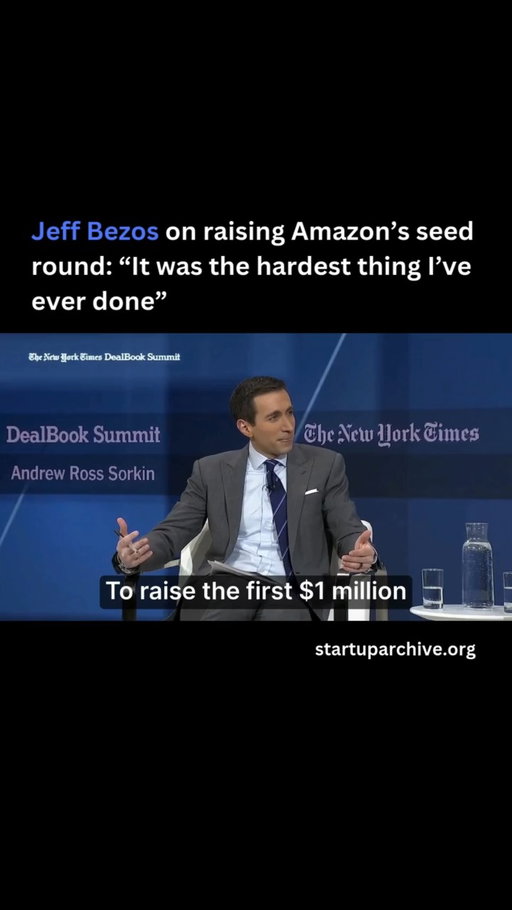
“To raise the first $1 million of seed capital for Amazon, I sold 20% of the company at a $5 million valuation. I sold 20% of the company for a million dollars to 22 angel investors, roughly $50,000 each.”
Jeff recalls taking 60 meetings to get to those 22 angels who said yes, which means roughly 40 of the investors he pitched said no.
“And by the way, the 40 ‘no’s were hard-earned ‘no’s… They were multiple meetings, working really hard to get people to write that $50,000 check. And the whole enterprise could have been extinguished then.”
This was in 1995, and the first question Jeff would always get was, “What’s the Internet?”
So Jeff would patiently explain what the Internet was. He would also always tell them he thought there was a 70% chance they would lose their investment.
“In retrospect, I think that might have been a little naive, but I think it was true. In fact, if anything, I think was giving myself better than the real odds.”
Video source: @nytimes (2024)
---
Want even more startup insights from the world's best founders?
Join the 11,000+ founders who read the free newsletter at startuparchive.org
![“All new fails” - Zynga CEO Mark Pincus explains his favorite product principle
“All new fails. If all new worked, we’d be using new stuff all the time. But how often do you change what’s on the front of your iPhone? How often do the top 10 or 25 apps change? They haven’t changed in 8 years because all new fails. A million new apps a year — they all fail.”
This realization led Mark to develop a new approach to building products that he calls “Proven. Better. New.” And he explains how he used it to build Zynga Poker into the largest poker site in the world.
“De-risk it. Start with with what’s proven. You don’t have the right to change proven. You should copy every pixel of [an experience that already works — legally, of course]… What you think is ‘better’ is called ‘new.’ When you say it’s better, that’s because you’re naive. Grow up. I’m guilty of this too — we all are. We get emotional and fall in love with our own ideas, so we need something to hold us accountable.”
Zynga Poker copied every other online poker game as their starting point.
The next step is to add one thing that’s undeniably better for users. For Zynga poker this was not having to download the application. “You lose half your users every time they have to click download,” Mark explains. “I don’t even need to ask, I know that’s better.”
The last step is to add something new that might work. For Zynga Poker, this was adding pictures of real people — often your friends — to the game. The game was an instant hit.
Mark urges founders to look at the product through your user’s eyes — not your peers:
“This isn’t about getting respect in this little bubble [of Silicon Valley]… This is about normal, real-life humans. They don’t care if you copied. They don’t care how innovative it is. All they care about is, ‘Does it feel better?’ And they can’t even tell you why… Innovation often comes in smaller bits.”
Video source: @speedrun (2025)
---
Want even more startup insights from the world's best founders?
Join the 11,000+ founders who read the free newsletter at startuparchive.org](https://cdn.socialpruf.com/instagram/thumbnails/3741736939167444769_60163851742?optimizer=image&width=512)
98.8K
1.34K
8
11mo ago
startuparchive_
“All new fails” - Zynga CEO Mark Pincus explains his favorite product principle
“All new fails. If all new worked, we’d be using new stuff all the time. But how often do you change what’s on the front of your iPhone? How often do the top 10 or 25 apps change? They haven’t changed in 8 years because all new fails. A million new apps a year — they all fail.”
This realization led Mark to develop a new approach to building products that he calls “Proven. Better. New.” And he explains how he used it to build Zynga Poker into the largest poker site in the world.
“De-risk it. Start with with what’s proven. You don’t have the right to change proven. You should copy every pixel of [an experience that already works — legally, of course]… What you think is ‘better’ is called ‘new.’ When you say it’s better, that’s because you’re naive. Grow up. I’m guilty of this too — we all are. We get emotional and fall in love with our own ideas, so we need something to hold us accountable.”
Zynga Poker copied every other online poker game as their starting point.
The next step is to add one thing that’s undeniably better for users. For Zynga poker this was not having to download the application. “You lose half your users every time they have to click download,” Mark explains. “I don’t even need to ask, I know that’s better.”
The last step is to add something new that might work. For Zynga Poker, this was adding pictures of real people — often your friends — to the game. The game was an instant hit.
Mark urges founders to look at the product through your user’s eyes — not your peers:
“This isn’t about getting respect in this little bubble [of Silicon Valley]… This is about normal, real-life humans. They don’t care if you copied. They don’t care how innovative it is. All they care about is, ‘Does it feel better?’ And they can’t even tell you why… Innovation often comes in smaller bits.”
Video source: @speedrun (2025)
---
Want even more startup insights from the world's best founders?
Join the 11,000+ founders who read the free newsletter at startuparchive.org
95.4K
2.24K
32
9mo ago
startuparchive_
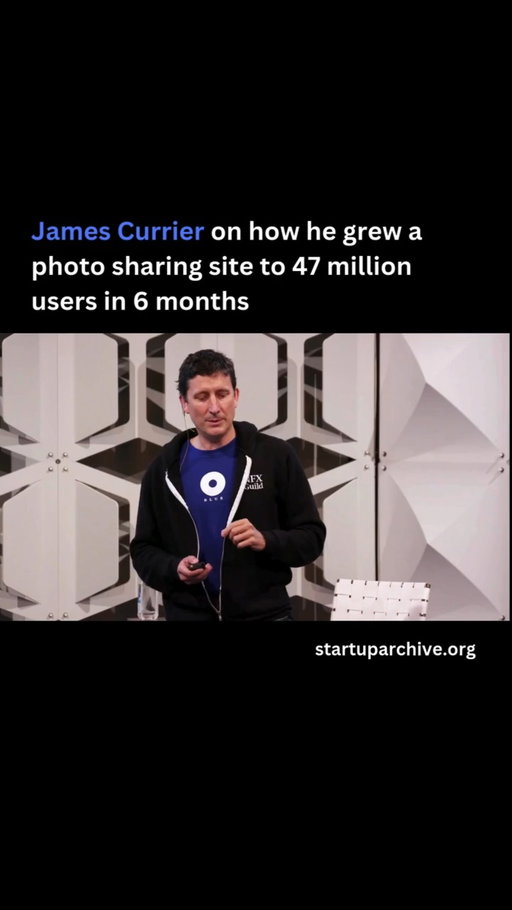
“Most product people start by saying, ‘There’s a problem and we’re going to build a product that’s going to solve that problem. Then we’re going to market it,” NFX founder James Currier observes.
Of the 45 companies James has spoken to in the last 18 months, at least 40 of them have said some version of this.
“I was also taught this back in the 1990s,” James says. “But through experimentation, I’ve realized that this is actually the wrong way to look at it. The right way to look at it — if you want to grow your business — is to ask, ‘What is the language? How am I going to market this?’ . . . Figure out what the language is and then build the product to fit what the language is.”
James gives the example of a photo sharing site he launched years ago:
“It said ‘Store your Photos’ on the homepage, and we were not growing. So one day, we literally just changed the homepage to say ‘Share your Photos.’ The team that was working on it said, ‘Our site doesn’t actually share photos. It just stores the photos.’ I said, ‘Well, fix that.’ What ended up happening was they started building features that allowed people to share their photos, and we registered 47 million people in 6 months. And that was back when the Internet was 250 million people.”
He continues:
“What we realized was that by changing the language, you change how the users are interacting with your site. And you also change your thinking about the product so that the features and subsequent language in the product actually fits with the main value proposition.”
James gives another example:
“We had a matchmaking site, and the promise there was ‘Find a date.’ It wasn’t growing and we had to buy all this traffic from Google and elsewhere to keep the whole thing going. So what we did was we changed the language and the value proposition to say, ‘Help people find a date.’ When we did that, we registered 28 million people in about 9 months, virally with no cost to us. We changed the language, and then we changed the product subsequently.”
---
Want even more startup insights from the world's best founders?
Join the 11,000+ founders who read the free newsletter at startuparchive.org
![“Marketplaces are incredibly defensible at scale, and maybe it’s because they’re incredibly hard to start. And the problem is simple - they call it the chicken and egg problem.”
As Brian explains, it was tough to bootstrap Airbnb in the beginning because travelers couldn’t book homes if there was no inventory, and homeowners didn’t want to list their homes unless people were going to book them.
“We didn’t know what to do for a while .We tried a lot of different things. And I can tell you what worked. Summer of 2008, the press announces that Barack Obama is moving from a 20,000 seat basketball arena to an 80,000 seat football stadium. And we said, that’s our shot. You have 60,000 people that don’t have housing, surely at least a few of them are going to need a place to stay… And so we literally started with local people in Denver. Then we started emailing bloggers. We got the bloggers. Then the Denver Post and the Rocky Mountain News covered us. Then the local ABC and NBC and CBS affiliates. And then the Wall Street Journal. Then the New York Times and CNN are in our living room… We did that in a matter of three weeks.”
Brian continues:
“We started these little infernos. You start getting a few users here, a hundred here, fifty there… And we did the same thing with the inauguration. And when you have a hundred people here and there, then you obsessively meet them… Paul Graham, our first investor, said it’s better to have a hundred people love you than a million people kind of like you. And the reason why is it’s really hard to build off of a really wide but shallow base. But with a hundred people, you can find out everything they want… You meet them, you spend a ton of time with them, and once they fall in love with your product, they’ll tell every one of their friends. That’s why [Airbnb] took a really long time to start, but it grew much faster later on.”
Video source: @cwclub (2011)
---
Want even more startup insights from the world's best founders?
Join the 11,000+ founders who read the free newsletter at startuparchive.org](https://cdn.socialpruf.com/instagram/thumbnails/3754183239615961113_60163851742?optimizer=image&width=512)
94.0K
2.14K
8
10mo ago
startuparchive_
“Marketplaces are incredibly defensible at scale, and maybe it’s because they’re incredibly hard to start. And the problem is simple - they call it the chicken and egg problem.”
As Brian explains, it was tough to bootstrap Airbnb in the beginning because travelers couldn’t book homes if there was no inventory, and homeowners didn’t want to list their homes unless people were going to book them.
“We didn’t know what to do for a while .We tried a lot of different things. And I can tell you what worked. Summer of 2008, the press announces that Barack Obama is moving from a 20,000 seat basketball arena to an 80,000 seat football stadium. And we said, that’s our shot. You have 60,000 people that don’t have housing, surely at least a few of them are going to need a place to stay… And so we literally started with local people in Denver. Then we started emailing bloggers. We got the bloggers. Then the Denver Post and the Rocky Mountain News covered us. Then the local ABC and NBC and CBS affiliates. And then the Wall Street Journal. Then the New York Times and CNN are in our living room… We did that in a matter of three weeks.”
Brian continues:
“We started these little infernos. You start getting a few users here, a hundred here, fifty there… And we did the same thing with the inauguration. And when you have a hundred people here and there, then you obsessively meet them… Paul Graham, our first investor, said it’s better to have a hundred people love you than a million people kind of like you. And the reason why is it’s really hard to build off of a really wide but shallow base. But with a hundred people, you can find out everything they want… You meet them, you spend a ton of time with them, and once they fall in love with your product, they’ll tell every one of their friends. That’s why [Airbnb] took a really long time to start, but it grew much faster later on.”
Video source: @cwclub (2011)
---
Want even more startup insights from the world's best founders?
Join the 11,000+ founders who read the free newsletter at startuparchive.org
86.3K
1.88K
11
11mo ago
startuparchive_
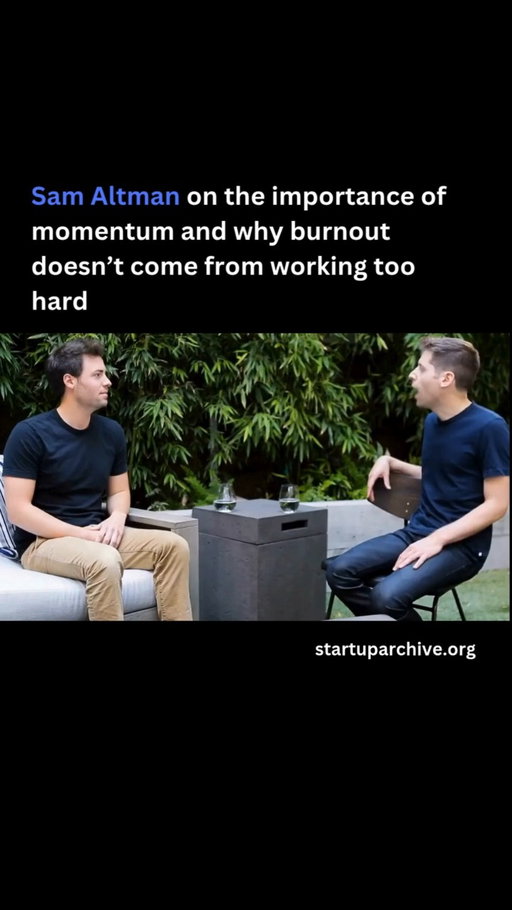
“I was told, and I thought for a long time, that you get burned out from working too hard. At least in my own experience, what I’ve found is that burnout actually comes from failing and things not working.”
Sam continues:
“Momentum is really energizing. The lack of momentum is super draining. And I find that I have infinite energy to work on things that I find interesting and that are working, and almost none to work on things that I either don’t find interesting or aren’t working.”
He offers the following advice to startup founders:
“I think you see a lot of founders try something and fail, and they assume that they just can’t work hard enough or don’t have enough energy or passion or whatever. And that’s actually not true. It’s just that that thing didn’t work. And what you should do is shut that company down, go on vacation, and try again.”
He concludes:
“When you look at really successful people and say, How do they get all those things done? It’s that they have the benefit of momentum. And momentum is energizing.”
Video source: @ycombinator (2016)
---
Want even more startup insights from the world's best founders?
Join the 11,000+ founders who read the free newsletter at startuparchive.org
83.5K
3.45K
69
10mo ago
startuparchive_
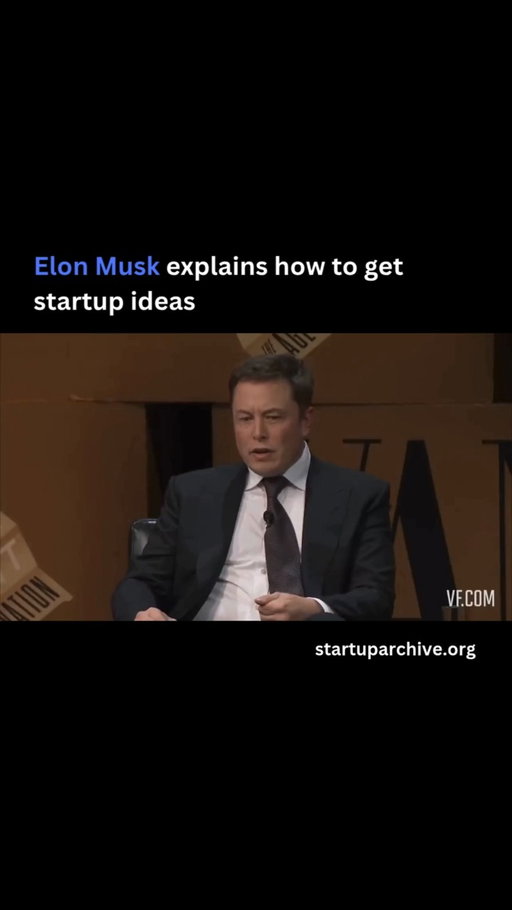
When asked how he comes up with startup ideas, Elon responds:
“I tend to think of things from a sort of physics standpoint… what’s the best way to accomplish something? And then pursue that. That’s also a good way to determine if something’s far from its optimum.”
He gives rockets as an example:
“You could reason by analogy and say the rocket is going to cost a certain amount because that’s what prior rockets have cost. Or you can say, well, what is a rocket made of? What are the material constituents? What do they weigh? What’s the cost per unit mass? And that sets the limit asymptotically for what a rocket can be. So if you can figure out some creative way to rearrange those elements into a rocket shape, then you can achieve a much better outcome.”
He also thinks combining ideas from different industries is really helpful for innovation:
“What have people discovered in one industry and can that be applied to other industries? That’s I think also a great source of ideas. But usually you just struggle on a solution and try a bunch of things. Most of them don’t work and occasionally one does.”
Video source: @vanityfair (2014)
---
Want even more startup insights from the world's best founders?
Join the 11,000+ founders who read the free newsletter at startuparchive.org
83.4K
2.25K
14
11mo ago
startuparchive_
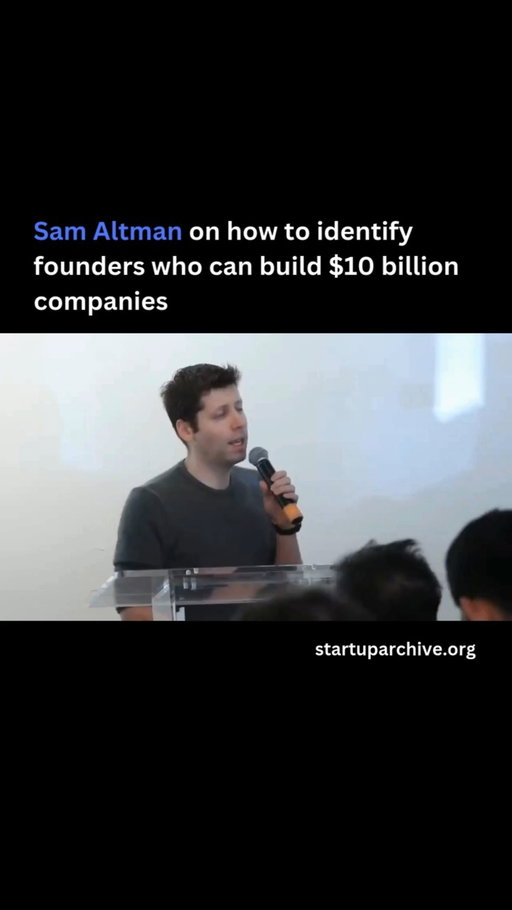
“It’s difficult to hear an idea at the very early stage and say: ‘Yeah, this idea has what it takes to be a $10 billion company.’ However, I think you can, with practice, identify founders that have a chance at creating one of those companies.’”
The first four traits Sam looks for comes from gmail creator Paul Buchhiet: obsession, focus, frugality, and love.
Next, Sam looks for intelligence:
“You can give a founder an idea, but the problem is they need to come up with new ideas for the company basically every week… We tried an experiment at Y Combinator where we funded 20 teams of strong founders that didn’t have ideas but otherwise were really good, and they all failed. What we learned is that good founders have ideas all the time.”
6. is communication skills:
“So much of your job as a founder is about communication—every time you hire someone, go to raise money, try to sell the product, and set a direction for the company. A huge amount of a founder’s job is being an evangelist for the company. If you don’t have strong communication skills or you don’t develop them quickly, you’re at a big disadvantage.”
7. is execution speed. How quickly can you generate a hypothesis, test it, and implement it? Sam observes that most slow-moving founders who went through Y Combinator didn’t go on to be successful: “A relentless cadence of execution is incredibly correlated with success.”
8. is the rate of improvement of the founder:
“If you look at a founder who comes to meet you for a seed round and compare that founder to Brian Chesky, you will be disappointed 100% of the time. That’s the wrong comparison… You should look at the at the growth rate of the founder… Humans always underestimate exponential growth.”
9. is the right motivations:
“There a lot of people who start a startup because they think it’s a way to get rich quickly, and unfortunately it’s just not. So startups have become the new default career trajectory for ambitious people… This does not work given the amount of pain you have to suffer for a startup… In our portfolio at YC, every time we thought a company was going to go really well and didn’t, the founder did not have a deep sense of mission.”
75.9K
2.04K
5
10mo ago
startuparchive_
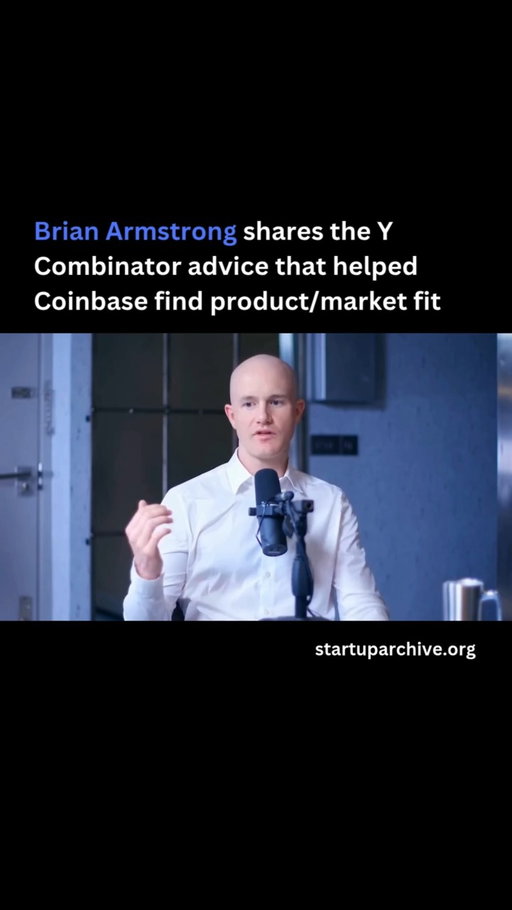
“The first version of a product you put out doesn’t work. In fact, that’s the only thing I’ve ever seen happen in startups. I’ve never seen a startup where the first version of their product actually worked. Sometimes in hindsight people like to tell that story, but I think in reality it’s very rare.”
The first version of Coinbase was a hosted Bitcoin wallet. Brian posted it to Reddit and a few people signed up but nobody stuck around. Rather than get discouraged though, he recalled the advice he got at Y Combinator:
“Don’t spend your time going to conferences and trying to raise money. If you don’t have product/market fit yet, talk to your customers and improve the product based on their feedback… There’s really only two things you should be doing in the early stage - talking to your customers and improving the product. It sounds like simple advice, but people spend so much time doing other stuff that’s not actually real work.”
Following that advice, Brian emailed 10 of the people who had signed up for Coinbase and asked if they’d be open to a quick phone call.
One of the users liked the wallet but didn’t have any Bitcoin.
Brian asked him: “If there was an easy way to get Bitcoin into your wallet - like a buy button or something - would you have stuck around and used it?”
“Yeah, probably” replied the user.
So Brian spent the next few months securing bank partnerships and money transmission licenses so he could build a simple buy button into the app. Then he launched it.
“The minute we launched that buy button, it started to grow every day organically with no marketing or anything. And that was the minute I felt like we finally had product/market fit.”
Video source: @steven (2022)
---
Want even more startup insights from the world's best founders?
Join the 11,000+ founders who read the free newsletter at startuparchive.org
68.0K
1.05K
12
8mo ago
startuparchive_
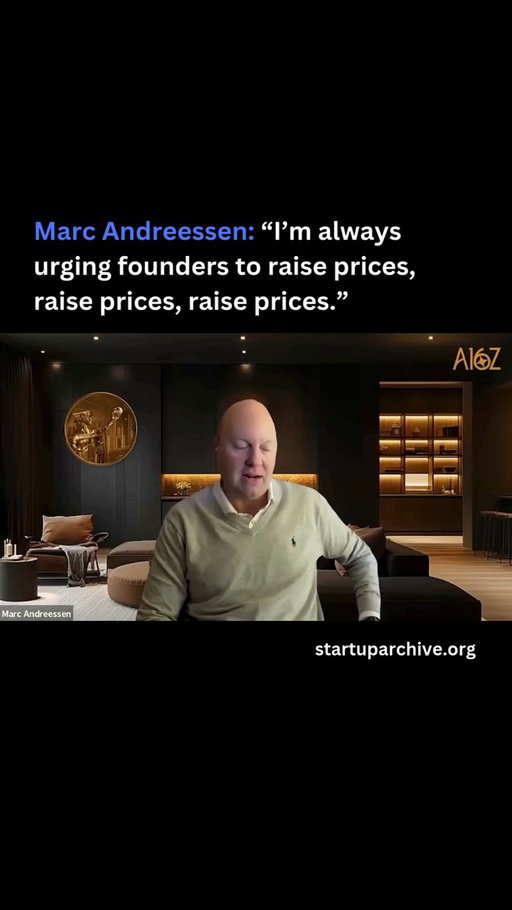
“We spend a lot of time working with our companies on pricing,” a16z co-founder Marc Andreessen explains. “It’s really this magical art and science that a lot of companies don’t take seriously enough.”
Marc continues:
“A core principle of pricing is that you don’t want to price by cost if you can avoid it. You want to price by value. Especially when you’re selling to businesses, you want to price as a percentage of the business value you’re creating.”
He gives the example of building an AI that can do the job of a programmer, a lawyer, or a radiologist:
“Can you price by value and get a percentage of what otherwise would’ve literally been a person? Or equivalently can you price by marginal productivity? If you can take a human doctor and make them much more productive because you give them AI, can you price as a percentage of the productivity uplift?”
Marc argues that high prices are under-appreciated by founders:
“The naive view on pricing is the lower the pricing, the better it is for the customer. The more sophisticated way of looking at it is that higher prices are often good for the customer because the higher price means the vendor can make the product better, faster. Companies with higher prices and higher margins can actually invest more in R&D and make the product better. Most people who buy things aren’t just looking for the cheapest price. They want something that’s going to work really well.”
Marc also emphasizes this point in an interview in Elad Gil’s High Growth Handbook:
“What I hear from companies is, ‘Oh, we have an awesome moat, and we’re still going to price our product cheap, because we think that’s somehow going to maximize our business.’ I’m always urging founders to raise prices, raise prices, raise prices. I’m always urging founders to raise prices, raise prices, raise prices.
Read the full newsletter at startuparchive.org
Video source: @a16z (2026)
67.8K
1.06K
6
7mo ago
startuparchive_
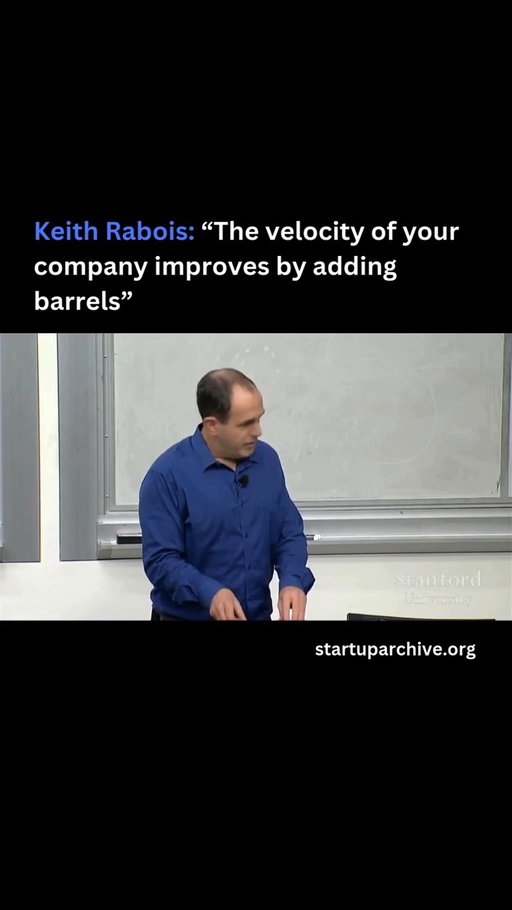
Keith shares his “Barrels and Ammunition” framework for building effective teams:
“Most companies—once they get into hiring mode—just hire a lot of people. And you expect that as you add people your throughput and velocity of shipping things is going to increase. But it turns out it doesn’t work that way. Usually when you hire more engineers, you actually don’t get that much more done. You sometimes get less done.”
Keith argues that the reason for this is that most people in a company—even great people—are “ammunition.” But to improve velocity, you need “barrels”. He defines barrels as extremely talented people who can take ideas from inception all the way through to fully shipped product. Most companies start with one barrel (the founder). And when they add another, they can get twice as many things done per week, quarter, etc.
But true barrels are incredibly difficult to find:
“When you have them, give them lots of equity, promote them, take them to dinner every week because they’re virtually irreplaceable. They’re also very culturally specific. A barrel at one company may not be a barrel at another company.”
Video source: @ycombinator (2014)
---
Want even more startup insights from the world's best founders?
Join the 11,000+ founders who read the free newsletter at startuparchive.org
67.0K
1.58K
27
9mo ago
startuparchive_
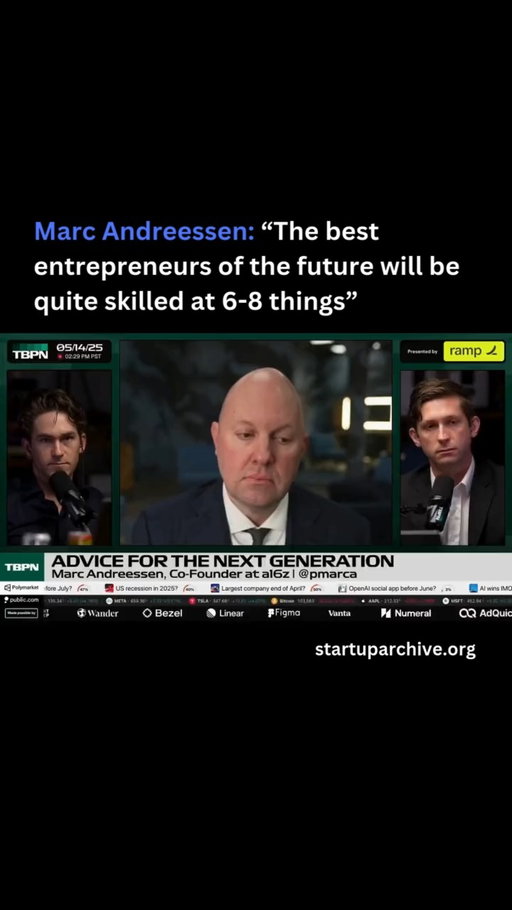
Marc is asked how being a founder changes in the age of AI, to which he responds:
“I think there are two ways to have a differentiated edge in general — go deep or go broad.”
Going deep means becoming a specialized expert in your domain.
“There are domains where that really matters,” Marc explains. “In biotech and working on AI foundation models, the deeper you are the better.”
But as AI gets more powerful, Marc would bet that “going broad” will be the winning strategy for most fields. He recommends knowing a lot about many different fields and how the world works — then use AI tools to go deep whenever you need to.
“If you talk to any of the great CEOs, you see this.” Mark explains. “The really great CEOs are great at product, sales, and marketing people, they’re great legal thinkers, and they’re great at finance and with investors and the press. It’s a multidisciplinary kind of approach.”
He continues:
“The best entrepreneurs of the future will probably be quite skilled at 6 or 8 things and then will be able to cross-pollinate and combine them.”
Video source: @tbpn (2025)
---
Want even more startup insights from the world's best founders?
Join the 11,000+ founders who read the free newsletter at startuparchive.org
Startup Archive (@startuparchive_) Instagram Stats & Analytics
Startup Archive (@startuparchive_) has 256K Instagram followers with a 1.92% engagement rate over the past 12 months. Across 419 posts, Startup Archive received 238K total likes and 12.4M impressions, averaging 567 likes per post. This page tracks Startup Archive's performance metrics, top content, and engagement trends — updated daily.
Startup Archive (@startuparchive_) Instagram Analytics FAQ
How many Instagram followers does Startup Archive have?+
Startup Archive (@startuparchive_) has 256K Instagram followers as of September 2026.
What is Startup Archive's Instagram engagement rate?+
Startup Archive's Instagram engagement rate is 1.92% over the last 12 months, based on 419 posts.
How many likes does Startup Archive get on Instagram?+
Startup Archive received 238K total likes across 419 posts in the last 12 months, averaging 567 likes per post.
How many Instagram impressions does Startup Archive get?+
Startup Archive's Instagram content generated 12.4M total impressions over the last 12 months.