NewGet @dickiebush's full report

instagram analytics
Similar Accounts:
instagram analytics
Similar Accounts:
followers
27.4K
impressions
1.27M
likes
44.3K
comments
841
posts
476
engagement
1.59%
emv
$37.5K
Average per post
2.67K
Key Metrics
Impressions
monthly
Distributions
Content
137K
5.48K
12
9mo ago

dickiebush
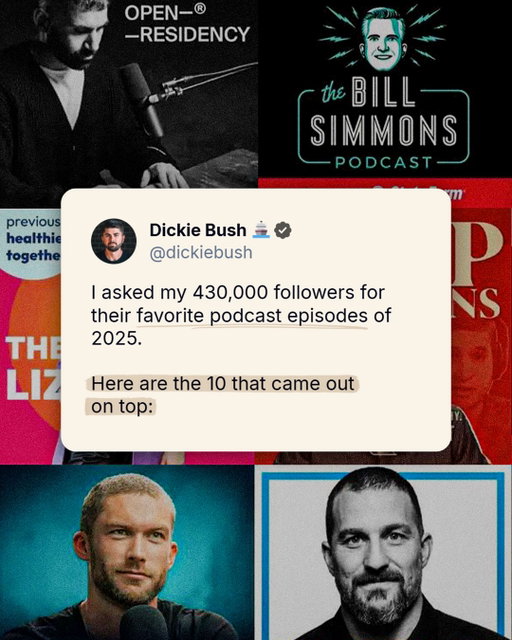
I asked my 430,000 followers for their favorite podcast episodes of 2025.
Here are the 10 that came out on top:
1. 44 Harsh Truths About The Game Of Life - Naval Ravikant
2. David Whyte on Tetragrammaton with Rick Rubin
3. Huberman Lab podcast: How to Overcome Inner Resistance - Steven Pressfield
4. Costco on Acquired
5. Open Residency Podcast with Sahil Bloom
6. Max Kellerman on Life After ‘First Take,’ Stephen A. Smith, and ESPN - The Bill Simmons Podcast
7. Chris Williamson interviewing Alex Hormozi
8. Stop Fearing AI. Start Using It Like THIS.
GaryVee w/ The Liz Moody Podcast
9. Tyler Cowen - The #1 bottleneck to AI progress is humans
10. Finish One Week Of Work Today - Life Changing Advice To Get Your Life Back - Cal Newport
Thanks for reading!
If you enjoyed this, then follow me for more posts on digital writing and digital businesses.
99.4K
3.97K
30
7mo ago
dickiebush
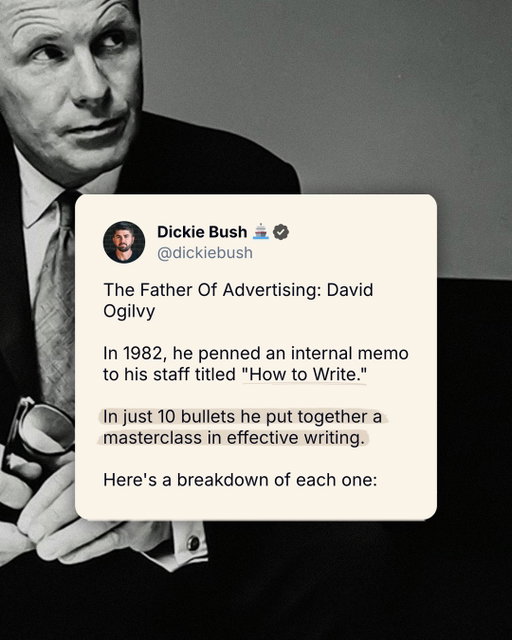
The Father Of Advertising:
David Ogilvy
In 1982, he penned an internal memo to his staff titled “How to Write.”
In just 10 bullets he put together a masterclass in effective writing.
Here’s a breakdown of each one:
1. Read the Roman-Raphelson book on writing.
2. Write the way you talk.
3. Use short words, short sentences, and short paragraphs.
4. Never use jargon words like “reconceptualizes, demassification, attitudinally, judgementally.”
5. Never write more than two pages on any subject.
6. Check your quotations.
7. Never send a letter or memo on the day you write it.
8. If it’s something important, get a colleague to improve it.
9. Before you send your letter or memo, make sure it is crystal clear what you want the recipient to do.
10. If you want ACTION, don’t write.
Staple these to your desktop.
92.8K
3.71K
26
6mo ago
dickiebush
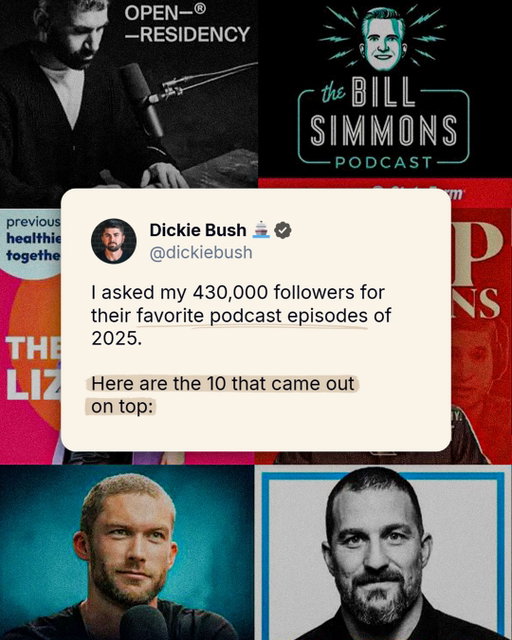
I asked my 430,000 followers for their favorite podcast episodes of 2025.
Here are the 10 that came out on top:
1. 44 Harsh Truths About The Game Of Life - Naval Ravikant
2. David Whyte on Tetragrammaton with Rick Rubin
3. Huberman Lab podcast: How to Overcome Inner Resistance - Steven Pressfield
4. Costco on Acquired
5. Open Residency Podcast with Sahil Bloom
6. Max Kellerman on Life After ‘First Take,’ Stephen A. Smith, and ESPN - The Bill Simmons Podcast
7. Chris Williamson interviewing Alex Hormozi
8. Stop Fearing AI. Start Using It Like THIS.
GaryVee w/ The Liz Moody Podcast
9. Tyler Cowen - The #1 bottleneck to AI progress is humans
10. Finish One Week Of Work Today - Life Changing Advice To Get Your Life Back - Cal Newport
Thanks for reading!
If you enjoyed this, then follow me for more posts on digital writing and digital businesses.
75.1K
3.00K
32
6mo ago
dickiebush
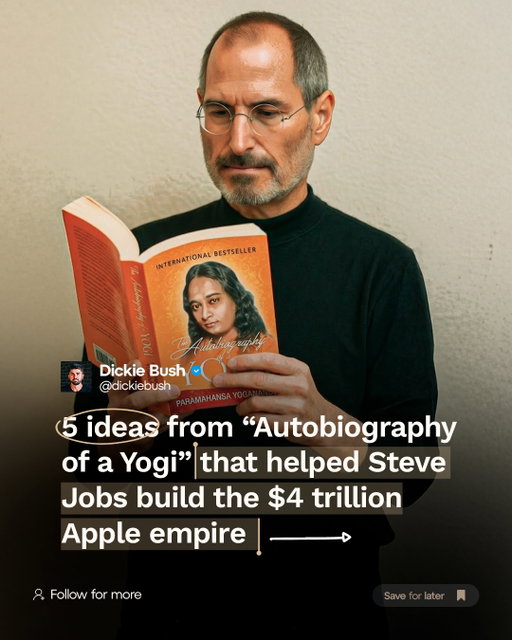
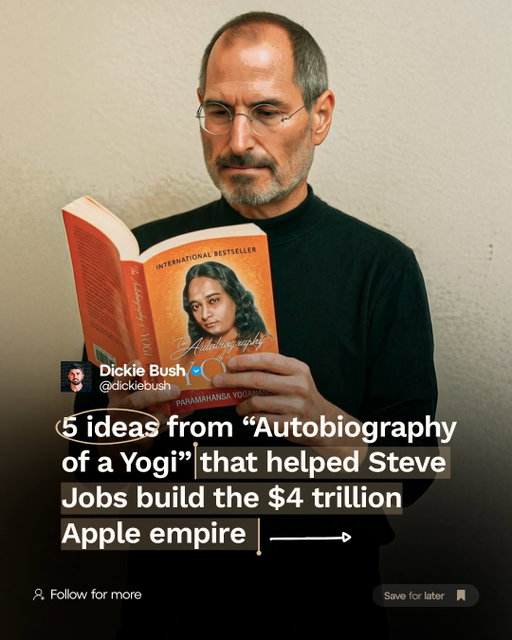
In 1972, while in high school, Steve Jobs discovered the “Autobiography of a Yogi” by Paramahansa Yogananda.
In Yogananda’s teachings, Jobs found the secret to channeling consciousness into creativity:
- He meditated daily
- Became a vegetarian
- Studied Zen Buddhism
And these 5 ideas from “Autobiography of a Yogi” helped him build the $1 trillion Apple empire:
1. Self-realization
2. Yogananda’s “no limitations” message became Jobs’s leadership mantra
3. Yogananda helped Jobs tap into his intuition
4. Simplicity is the ultimate sophistication
5. Passion is born of a deep sense of purpose
Jobs always saw himself as part of the spiritual lineage of innovators like Yogananda.
And his dying wish for the world echoes the core message of the yogi whose words shaped his life.
“You can’t connect the dots looking forward,” he famously said. “Only backwards.”
Yogananda’s memoir was his map.
71.1K
2.84K
44
8mo ago
dickiebush
In 1972, while in high school, Steve Jobs discovered the “Autobiography of a Yogi” by Paramahansa Yogananda.
In Yogananda’s teachings, Jobs found the secret to channeling consciousness into creativity:
- He meditated daily
- Became a vegetarian
- Studied Zen Buddhism
And these 5 ideas from “Autobiography of a Yogi” helped him build the $1 trillion Apple empire:
1. Self-realization
2. Yogananda’s “no limitations” message became Jobs’s leadership mantra
3. Yogananda helped Jobs tap into his intuition
4. Simplicity is the ultimate sophistication
5. Passion is born of a deep sense of purpose
Jobs always saw himself as part of the spiritual lineage of innovators like Yogananda.
And his dying wish for the world echoes the core message of the yogi whose words shaped his life.
“You can’t connect the dots looking forward,” he famously said. “Only backwards.”
Yogananda’s memoir was his map.
56.0K
2.24K
33
4mo ago
dickiebush
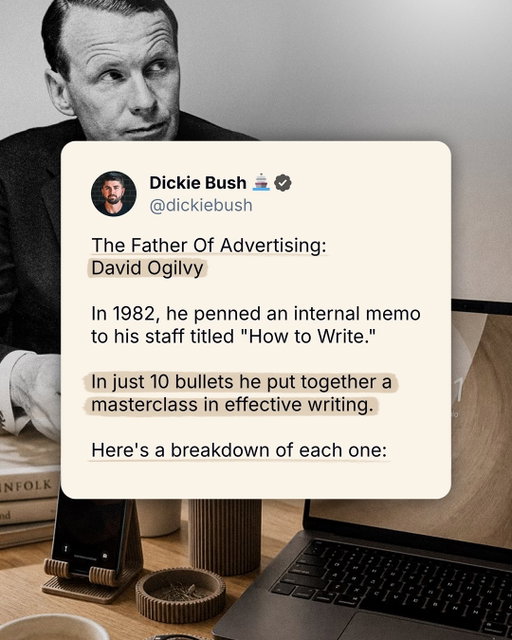
The Father Of Advertising: David Ogilvy
In 1982, he penned an internal memo to his staff titled “How to Write.”
In just 10 bullets he put together a masterclass in effective writing.
Here’s a breakdown of each one:
The memo starts with a clear why:
“The better you write, the higher you will go in Ogilvy & Mather.
People who think well, write well.
Good writing is not a natural gift. You have to learn to write well.”
Replace “Ogilvy & Mather” with any company and this holds true.
#1. Read the Roman-Raphelson book on writing.
#2. Write the way you talk.
#3. Use short words, short sentences, and short paragraphs.
#4. Never use jargon words like “reconceptualizes, demassification, attitudinally, judgementally.”
#5. Never write more than two pages on any subject.
6. Check your quotations.
7. Never send a letter or memo on the day you write it.
8. If it's ’omething important, get a colleague to improve it.
9. Before you send your letter or memo, make sure it is crystal clear what you want the recipient to do.
10. If you want ACTION, don't wr’te.
That's a ’rap!
• Never use jargon
• Use shorter words
• Write how you talk
• Check your quotations
• Read "Writ“ng That Works”
• Give your writing time to breathe
• Get edits on important messages
• Never write more than two pages
Staples these to your desktop.
Thanks for reading!
And if you enjoyed this, follow for more posts on digital writing and digital businesses.
35.3K
1.41K
43
5mo ago
dickiebush
All roads lead back to 9 PM bed time, 5 AM wake up, 4 hours of deep, focused work creative work first thing, work out mid day to break it up, admin & calls in the afternoon, hang with friends and loved ones in the evening, repeat forever.
32.8K
1.31K
21
7mo ago
dickiebush
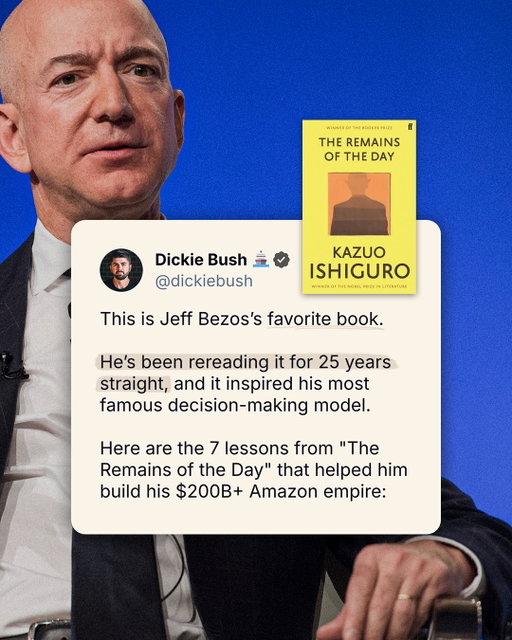
This is Jeff Bezos’s favorite book.
He’s been rereading it for 25 years straight, and it inspired his most famous decision-making model.
Here are the 7 lessons from “The Remains of the Day” that helped him build his $200B+ Amazon empire:
Lesson 1: Make decisions through the lens of your 80-year-old self
Lesson 2: Professional dignity is a trap
Lesson 3: Move with urgency and intensity
Lesson 4: Emotion drives the biggest breakthroughs
Lesson 5: The “safe path” is often the riskiest
Lesson 6: Build reflection into your system
Lesson 7: Study timeless principles
Thanks for reading!
If you enjoyed this, follow for more posts on digital writing and digital businesses.
27.4K
1.10K
7
7mo ago
dickiebush
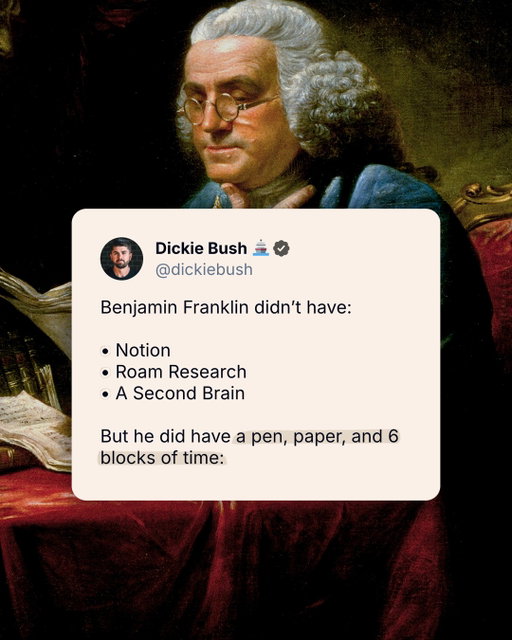
Benjamin Franklin didn't have:
• Notion
• Roam Research
• A Second Brain
But he did have a pen, paper, and 6 blocks of time:

27.2K
474
6
8mo ago

dickiebush
The masculine urge to have a beautiful wife with 5 kids, $100mm in the bank, multiple international residences, fluency in several languages, and 12% body fat at age 40.
22.2K
889
10
9mo ago
dickiebush
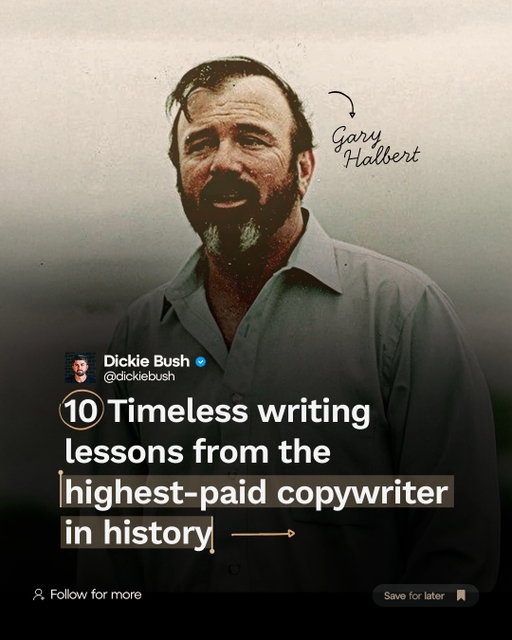
The highest-paid copywriter in history: Gary Halbert.
His legendary sales letters generated over $1,000,000,000 in revenue.
And in one of his very last letters, he shared 10 time-tested strategies for writing better copy, faster.
Here’s a breakdown of each one:
1. Set up a proper writing space
2. Set up a writing routine
3. Write. A LOT.
4. Write for set time periods.
5. Write something easy, first.
6. Allow yourself to create junk.
7. Write your first draft fast and furious with no editing.
8. Create an idea capture system
9. Specialize in something
10. Reward yourself
And that’s it!
If you enjoyed this post, make sure to follow for more!
22.1K
885
10
11mo ago
dickiebush
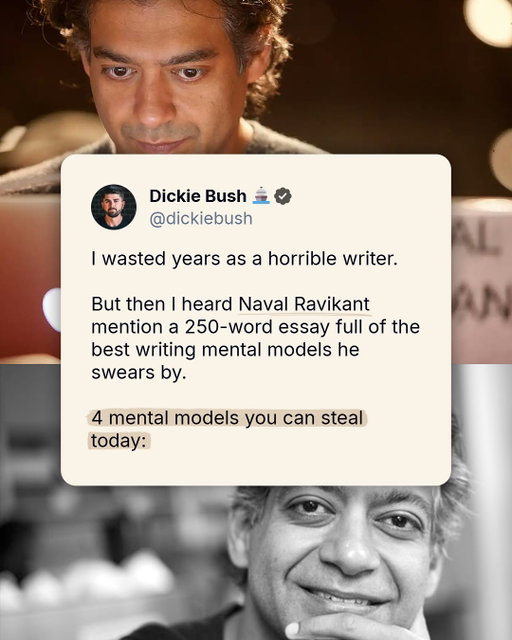
I wasted years as a horrible writer.
But then I heard Naval Ravikant mention a 250-word essay full of the best writing mental models he swears by.
4 mental models you
can steal today:
On The Tim Ferriss Show, Naval said this is his go-to resource for writing:
“The Day You Became A Better Writer” by Scott Adams
I read it so you don’t have to.
Here are the 4 most important mental models:
1. Keep it simple
2. Hook the reader from the very first sentence
3. Use short sentences
4. Subject before action
“The boy hit the ball” not “The ball was hit by the boy.”
It’s easier to comprehend ‘the boy hit the ball’ than ‘the ball was hit by the boy.’
Naval Ravikant swears by Scott Adams’ writing tips.
But for me, it’s Ravikant’s ideas that make his writing truly irresistible.
(These simple life formulas are a must-read.)
This is why writing is such a superpower according to Naval:
“Ideas are the new oil”
Modern society requires ideas to disrupt ways of thinking.
Just as oil needs to be extracted and refined to be useful, raw ideas need molding.
And writing is a powerful tool to gain clarity and shape ideas:
Naval’s definition of success is an idea everyone needs to hear.
Overcoming the need for external validation helps you find your voice and gain mental clarity.
Doing something like writing or reading for 1-2 hours every day puts you in the top 1%.
Building this habit is simple.
That’s it!
Here are 4 writing mental models for great writing by Scott Adams:
1. Simplicity wins
2. Hook them early
3. Keep sentences short
4. Subject before action
Thanks for reading!
If you enjoyed this, then follow me for more posts on digital writing and digital businesses.
19.6K
784
8
7mo ago
dickiebush
On The Tim Ferriss Show, Naval said this is his go-to resource for writing:
“The Day You Became A Better Writer” by Scott Adams
I read it so you don’t have to.
Here are the 4 most important mental models:
1. Simplicity wins
2. Hook them early
3. Keep sentences short
4. Subject before action
(Save this for your next writing session)
—
Thanks for reading!
If you enjoyed this, then follow me for more posts on digital writing.
18.3K
733
4
5mo ago
dickiebush
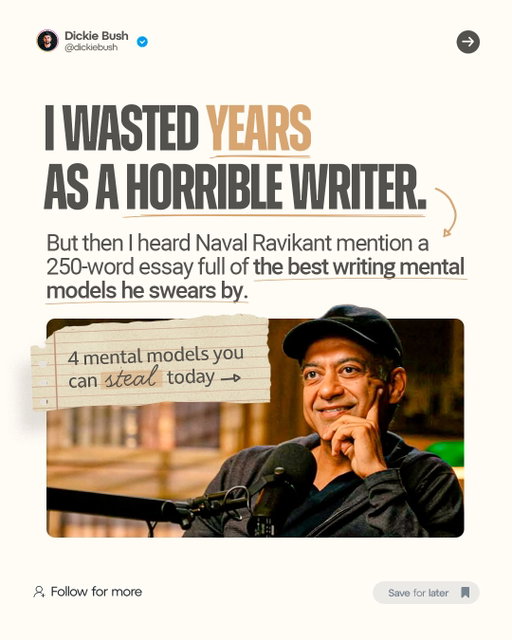
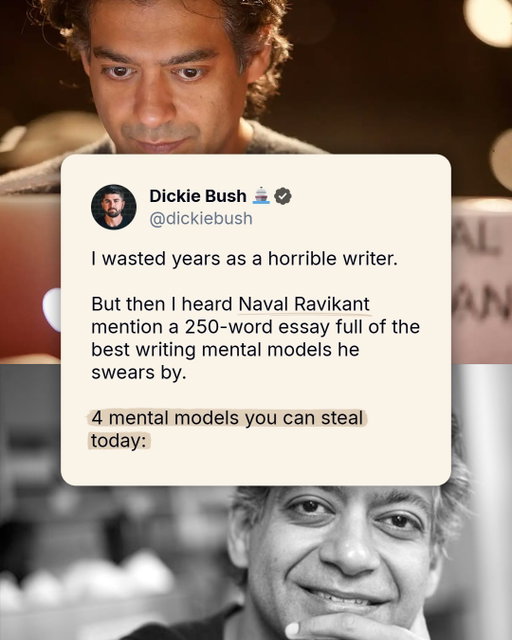
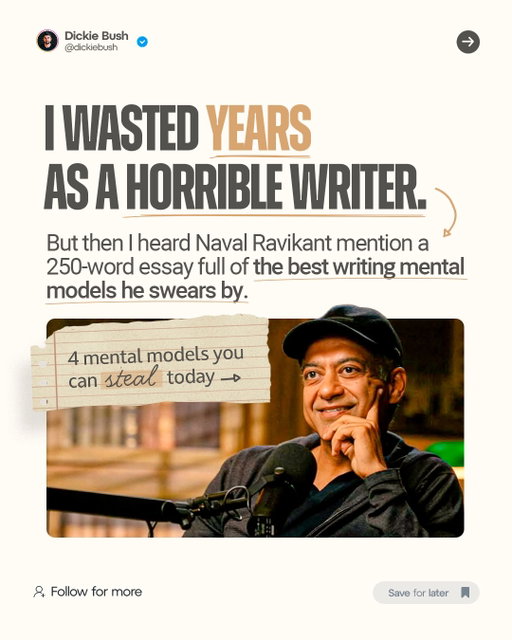
I wasted years as a horrible writer.
But then I heard Naval Ravikant mention a 250-word essay full of the best writing mental models he swears by.
4 mental models you
can steal today:
On The Tim Ferriss Show, Naval said this is his go-to resource for writing:
“The Day You Became A Better Writer” by Scott Adams
I read it so you don’t have to.
Here are the 4 most important mental models:
1. Keep it simple
2. Hook the reader from the very first sentence
3. Use short sentences
4. Subject before action
“The boy hit the ball” not “The ball was hit by the boy.”
It’s easier to comprehend ‘the boy hit the ball’ than ‘the ball was hit by the boy.’
Naval Ravikant swears by Scott Adams’ writing tips.
But for me, it’s Ravikant’s ideas that make his writing truly irresistible.
(These simple life formulas are a must-read.)
This is why writing is such a superpower according to Naval:
“Ideas are the new oil”
Modern society requires ideas to disrupt ways of thinking.
Just as oil needs to be extracted and refined to be useful, raw ideas need molding.
And writing is a powerful tool to gain clarity and shape ideas:
Naval’s definition of success is an idea everyone needs to hear.
Overcoming the need for external validation helps you find your voice and gain mental clarity.
Doing something like writing or reading for 1-2 hours every day puts you in the top 1%.
Building this habit is simple.
That’s it!
Here are 4 writing mental models for great writing by Scott Adams:
1. Simplicity wins
2. Hook them early
3. Keep sentences short
4. Subject before action
Thanks for reading!
If you enjoyed this, then follow me for more posts on digital writing and digital businesses.
11.2K
449
6
8mo ago
dickiebush
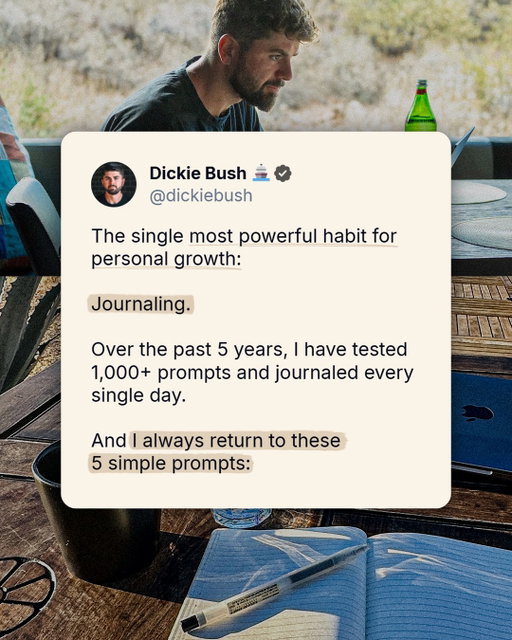
The single most powerful habit for personal growth:
Journaling.
Over the past 5 years, I have tested 1,000+ prompts and journaled every single day.
And I always return to these 5 simple prompts:
For my prompts, I use:
• The 80/20 Audit
• The Morning Kickstart
• The Evening Shutdown
• The Bottleneck Analysis
• The Compounding Projection
For notebook & pen, I use:
• Muji 0.5 pens
• Leuchtturm1917 soft-covers
These are the 5 prompts I come back to time and time again.
• The 80/20 Audit
• The Morning Kickstart
• The Evening Shutdown
• The Bottleneck Analysis
• The Compounding Projection
And they always leave me with a feeling of elite clarity.
Thanks for reading!
If you enjoyed this, then follow me for more posts on digital writing and digital businesses.
11.1K
443
2
6mo ago
dickiebush
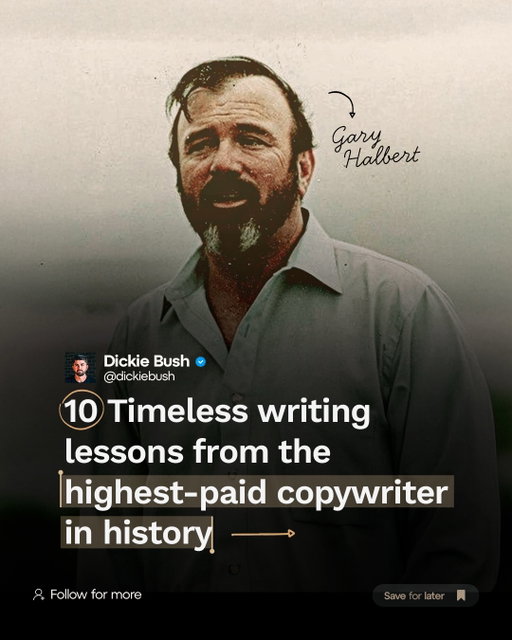
The highest-paid copywriter in history: Gary Halbert.
His legendary sales letters generated over $1,000,000,000 in revenue.
And in one of his very last letters, he shared 10 time-tested strategies for writing better copy, faster.
Here’s a breakdown of each one:
1. Set up a proper writing space
2. Set up a writing routine
3. Write. A LOT.
4. Write for set time periods.
5. Write something easy, first.
6. Allow yourself to create junk.
7. Write your first draft fast and furious with no editing.
8. Create an idea capture system
9. Specialize in something
10. Reward yourself
And that’s it!
If you enjoyed this post, make sure to follow for more!

9.05K
362
4
9mo ago
dickiebush
The Father Of Advertising: David Ogilvy
In 1982, he penned an internal memo to his staff titled “How to Write.”
In just 10 bullets he put together a masterclass in effective writing.
1. Read the Roman-Raphelson book on writing. Read it three times.
2. Write the way you talk. Naturally.
3. Use short words, short sentences, and short paragraphs.
4. Never use jargon words like “reconceptualizes, demassification, attitudinally, judgementally.”
5. Never write more than two pages on any subject.
6. Check your quotations.
7. Never send a letter or memo on the day you write it. Read it aloud the next morning, then edit it.
8. If it’s something important, get a colleague to improve it.
9. Before you send your letter or memo, make sure it is crystal clear what you want the recipient to do.
10. If you want ACTION, don’t write. Go and tell the guy what you want.
Thanks for reading!
And if you enjoyed this, follow for more posts on digital writing and digital businesses.
8.75K
350
0
8mo ago
dickiebush
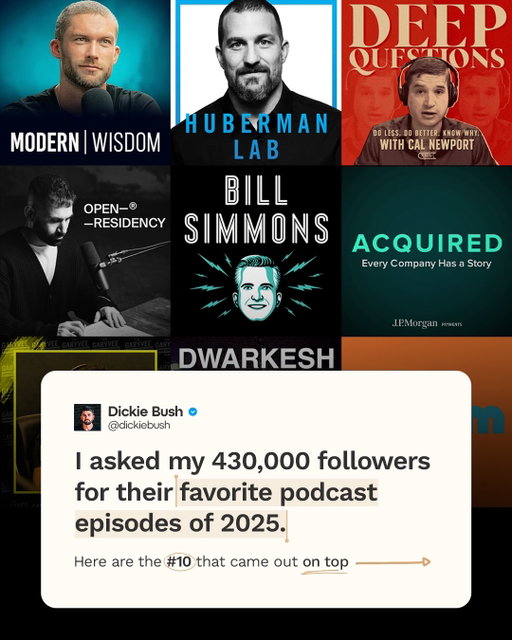
I asked my 430,000 followers for their favorite podcast episodes of 2025.
Here are the 10 that came out on top:
1. 44 Harsh Truths About The Game Of Life - Naval Ravikant
2. David Whyte on Tetragrammaton with Rick Rubin
3. Huberman Lab podcast: How to Overcome Inner Resistance - Steven Pressfield
4. Costco on Acquired
5. Open Residency Podcast with Sahil Bloom
6. Max Kellerman on Life After ‘First Take,’ Stephen A. Smith, and ESPN - The Bill Simmons Podcast
7. Chris Williamson interviewing Alex Hormozi
8. Stop Fearing AI. Start Using It Like THIS. GaryVee w/ The Liz Moody Podcast
9. Tyler Cowen - The #1 bottleneck to AI progress is humans
10. Finish One Week Of Work Today - Life Changing Advice To Get Your Life Back - Cal Newport
Thanks for reading!
If you enjoyed this, then follow me for more posts on digital writing and digital businesses.
8.60K
344
4
5mo ago
dickiebush
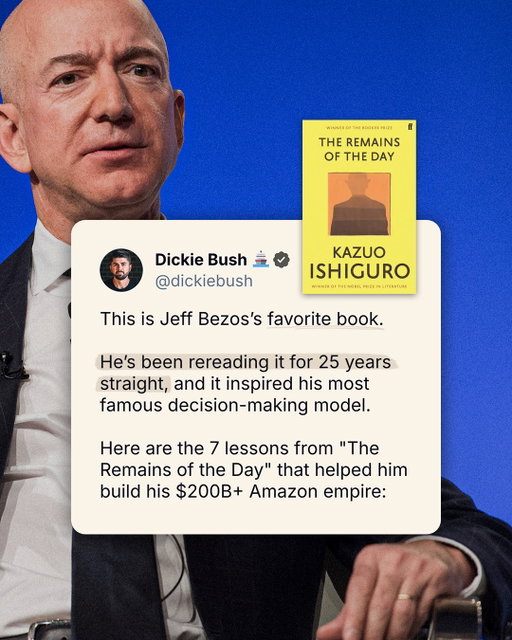
This is Jeff Bezos’s favorite book.
He’s been rereading it for 25 years straight, and it inspired his most famous decision-making model.
Here are the 7 lessons from “The Remains of the Day” that helped him build his $200B+ Amazon empire:
Lesson 1: Make decisions through the lens of your 80-year-old self
Lesson 2: Professional dignity is a trap
Lesson 3: Move with urgency and intensity
Lesson 4: Emotion drives the biggest breakthroughs
Lesson 5: The “safe path” is often the riskiest
Lesson 6: Build reflection into your system
Lesson 7: Study timeless principles
Thanks for reading!
If you enjoyed this, follow for more posts on digital writing and digital businesses.
6.98K
279
4
6mo ago
dickiebush
On The Tim Ferriss Show, Naval said this is his go-to resource for writing:
“The Day You Became A Better Writer” by Scott Adams
I read it so you don’t have to.
Here are the 4 most important mental models:
1. Simplicity wins
2. Hook them early
3. Keep sentences short
4. Subject before action
(Save this for your next writing session)
—
Thanks for reading!
If you enjoyed this, then follow me for more posts on digital writing.
Dickie Bush (@dickiebush) Instagram Stats & Analytics
Dickie Bush (@dickiebush) has 27.4K Instagram followers with a 1.59% engagement rate over the past 12 months. Across 476 posts, Dickie Bush received 44.3K total likes and 1.27M impressions, averaging 93.1 likes per post. This page tracks Dickie Bush's performance metrics, top content, and engagement trends — updated daily. To benchmark @dickiebush against other accounts, use Socialpruf's Instagram competitor analysis tool.
Dickie Bush (@dickiebush) Instagram Analytics FAQ
How many Instagram followers does Dickie Bush have?+
Dickie Bush (@dickiebush) has 27.4K Instagram followers as of October 2026.
What is Dickie Bush's Instagram engagement rate?+
Dickie Bush's Instagram engagement rate is 1.59% over the last 12 months, based on 476 posts.
How many likes does Dickie Bush get on Instagram?+
Dickie Bush received 44.3K total likes across 476 posts in the last 12 months, averaging 93.1 likes per post.
How many Instagram impressions does Dickie Bush get?+
Dickie Bush's Instagram content generated 1.27M total impressions over the last 12 months.
Can I compare Dickie Bush with other Instagram accounts?+
Yes. Add @dickiebush to a competitor set with Socialpruf's Instagram competitor analysis tool and benchmark it side by side with any other public accounts on views, engagement rate and follower growth, with history back to each account's first post.