
Post Analytics

Link copied!
theatlantic
Feb 28, 202669.7K
827
65
theatlantic
Feb 28, 2026
69.7K
827
65
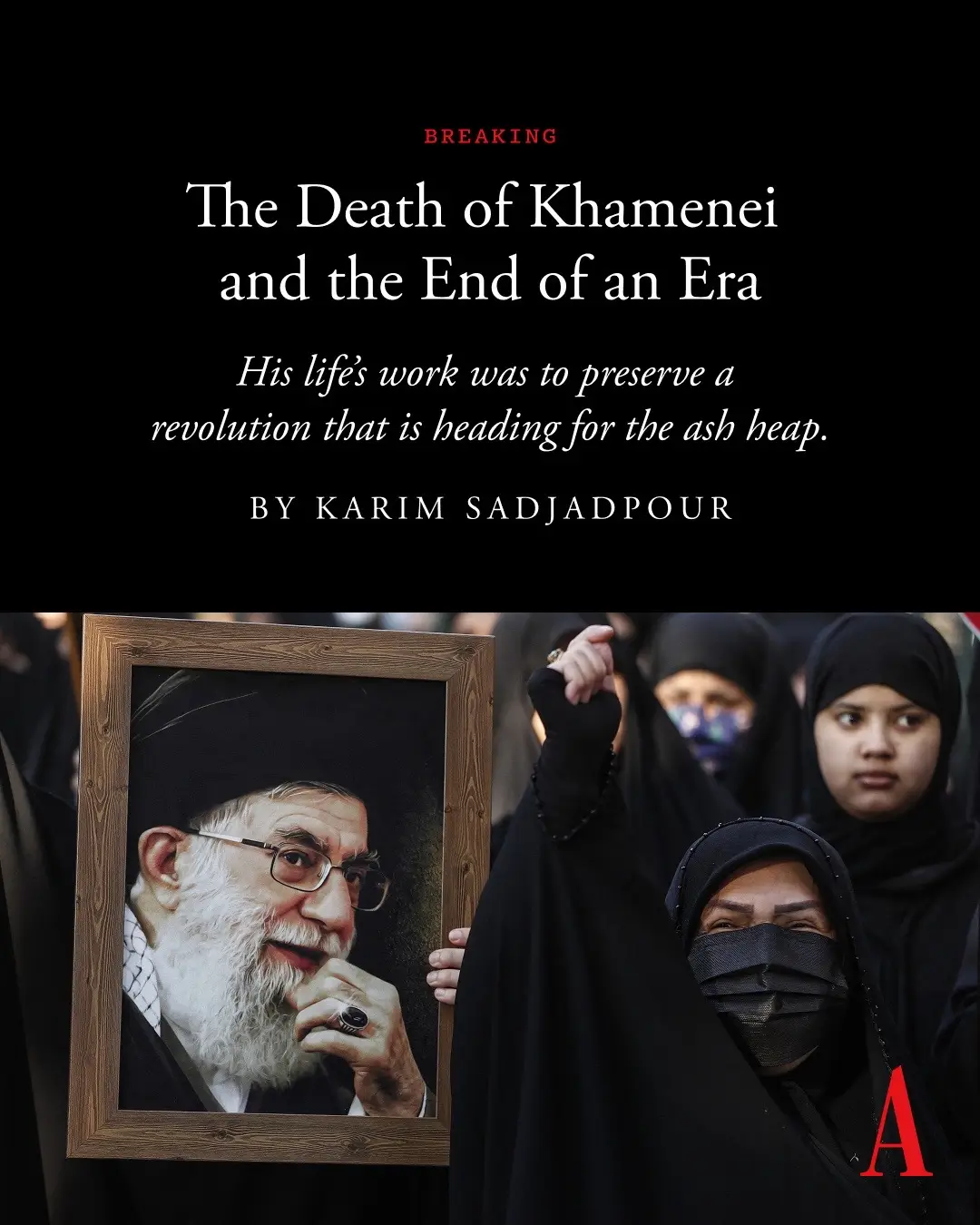
Ayatollah Ali Khamenei’s death at the hand of a nation he worked very hard to kill is a hinge moment in the history of Iran’s revolution, Karim Sadjadpour argues. Khamenei “did not build the Islamic Republic of Iran. He inherited it from its founder, Ayatollah Ruhollah Khomeini,” Sadjadpour writes. In 1979, Khomeini led a revolution that deposed a U.S.-aligned monarchy and replaced it with an Islamist theocracy whose three ideological pillars were “Death to America,” “Death to Israel,” and the mandatory covering of women—the hijab, he said, was “the flag of the revolution.” “Khomeini died in 1989, and his successor’s life’s work was to keep that revolution alive long after the society it governed had moved on,” Sadjadpour argues. “In this, Khamenei was remarkably, ruthlessly successful. But the world view he imposed was never truly his own. He was the spokesman for a ghost.” “Khamenei understood that his power was best preserved in a bubble. Not complete isolation—he wanted to sell Iran’s oil—but calibrated insularity,” Sadjadpour continues. “But insularity has its costs, and they were borne entirely by the Iranian people.” “Khamenei treated the relationship between the state and its citizens not as a social contract but as a predatory lease—nonnegotiable, imposed by the landlord, long since expired. The regime micromanaged the personal lives of more than 90 million people, dictating whom they were allowed to love, what they drank, what women wore on their heads,” Sadjadpour writes. “Khamenei confronted the paradox that every revolutionary caretaker must face: The revolution he preserved was designed for a world that no longer exists,” Sadjadpour argues. “In the end, he was felled by Donald Trump and Benjamin Netanyahu, an American president and an Israeli prime minister whom he loathed. He lived by ‘Death to America’ and ‘Death to Israel.’ He died by death from America and Israel.” Read more at the link in our bio. 📸: Ahmad Al-Rubaye / AFP / Getty
Ayatollah Ali Khamenei’s death at the hand of a nation he worked very hard to kill is a hinge moment in the history of Iran’s revolution, Karim Sadjadpour argues. Khamenei “did not build the Islamic Republic of Iran. He inherited it from its founder, Ayatollah Ruhollah Khomeini,” Sadjadpour writes. In 1979, Khomeini led a revolution that deposed a U.S.-aligned monarchy and replaced it with an Islamist theocracy whose three ideological pillars were “Death to America,” “Death to Israel,” and the mandatory covering of women—the hijab, he said, was “the flag of the revolution.” “Khomeini died in 1989, and his successor’s life’s work was to keep that revolution alive long after the society it governed had moved on,” Sadjadpour argues. “In this, Khamenei was remarkably, ruthlessly successful. But the world view he imposed was never truly his own. He was the spokesman for a ghost.” “Khamenei understood that his power was best preserved in a bubble. Not complete isolation—he wanted to sell Iran’s oil—but calibrated insularity,” Sadjadpour continues. “But insularity has its costs, and they were borne entirely by the Iranian people.” “Khamenei treated the relationship between the state and its citizens not as a social contract but as a predatory lease—nonnegotiable, imposed by the landlord, long since expired. The regime micromanaged the personal lives of more than 90 million people, dictating whom they were allowed to love, what they drank, what women wore on their heads,” Sadjadpour writes. “Khamenei confronted the paradox that every revolutionary caretaker must face: The revolution he preserved was designed for a world that no longer exists,” Sadjadpour argues. “In the end, he was felled by Donald Trump and Benjamin Netanyahu, an American president and an Israeli prime minister whom he loathed. He lived by ‘Death to America’ and ‘Death to Israel.’ He died by death from America and Israel.” Read more at the link in our bio. 📸: Ahmad Al-Rubaye / AFP / Getty
Key Metrics
Plays
69.7K
Likes
827
Comments
65
Engagement
1.28%
Historical Performance
Plays
Last refreshed: 52 minutes ago